Glutamic acid
Ukraine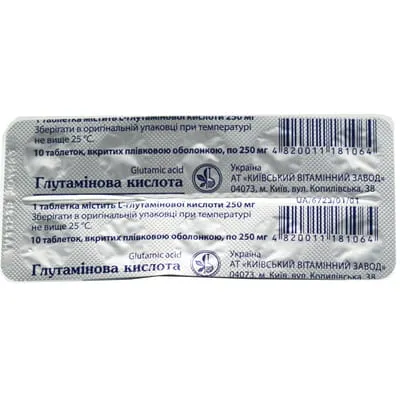
Table of Contents
INSTRUCTIONS FOR MEDICAL USE OF THE MEDICINAL PRODUCT GLUTAMIC ACID (GLUTAMIC ACID)
Composition:
Active ingredient: 1 tablet contains 250 mg of L-glutamic acid;
Excipients: microcrystalline cellulose, povidone, calcium stearate;
Coating: Opadry II Blue film-coating mixture: hypromellose, lactose monohydrate, polyethylene glycol, titanium dioxide (E 171), indigo carmine (E 132), quinoline yellow (E 104).
Pharmaceutical form. Film-coated tablets.
Main physicochemical properties: round, biconvex tablets with a blue film coating.
Pharmacotherapeutic group. Agents acting on the nervous system. ATC code N07X X.
Pharmacological Properties.
Pharmacodynamics.
A substitute amino acid involved in the processes of amino acid transamination in the body, in protein and carbohydrate metabolism, stimulates oxidative processes, promotes detoxification and removal of ammonia from the body, increases organism resistance to hypoxia. It facilitates the synthesis of acetylcholine and adenosine triphosphate (ATP), transfer of potassium ions, and plays an important role in skeletal muscle function. Glutamic acid belongs to excitatory neurotransmitter amino acids that stimulate impulse transmission in synapses of the central nervous system.
Pharmacokinetics.
Glutamic acid is well absorbed upon oral administration. It is rapidly eliminated from the blood and accumulates predominantly in muscle and nervous tissues, liver, and kidneys. It penetrates the blood-brain barrier and cellular membranes. During absorption, part of glutamic acid undergoes transamination to form alanine. Under the influence of the enzyme glutamate decarboxylase, it is converted in the brain into the neurotransmitter gamma-aminobutyric acid (GABA). Approximately 4–7% is excreted unchanged in urine; the remainder is utilized in metabolic transformations.
Clinical characteristics.
Indications.
Treatment of epilepsy, mainly minor seizures with equivalents, somatogenic, involutional, intoxication psychoses, reactive states with symptoms of depression, exhaustion; in delayed mental development in children, Down's disease, in cerebral palsy in children, poliomyelitis (acute and recovery periods), in progressive myopathy, for elimination and prevention of neurotoxic effects that may occur during administration of isoniazid and other drugs of the isonicotinic acid hydrazide group.
Contraindications.
Febrile conditions, increased excitability, severely expressed psychotic reactions, hepatic and/or renal insufficiency, nephrotic syndrome, peptic ulcer of the stomach and duodenum, blood-forming organ diseases, anemia, leukopenia.
Interaction with other medicinal products and other types of interactions.
Glutamic acid can be used simultaneously with thiamine and pyridoxine (vitamin B complex preparations) for prevention and treatment of neurotoxic effects caused by patient intake of medicinal products of the INAH group (isonicotinic acid hydrazide, e.g.: phthivazid, isoniazid).
In myopathy and muscular dystrophy, glutamic acid is more effective when combined with pahycarpine or glycocoll.
Special precautions for use.
During treatment, regular urine and blood tests should be performed. If adverse effects occur, it is recommended to reduce the dosage of the medicinal product. Glutamic acid can also be used to relieve neurotoxic symptoms associated with taking other drugs.
After taking glutamic acid, the mouth should be rinsed with a weak solution of sodium bicarbonate.
The medicinal product contains lactose; therefore, it should not be administered to patients with rare hereditary forms of galactose intolerance, lactase deficiency, or glucose-galactose malabsorption syndrome.
Use during pregnancy or breastfeeding.
This medicinal product should not be used during pregnancy or breastfeeding.
Ability to affect reaction speed when driving or operating machinery.
Due to the possible effect of the medicinal product on the nervous system, it should be used with caution when driving or operating machinery.
Method of Administration and Dosage.
For adults, the recommended single dose is 1 g, administered 2–3 times daily.
Single doses for children aged 3–6 years – 250 mg; aged 7–9 years – 0.5–1 g; aged 10 years and older – 1 g.
Frequency of administration – 2–3 times daily.
In cases of oligophrenia – 100–200 mg per 1 kg of the patient's body weight, administered for several months.
The drug should be taken 15–30 minutes before meals; if dyspeptic symptoms develop, it should be taken during or after meals.
Duration of treatment – from 1–2 to 6–12 months.
Children.
The medicinal product is contraindicated in children under 3 years of age.
Overdose.
May result in an increase in adverse reactions.
Treatment: symptomatic therapy, gastric lavage, use of enterosorbents.
Side effects.
Blood and lymphatic system disorders: decreased hemoglobin levels, leukopenia.
Gastrointestinal disorders: vomiting, diarrhea.
Nervous system disorders: headache, increased irritability, insomnia.
Immune system disorders: allergic reactions, including skin rash, itching, hyperemia.
Shelf life. 4 years.
Storage conditions.
Store in the original packaging at a temperature not exceeding 25 °C.
Keep out of reach of children.
Packaging.
10 tablets in blisters.
10 tablets in a blister, 3 blisters per pack.
Availability. Over-the-counter.
Manufacturer: JSC "KYIV VITAMIN PLANT".
Manufacturer's address and place of business.
38 Kopilivska Street, Kyiv, 04073, Ukraine.
Web-site: www.vitamin.com.ua