Glycine-zdorovya
Ukraine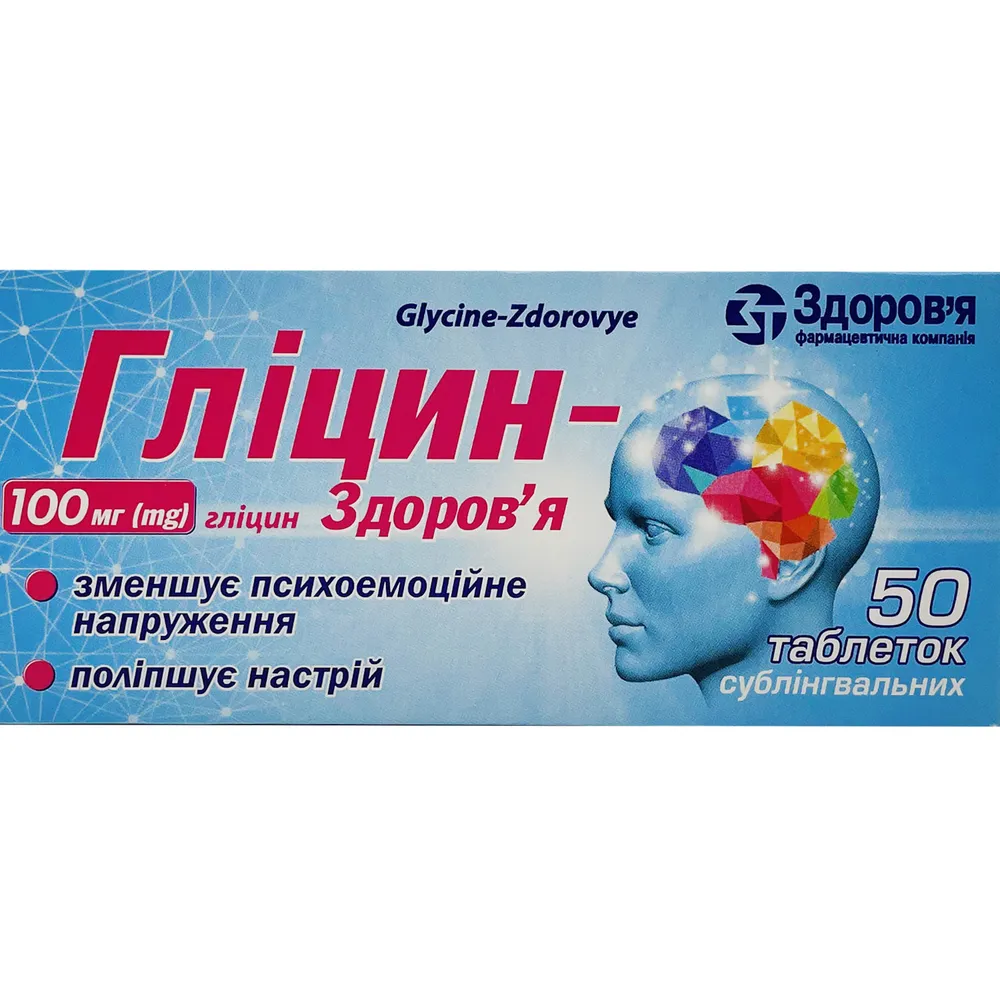
Table of Contents
INSTRUCTIONS FOR MEDICAL USE OF THE MEDICINAL PRODUCT GLYCINE-ZDOROVYE (GLYCINE-ZDOROVYE)
Composition:
Active substance: glycine;
1 tablet contains glycine 0.1 g (100 mg);
Excipients: povidone, carbomers, magnesium stearate.
Pharmaceutical form. Sublingual tablets.
Main physicochemical properties: tablets are almost white or white, round-shaped with a flat surface and beveled edges.
Pharmacotherapeutic group. Other agents acting on the nervous system. ATC code N07XX.
Pharmacological Properties
Pharmacodynamics
Glycine (aminoacetic acid) has properties of a metabolic regulator and is a non-essential amino acid (a natural metabolite). It acts as an inhibitory-type neurotransmitter and regulates metabolic processes in the central nervous system.
The drug exerts glycine- and GABA-ergic, α-adrenoblocking, antioxidant, and antitoxic effects, and modulates the activity of glutamate receptors, enabling it to:
- reduce psychoemotional tension, aggression, and conflict behavior, while improving social adaptation;
- improve mood;
- facilitate falling asleep and normalize sleep;
- enhance mental performance;
- reduce vegetative-vascular disorders, including those occurring during the climacteric period;
- lessen the severity of cerebral disorders associated with ischemic stroke and traumatic brain injury;
- reduce the toxic effects of alcohol.
The medicinal product does not cause dependence.
Pharmacokinetics
Glycine readily penetrates into most biological fluids and tissues, including the brain. It is rapidly metabolized in the liver by glycine oxidase into water and carbon dioxide. Glycine does not accumulate in tissues.
Clinical characteristics.
Indications.
Reduced mental performance.
In stressful situations and psychoemotional stress (during examination periods, conflict situations).
Deviant behavior patterns in children and adults.
Functional and organic disorders of the nervous system (neuroses, neurosis-like conditions, vegetovascular dystonia, consequences of neuroinfection, traumatic brain injury, perinatal and other forms of encephalopathy, including those of alcoholic origin), accompanied by increased excitability, emotional instability, reduced mental performance, and sleep disturbances.
Ischemic stroke and cerebral circulation disorders.
As an adjunctive agent in the treatment of alcoholism.
Contraindications.
Individual intolerance to the drug and hypersensitivity to its individual components; arterial hypotension. Children under 3 years of age.
Interaction with other medicinal products and other types of interactions.
Glycine reduces the toxicity of anticonvulsants, antipsychotic agents, and antidepressants. When combined with sedatives, tranquilizers, and antipsychotic agents, the central nervous system depressant effect is enhanced.
Special precautions for use.
If a patient has a tendency towards arterial hypotension, arterial pressure should be monitored and, if necessary, the dose of the drug adjusted: Glycine-Health should be administered in lower doses and with regular monitoring of arterial pressure. If arterial pressure decreases below the usual level, the use of the drug should be discontinued.
Use during pregnancy or breastfeeding.
The effect of the drug on the body during pregnancy or breastfeeding has not been thoroughly studied; therefore, the use of the drug is not recommended.
Ability to affect reaction rate when driving or operating machinery.
Caution is required when driving vehicles or operating machinery, as well as during other potentially hazardous activities.
Dosage and Administration.
The drug is administered transbuccally or sublingually (as tablets or as a powder after crushing the tablet).
Children from 3 years of age, adolescents, adults: For decreased mental performance, memory, attention, mental retardation, psychoemotional stress, and deviant behavioral patterns, Glycine-Zdorovya is prescribed at 1 tablet (100 mg) 2–3 times daily for 14–30 days.
Maximum daily dose – 300 mg.
Children from 3 years of age and adults with increased excitability and emotional lability should take 1 tablet 2–3 times daily for 7–14 days. If necessary, the treatment course may be repeated.
For sleep disorders, 100 mg should be administered 20 minutes before bedtime or immediately before sleep.
In ischemic stroke and cerebral circulation disorders: 1 g of the drug should be administered transbuccally or sublingually (if necessary, the tablet may be crushed) within the first 3–6 hours after stroke onset, followed by 1 g daily for the next 1–5 days, and then 1–2 tablets 3 times daily for days 6–30.
In the treatment of alcoholism: the drug is used as an adjunctive agent at a dose of 1 tablet 2–3 times daily for 14–30 days. If necessary, the treatment course may be repeated 4–6 times per year.
Children: The medicinal product is indicated for children aged 3 years and older.
Overdose.
There is no information on clinical manifestations of overdose.
Side effects.
The medicinal product is usually well tolerated. In individual cases, with individual hypersensitivity, allergic reactions may occur, including rash, itching, rhinitis, conjunctivitis, urticaria, throat irritation, and weakness. Gastrointestinal side effects, including epigastric pain and nausea, are possible. Isolated cases of nervous system-related side effects such as impaired concentration, headache, tension, and irritability have been observed.
Shelf life. 3 years.
Storage conditions.
Store in the original packaging at a temperature not exceeding 25 °C.
Keep out of reach of children.
Packaging. 10 or 30 tablets in a blister pack. 5 blisters of 10 tablets or 1 blister of 30 tablets in a cardboard box.
Availability. Over-the-counter.
Manufacturer. LIMITED LIABILITY COMPANY "CORPORATION "ZDOROVIYA".
Manufacturer's address and place of business.
22, Shevchenka Street, Kharkiv, Kharkiv Oblast, 61013, Ukraine.