Hemate® p
Ukraine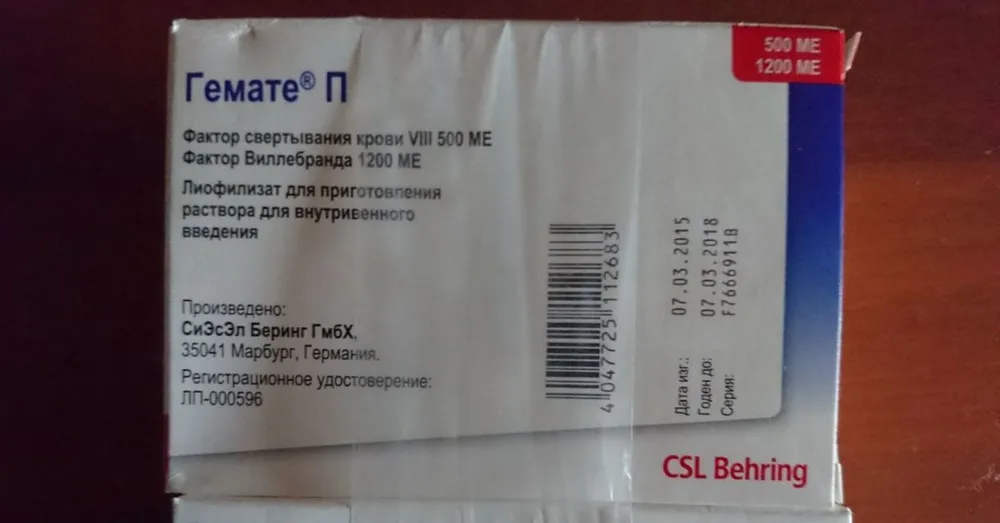
Table of Contents
INSTRUCTIONS FOR MEDICAL USE OF THE MEDICINAL PRODUCT Haemate® P (Haemate® P)
Composition:
Active substances: human coagulation factor VIII (FVIII), human von Willebrand factor (VWF).
One vial of Haemate® P with an activity of 250 IU FVIII / 600 IU VWF contains 250 IU of human blood coagulation factor VIII (FVIII) and 600 IU of human von Willebrand factor (VWF);
after reconstitution by adding 5 mL of water for injections, the solution contains 50 IU/mL FVIII and 120 IU/mL VWF.
One vial of Haemate® P with an activity of 500 IU FVIII / 1200 IU VWF contains 500 IU of human blood coagulation factor VIII (FVIII) and 1200 IU of human von Willebrand factor (VWF);
after reconstitution by adding 10 mL of water for injections, the solution contains 50 IU/mL FVIII and 120 IU/mL VWF.
One vial of Haemate® P with an activity of 1000 IU FVIII / 2400 IU VWF contains 1000 IU of human blood coagulation factor VIII (FVIII) and 2400 IU of human von Willebrand factor (VWF);
after reconstitution by adding 15 mL of water for injections, the solution contains 66.6 IU/mL FVIII and 160 IU/mL VWF.
Excipients: human albumin, glycine, sodium chloride, sodium citrate, sodium hydroxide or hydrochloric acid (in small amounts for pH adjustment).
Solvent: water for injections – 5 mL, 10 mL, and 15 mL, respectively.
FVIII activity (IU) is determined by chromogenic assay according to the European Pharmacopoeia. Specific activity of FVIII in Haemate® P is approximately 2–6 IU FVIII/mg protein.
VWF activity (IU) is measured based on ristocetin cofactor activity (VWF:RCo) relative to the international standard preparation of von Willebrand factor (WHO). Specific activity of VWF in Haemate® P is approximately 5–17 IU VWF:RCo/mg protein.
Haemate® P is manufactured from human donor plasma.
Pharmaceutical form. Powder and solvent for solution for injection or infusion.
Main physicochemical properties: white powder and clear, colourless solvent for solution for injection/infusion.
Pharmacotherapeutic group.
Haemostatics. Coagulation factors. Von Willebrand factor in combination with coagulation factor VIII.
ATC code: B02BD06.
Pharmacological properties
Pharmacodynamics
von Willebrand factor
Hemate® P acts in the same manner as endogenous VWF.
In addition to its function as a factor VIII-protecting protein, von Willebrand factor mediates platelet adhesion at sites of vascular injury and plays a key role in platelet aggregation.
The use of VWF enables correction of hemostatic defects in patients with VWF deficiency (VWD) at two levels:
- VWF restores platelet adhesion to the vascular subendothelium at the site of vessel injury (since it binds both to the vascular subendothelium and to the platelet membrane), thereby ensuring primary hemostasis, as evidenced by reduced bleeding time. This effect occurs immediately and is known to depend largely on the presence of high-molecular-weight VWF multimers.
- VWF contributes to delayed correction of associated FVIII deficiency. After intravenous administration, VWF binds endogenous FVIII (normally produced by the patient) and, by stabilizing this factor, prevents its rapid degradation.
As a result, administration of pure VWF (a VWF preparation with low FVIII content) restores FVIII:C levels to normal as a secondary effect after the first infusion, with a slight delay.
Administration of an FVIII:C-containing VWF preparation restores FVIII:C levels to normal immediately after the first infusion.
Factor VIII
Hemate® P acts in the same manner as endogenous FVIII.
The factor VIII/von Willebrand factor complex consists of two molecules (factor VIII and von Willebrand factor) with different physiological functions.
When administered to a patient with hemophilia, factor VIII binds to von Willebrand factor in the patient's circulation.
Activated factor VIII acts as a cofactor for activated factor IX, accelerating the conversion of factor X to activated factor X. Activated factor X converts prothrombin to thrombin. Thrombin, in turn, converts fibrinogen to fibrin and promotes thrombus formation. Hemophilia A is an inherited, sex-linked coagulation disorder due to reduced factor VIII levels, leading to profuse bleeding into joints, muscles, or internal organs, either spontaneously or following accidental trauma or surgical intervention. Replacement therapy increases factor VIII levels in blood plasma, thereby temporarily correcting the deficiency and ameliorating the bleeding tendency.
It should be noted that annual bleeding rates (ABR) are not comparable across different factor concentrates or different clinical trials.
Pharmacokinetics
von Willebrand factor
The pharmacokinetics of Hemate® P were evaluated in 28 patients with VWD [type 1, n = 10; type 2A, n = 10; type 2M, n = 1; type 3, n = 7] in the absence of bleeding. The median terminal half-life of VWF:RCo (two-compartment model) was 9.9 hours (range: 2.8–51.1 hours). The median initial half-life was 1.47 hours (range: 0.28–13.86 hours). The median in vivo recovery for VWF:RCo activity was 1.9 (IU/dL)/(IU/kg) [range: 0.6–4.5 (IU/dL)/(IU/kg)]. The median AUC was 1664 IU/dL·hour (range: 142–3846 IU/dL·hour), the median MRT was 13.7 hours (range: 3.0–44.6 hours), and the mean clearance was 4.81 mL/kg/hour (range: 2.08–53.0 mL/kg/hour).
The maximum plasma level of VWF is typically observed approximately 50 minutes after administration. The maximum FVIII level is observed 1–1.5 hours after administration.
Factor VIII
After intravenous injection, a rapid increase in factor VIII activity (FVIII:C) in plasma is observed, followed by a rapid decline in activity and then a slower decline. Studies in patients with hemophilia A demonstrated a mean half-life of 12.6 hours (range: 5.0–27.7 hours). The overall median in vivo recovery of FVIII was 1.73 IU/dL per 1 IU/kg (range: 0.5–4.13). In one study, the mean residence time (MRT) was 19.0 hours (range: 14.8–40.0 hours), the mean area under the curve (AUC) was 36.1 (%·hour)/(IU/kg) (range: 14.8–72.4 (%·hour)/(IU/kg)), and the mean clearance was 2.8 mL/hour/kg (range: 1.4–6.7 mL/hour/kg).
Children
There are no pharmacokinetic data available for patients under 12 years of age.
Preclinical safety data
Hemate® P contains factor VIII and von Willebrand factor as active substances derived from human plasma, which act as endogenous plasma components. Administration of a single dose of Hemate® P in various animal species did not reveal any toxic effects. Preclinical studies involving repeated dosing (chronic toxicity, carcinogenicity, and mutagenicity) cannot be reasonably conducted in conventional animal models due to the development of antibodies following administration of heterologous human proteins.
Clinical characteristics.
Indications.
Von Willebrand disease (VWD)
For the prevention and treatment of bleeding or bleeding during surgical interventions when monotherapy with desmopressin (DDAVP) is ineffective or contraindicated.
Hemophilia A (congenital factor VIII deficiency)
For the prevention and treatment of bleeding in patients with hemophilia A.
The drug can be used to control the course of acquired factor VIII deficiency and for the treatment of patients with inhibitors (antibodies) to factor VIII.
Contraindications.
Hypersensitivity to the active substance or to any of the excipients (see section "Composition").
Interaction with other medicinal products and other forms of interaction.
The interaction of VWF and FVIII with other medicinal products has not been studied.
Special precautions for use
Tracking
To improve the traceability of biological medicinal products, the name and batch number of the administered product should be clearly documented.
Hypersensitivity
Allergic-type hypersensitivity reactions may occur. If symptoms of hypersensitivity occur, patients should be advised to discontinue the product immediately and seek medical advice. Patients should be informed about early signs of hypersensitivity reactions, including rash, generalized urticaria, chest tightness, wheezing, hypotension, and anaphylaxis. In the event of shock, current medical standards for shock management should be followed.
von Willebrand Disease (VWD)
There is a risk of thrombotic complications, including pulmonary embolism, particularly in patients with known clinical or laboratory risk factors (e.g., lack of thromboprophylaxis in the perioperative period, absence of early mobilization, obesity, overdose, or malignancy). Therefore, patients at risk should be monitored for early signs of thrombosis. Venous thromboembolism prophylaxis should be performed in accordance with current guidelines.
When using VWF-containing products, physicians should be aware that prolonged treatment may lead to excessive elevation of FVIII:C. In patients receiving VWF-containing factor VIII products, plasma FVIII:C levels should be monitored to avoid sustained elevation of FVIII:C in plasma, which is associated with an increased risk of thrombotic complications. Antithrombotic measures should also be considered.
In patients with VWF deficiency, particularly those with type 3 VWD, neutralizing antibodies (inhibitors) to VWF may develop. If the expected VWF:RCo activity level in plasma is not achieved or if bleeding cannot be controlled with an appropriate dose, testing for VWF inhibitors should be performed. In patients with high inhibitor levels, therapy may be ineffective, and alternative treatment options should be considered.
Hemophilia A
Inhibitors
The development of neutralizing antibodies (inhibitors) to factor VIII is a known complication in the treatment of patients with hemophilia A. These inhibitors are typically IgG immunoglobulins directed against the procoagulant activity of factor VIII and are quantitatively measured in Bethesda Units (BU) per 1 mL of plasma using a modified assay. The risk of inhibitor development correlates with disease severity and exposure to factor VIII. The risk is highest during the first 50 exposure days but persists throughout life, although it is uncommon.
The clinical significance of inhibitor development depends on the inhibitor titer, with a low titer posing a lower risk of inadequate clinical response compared to a high titer.
All patients receiving factor VIII replacement therapy should be closely monitored for inhibitor development through appropriate clinical observations and laboratory testing. If the desired factor VIII plasma activity level is not achieved or if bleeding persists despite administration of an appropriate dose, testing for FVIII inhibitors should be performed. In patients with high inhibitor titers, factor VIII therapy may be ineffective, and alternative treatment options should be considered. Management of such patients should be performed by a physician experienced in treating patients with hemophilia A and those with factor VIII inhibitors.
Cardiovascular risks
In patients with pre-existing cardiovascular risk factors, factor VIII replacement therapy may increase cardiovascular risk.
Complications associated with catheter use
If a central venous access device (CVAD) is required, the risk of CVAD-related complications, such as local infections, bacteremia, and catheter site thrombosis, should be considered.
Viral safety
Standard precautions to prevent transmission of infection from medicinal products derived from human blood or plasma include donor selection, testing of individual donations and plasma pools for specific infectious markers, and implementation of effective manufacturing steps for virus inactivation/removal. Nevertheless, when administering products derived from human blood or plasma, the possibility of transmitting infectious agents cannot be completely excluded, including unknown or emerging viruses and other pathogens.
The measures taken are considered effective against enveloped viruses such as human immunodeficiency virus (HIV), hepatitis B virus (HBV), and hepatitis C virus (HCV), as well as against non-enveloped viruses such as hepatitis A virus (HAV).
However, these measures may have limited effectiveness against non-enveloped viruses such as parvovirus B19.
Parvovirus B19 infection may have serious consequences for pregnant women (fetal infection) and for individuals with immunodeficiency or increased erythropoiesis (e.g., hemolytic anemia).
Appropriate vaccination (against hepatitis A and B) should be considered for patients who are regularly or repeatedly administered plasma-derived FVIII/VWF products.
Sodium content
Hemate® P with an activity of 250 IU FVIII / 600 IU VWF contains less than 1 mmol sodium (23 mg) per dose unit and can therefore be considered essentially "sodium-free."
Hemate® P with an activity of 500 IU FVIII / 1200 IU VWF contains 26 mg of sodium per vial, equivalent to 1.3% of the WHO-recommended maximum daily intake of 2 g sodium for adults.
Hemate® P with an activity of 1000 IU FVIII / 2400 IU VWF contains 52.5 mg of sodium per vial, equivalent to 2.6% of the WHO-recommended maximum daily intake of 2 g sodium for adults.
Use during pregnancy or breastfeeding
Reproductive toxicity studies in animals with Hemate® P have not been conducted.
Hemophilia A
Since hemophilia A is rare in women, experience with factor VIII use during pregnancy and lactation is lacking.
von Willebrand Disease (VWD)
von Willebrand disease is inherited in an autosomal manner. It is more common in women than in men due to the additional risk associated with blood loss during menstruation, pregnancy, childbirth, and gynecological disorders. Based on post-marketing experience, VWF replacement therapy is recommended for the treatment and prevention of acute bleeding episodes. However, clinical data on VWF replacement therapy during pregnancy and lactation are limited.
Therefore, VWF and FVIII should be used during pregnancy and lactation only if clearly indicated.
Ability to affect driving and operating machinery
No effect of Hemate® P on the ability to drive or operate machinery has been observed.
Administration and Dosage
Administration
The medication is administered intravenously.
Treatment should be carried out under the supervision of a physician experienced in managing patients with hemophilia.
The medication should be reconstituted according to the "Instructions for Preparing the Medication Before Administration" provided below. Before administration, the reconstituted medication should be warmed to room temperature or body temperature. It should be administered intravenously slowly, at a rate comfortable for the patient. After transferring the medication into a syringe, it should be used immediately.
If a larger amount of factor is required, administration may also be performed via infusion. In such cases, the reconstituted medication should be transferred into a suitable infusion system.
The rate of injection or infusion must not exceed 4 mL per minute. The patient should be monitored for any immediate-type allergic reactions. If any reaction possibly related to Hemate® P occurs, the infusion rate should be reduced or administration discontinued, depending on the patient's clinical condition.
Dosage
Von Willebrand Disease
It is important to calculate the dose using the specified amount of VWF:RCo IU.
Generally, 1 IU/kg of VWF:RCo increases circulating VWF:RCo levels by 0.02 IU/mL (2%).
Target levels should be VWF:RCo > 0.6 IU/mL (60%) and FVIII:C > 0.4 IU/mL (40%).
Typically, 40–80 IU/kg of von Willebrand factor (VWF:RCo) and 20–40 IU FVIII:C/kg body weight are recommended to achieve hemostasis.
An initial dose of 80 IU/kg of von Willebrand factor may be required, particularly for patients with type 3 von Willebrand disease, where maintaining adequate levels may require higher doses than in other types of von Willebrand disease.
Prevention of Bleeding During Surgery or Severe Trauma
To prevent excessive bleeding during or after surgery, administration should begin 1–2 hours before the surgical procedure.
The appropriate dose should be repeated every 12–24 hours. The dose and duration of treatment depend on the patient's clinical condition, type and severity of bleeding, and levels of VWF:RCo and FVIII:C.
When using von Willebrand factor containing FVIII, physicians should be aware that prolonged treatment may lead to excessive elevation of FVIII:C. After 24–48 hours of treatment, to avoid uncontrolled increases in FVIII:C, consideration should be given to reducing the dose and/or extending the dosing interval.
Children
Dosage for children is based on body weight and generally follows the same recommendations as for adults. The frequency of administration should always be determined based on clinical efficacy in each individual case.
Hemophilia A
Dosage
During treatment, factor VIII levels should be monitored to calculate doses and frequency of repeat infusions. Individual patients may differ in their response to factor VIII, achieving different in vivo recovery levels and demonstrating varying half-lives. Patients with underweight or overweight may require dose adjustments based on body weight. Accurate monitoring of replacement therapy using coagulation tests (factor VIII activity) is especially important during major surgical procedures.
Monitoring for the development of factor VIII inhibitors is essential; see also section "Special Warnings and Precautions for Use."
It is important to calculate the dose using the specified amount of FVIII:RCo IU.
The dosage and duration of replacement therapy depend on the severity of factor VIII deficiency, location and intensity of bleeding, and the patient's clinical condition.
Factor VIII quantity is expressed in International Units (IU), calculated according to the current WHO International Standard for blood coagulation factor VIII-containing products. Factor VIII plasma activity is expressed either as a percentage (relative to normal human plasma) or predominantly in IU (relative to the International Standard for factor VIII in plasma).
1 IU of factor VIII activity is equivalent to the amount of factor VIII present in 1 mL of normal human plasma.
On-demand Treatment
The required dose of factor VIII is calculated empirically, based on the observation that 1 IU of factor VIII per kg of body weight increases plasma factor VIII activity by approximately 2% (2 IU/dL) of normal activity. The required dose is calculated using the following formula:
Required number of units = body weight [kg] × desired increase in factor VIII [% or IU/dL] × 0.5.
The frequency and number of doses should be determined based on clinical efficacy in each individual case.
In the event of the hemorrhagic conditions listed below, factor VIII activity should not fall below the plasma activity level (in % of normal or in IU/dL) indicated for the corresponding period.
The table below (Table 1) can be used to determine dosing for bleeding episodes and surgical procedures.
Table 1
Type of bleeding / type of surgical intervention |
Required factor VIII level (% or IU/dL) |
Frequency of administration (hours) / duration of treatment (days) |
| Bleeding |
||
| Early haemarthrosis, muscle or oral bleeding |
20–40 |
Repeat infusion every 12–24 hours. At least 1 day, until bleeding has stopped (based on pain relief) or until healing occurs. |
| More extensive haemarthrosis, muscle bleeding or hematoma |
30–60 |
Repeat infusion every 12–24 hours. For 3–4 days or longer, until pain resolves and mobility is restored. |
| Life-threatening bleeding |
60–100 |
Repeat infusion every 8–24 hours, until the life-threatening condition has resolved. |
| Surgical interventions |
||
| Minor, including tooth extraction |
30–60 |
Every 24 hours. For at least 1 day, until recovery. |
| Major |
80–100 (before and after surgery) |
Repeat infusion every 8–24 hours, until adequate wound healing. Then continue therapy for 7 days to maintain factor VIII activity at 30–60% (IU/dL). |
Prophylaxis
For long-term prophylactic treatment of severe hemophilia A, a dosage of 20–40 IU of factor VIII per kg body weight every 2–3 days is recommended. Sometimes, especially in the treatment of young patients, it may be necessary to shorten the intervals between administrations or increase the dose.
Children
There are no clinical data available on the dosing of Hemate® P in children.
Instructions for preparation of the medicinal product prior to administration
General instructions
- The solution should be clear or slightly opalescent. After filtration/withdrawal (see below), the reconstituted product must be visually inspected for the presence of particulate matter and discoloration prior to administration. Even when reconstitution procedures are strictly followed, a few flake-like particles or inclusions may occasionally remain. The filter contained in the solvent addition device «Mix-2Vial™ 20/20» completely removes these particles. Filtration does not affect the dosage calculation. Do not use cloudy solutions or solutions which still contain flake-like particles or mechanical inclusions after filtration.
- Reconstitution and withdrawal of the solution must be performed under aseptic conditions.
Reconstitution
Allow the solvent to reach room temperature. Remove the caps from the vials containing the medicinal product and the solvent, disinfect the stoppers with an antiseptic solution, and allow them to dry before opening the package containing the integrated filter «Mix-2Vial™ 20/20».
| 1 |
|
| 2 |
|
| 3 |
|
| 4 |
|
| 5 |
|
| 6 |
|
| 7 |
|
Collection and separation
| 8 |
|
| 9 |
|
For injections of Hemate® P, it is recommended to use disposable plastic syringes, since solutions of this type may adhere to the walls of glass syringes.
The solution should be administered slowly intravenously (see section "Posology and method of administration"), taking care to ensure that blood does not enter the syringe containing the medicinal product.
Any unused medicinal product or waste material must be disposed of in accordance with national requirements.
Children.
The medicinal product should be used according to the recommendations specified in the section "Posology and method of administration".
Overdose.
Symptoms of overdose with VWF and FVIII have not been reported. However, the risk of thrombosis cannot be excluded in case of extremely high doses, particularly with VWF-containing FVIII products having high FVIII content.
Adverse reactions
The adverse reactions listed below are known from post-marketing experience.
Summary of safety profile
During treatment with Hemate® P, the following adverse reactions may occur in adults and adolescents: hypersensitivity or allergic reactions, thromboembolic complications, and pyrexia. In addition, inhibitors to FVIII and VWF may develop in patients.
Summary table of adverse reactions
Table 2 is organized according to MedDRA organ system classifications.
Frequency categories were defined according to the following criteria: very common (≥ 1/10); common (≥ 1/100 to < 1/10); uncommon (≥ 1/1,000 to < 1/100); rare (≥ 1/10,000 to < 1/1,000); very rare (< 1/10,000); frequency not known (cannot be estimated based on available data).
Table 2
| System organ |
Adverse reaction |
Frequency |
| Blood and lymphatic system disorders |
Hypervolemia Hemolysis Inhibition of VWF Inhibition of FVIII |
Frequency unknown Frequency unknown Very rare Uncommon (PTP)* Very common (PUP)* |
| General disorders and administration site conditions |
Fever |
Very rare |
| Immune system disorders |
Hypersensitivity (allergic reactions) |
Very rare |
| Vascular disorders |
Thrombosis Thromboembolic complications |
Very rare Very rare |
* Frequency was determined based on studies with all FVIII products, which included patients with severe haemophilia A.
PTP – previously treated patients.
PUP – previously untreated patients.
Description of some adverse reactions
Blood and lymphatic system disorders
When very high or frequently repeated doses are required, when inhibitors are present, or when peri- and postoperative care is involved, patients should be monitored for signs of hypervolaemia. In addition, patients with blood groups A, B, and AB should be monitored for signs of intravascular haemolysis and/or decreased haematocrit levels.
General disorders and administration site conditions
Fever has been observed very rarely.
Immune system disorders
Hypersensitivity or allergic reactions (which may include angioneurotic oedema, burning and tingling sensations at the infusion site, chills, flushing, generalized urticaria, headache, rash, hypotension, lethargy, nausea, restlessness, tachycardia, chest tightness, pruritus, vomiting, wheezing) have been observed very rarely; in some cases, these may progress to severe anaphylaxis (including shock).
Von Willebrand disease
Blood and lymphatic system disorders
In patients with VWF, particularly in patients with type 3 VWD, neutralizing antibodies (inhibitors) to VWF may very rarely develop. If such inhibitors appear, the condition will manifest as inadequate clinical response. These antibodies are precipitating and may occur simultaneously with anaphylactic reactions. Therefore, patients who experience an anaphylactic reaction should be tested for the presence of inhibitor.
In all such cases, consultation with specialized haemophilia centres is recommended.
Vascular disorders
Very rarely, there is a risk of thrombotic/thromboembolic complications (including pulmonary embolism).
In patients receiving VWF-containing products, high plasma levels of FVIII:C may occur, which could increase the risk of thrombotic complications (see also section "Special precautions for use").
Haemophilia A
Blood and lymphatic system disorders
In patients with haemophilia A treated with factor VIII, including Haemate® P, development of neutralizing antibodies (inhibitors) is possible. If such inhibitors develop, the condition may manifest as inadequate clinical response. In such cases, consultation with specialized haemophilia centres is recommended.
For safety concerns regarding infectious agents, see section "Special precautions for use".
Paediatric population
The frequency, type, and severity of adverse reactions in children are expected to be similar to those in adults.
Reporting of suspected adverse reactions after marketing authorization is important. It allows continued monitoring of the benefit-risk balance of the medicinal product. Medical and pharmaceutical professionals, as well as patients or their legal representatives, should report all suspected adverse reactions and lack of efficacy through the automated pharmacovigilance information system at: https://aisf.dec.gov.ua/.
Shelf life. 3 years.
Chemical and physical stability of the reconstituted product has been demonstrated for 8 hours at 25 °C. From a microbiological standpoint, and since the medicinal product contains no preservatives, the reconstituted solution should be used immediately. If not used immediately, the storage time at room temperature should not exceed 8 hours.
If the product has been transferred into a syringe, it should be used immediately.
Storage conditions.
Store at a temperature not exceeding 25 °C. Do not freeze. Keep in the original packaging. Store out of reach of children.
Incompatibilities.
This medicinal product must not be mixed with other medicinal products, diluents, or solvents except for water for injections provided in the package.
Packaging.
One vial of powder in combination with one vial of solvent (water for injections), one transfer device with an integrated 15 µm filter ("Mix-2-Vial™ 20/20"), and one administration set for intravenous use (one single-use syringe, one butterfly needle, two disinfecting wipes in individual sealed packages, and one non-sterile adhesive plaster) in a cardboard box.
Prescription status.
Prescription only.
Manufacturer.
CSL Behring GmbH.
Manufacturer's address.
Emil-von-Behring-Strasse 76, 35041 Marburg, Germany.