Fusikutan®
Ukraine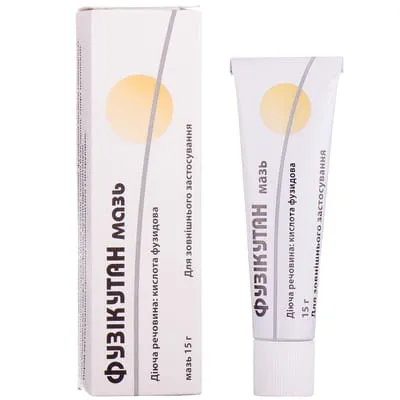
Table of Contents
INSTRUCTIONS FOR MEDICAL USE OF THE MEDICINAL PRODUCT FUSICUTAN® (FUSICUTAN)
Composition:
Active substance: fusidic acid;
1 g of ointment contains 20 mg of fusidic acid (as fusidic acid hemihydrate);
Excipients: white soft paraffin, anhydrous lanolin, cetyl alcohol, mineral oil, alpha-tocopherol, butylhydroxytoluene.
Pharmaceutical form. Ointment.
Main physicochemical properties: pale yellow, shiny, homogeneous, soft ointment with a weak characteristic odor.
Pharmacotherapeutic group. Other antibiotics for local use.
ATC code D06AX01.
Pharmacological properties.
Pharmacodynamics.
Fusidic acid is an antibiotic produced during the growth of Fusidium coccineum. It disrupts protein synthesis in microbial cells and, depending on the dose, exerts either bacteriostatic or bactericidal effects. The drug demonstrates potent antibacterial activity against a broad range of Gram-positive microorganisms – Staphylococcus spp., Streptococcus spp., Corynebacterium minutissimum, and Propionibacterium acnes – including penicillin-, streptomycin-, chloramphenicol-, erythromycin-, and other antibiotic-resistant strains of staphylococci. Fusikutan® has the ability to act through intact skin. When applied topically, fusidic acid is active against Corynebacteria spp., Neisseria spp., Clostridia spp., Bacteroides spp.
Pharmacokinetics.
With topical application, systemic absorption is negligible.
Clinical characteristics.
Indications.
Fusikutan® ointment is indicated for topical treatment of bacterial skin infections caused by microorganisms sensitive to fusidic acid (see section "Pharmacodynamics"). Apply the ointment in dry lesions and in chronic conditions.
Contraindications.
Hypersensitivity to fusidic acid or to any of the excipients. Do not apply Fusikutan® ointment to the area around the eyes.
Interaction with other medicinal products and other forms of interaction.
Interaction studies have not been performed. Interaction with systemic medicinal products is considered to be minimal due to the negligible systemic absorption of fusidic acid.
Special precautions for use
Resistance in Staphylococcus aureus bacteria has been reported during topical use of fusidic acid. As with any antibiotics, prolonged or repeated use of fusidic acid may increase the risk of developing antibiotic resistance.
Butylhydroxyanisole may cause local skin reactions (e.g., contact dermatitis) or irritation of the eyes and mucous membranes. Cetyl alcohol and potassium sorbate may also lead to local skin reactions (e.g., contact dermatitis).
When using latex condoms during treatment with Fucicutan® ointment applied to the anal area or genital region, the stability of condoms may be reduced due to the excipients white soft paraffin and liquid paraffin, potentially compromising the reliability of this contraceptive method.
Use during pregnancy or breastfeeding
Fucicutan® ointment should be used during pregnancy or breastfeeding only when the expected benefit to the mother outweighs the potential risk to the fetus/infant. During breastfeeding, avoid applying the product to the skin of the mammary glands.
Ability to affect reaction speed while driving or operating machinery
Fusidic acid has no effect or has negligible effect on the ability to drive or operate machinery.
Method of Administration and Dosage.
For adults and children aged 2 years and older, apply the ointment to affected skin areas 2–3 times daily for 7 days. If necrotic material is present, it should be removed prior to application of the medication.
Children.
There is no clinical experience with the use of Fuzikutan® ointment in patients under 2 years of age.
Overdose.
Not described.
Adverse reactions.
The assessment of the frequency of adverse reactions was based on the results of a pooled analysis of clinical trial data and spontaneous reports.
The most commonly reported adverse reactions during treatment were various skin reactions such as itching and rashes; less frequently, reactions at the application site such as pain and irritation were reported, observed in less than 1% of patients.
Cases of hypersensitivity and angioedema have been reported.
Adverse reactions are listed by MedDRA system organ classes, with individual adverse reactions presented starting with the most frequent. Within each frequency group, adverse reactions are listed in decreasing order of occurrence.
The corresponding frequency categories of adverse reactions were defined according to the following criteria:
Very common: (≥1/10)
Common: (≥1/100 and <1/10)
Uncommon: (≥1/1000 and <1/100)
Rare: (≥1/10,000 and <1/1,000)
Very rare: (<1/10,000)
Frequency not known: (frequency cannot be estimated from available data)
Immune system disorders
Rare: Hypersensitivity.
Eye disorders
Rare: Conjunctivitis.
Skin and subcutaneous tissue disorders
Uncommon: Dermatitis (including contact dermatitis, eczema), rash*, pruritus, erythema.
*Various types of rashes were reported, such as erythematous, pustular, vesicular, maculopapular, and papular. Cases of generalized rashes were also observed.
Rare: Angioedema, urticaria, blisters.
General disorders and administration site conditions
Uncommon: Application site pain (including skin burning sensation), application site irritation.
Paediatric population
The frequency, type, and severity of adverse reactions in children are expected to be no different from those in adults.
Reporting of suspected adverse reactions
Reporting suspected adverse reactions after marketing authorization is important. It allows continuous monitoring of the benefit-risk balance of the medicinal product. Healthcare professionals should report any suspected adverse reactions via the national reporting system.
Shelf life. 3 years.
After opening the tube – 6 months.
Storage conditions.
Store out of reach and sight of children at a temperature not exceeding 30 °C.
Packaging. Ointment, 5 g, 15 g, or 30 g in a tube, in a cardboard box.
Prescription status.
Prescription only.
Manufacturer.
mibe GmbH Arzneimittel.
Manufacturer's address and place of business.
Muenchener Strasse 15, Breuna, Saxony-Anhalt, 06796, Germany.