Furacilin
Ukraine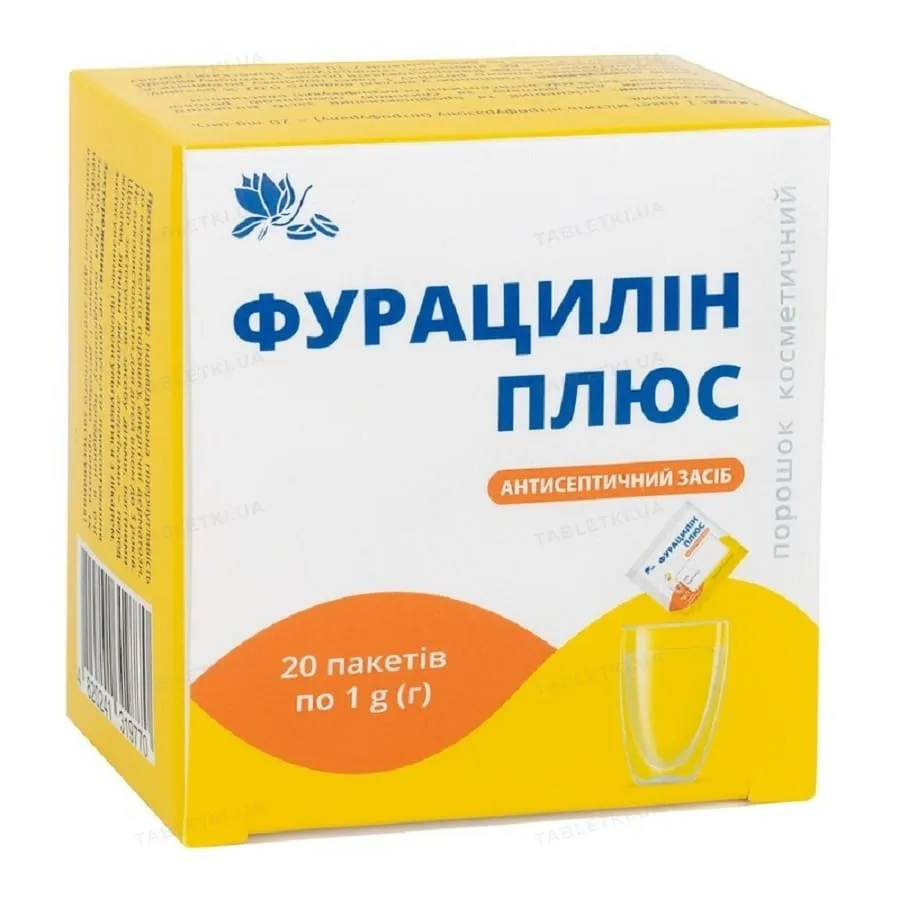
Table of Contents
INSTRUCTIONS for medical use of the medicinal product FURACILIN® (FURACILIN)
Composition:
Active substance: nitrofurazone;
1 sachet contains nitrofurazone 40 mg;
Excipients: sodium chloride, povidone.
Pharmaceutical form. Powder for solution for external use.
Main physicochemical properties: powder from light yellow to yellow in color. Hygroscopic.
Pharmacotherapeutic group.
Antiseptics and disinfectants. Nitrofuran derivatives. ATC code D08AF01.
Pharmacological properties.
Pharmacodynamics.
Nitrofurale belongs to antibacterial agents. It is an antiseptic active against staphylococci, streptococci, Shigella and Escherichia coli, Salmonella, and causative agents of gas gangrene. It promotes granulation and wound healing processes. The mechanism of action of the drug is associated with its ability to reduce the nitro group to an amino group, disrupt DNA function, and inhibit microbial cellular respiration.
Clinical characteristics.
Indications.
Used as part of combination therapy in inflammatory diseases of the oral cavity and pharynx, sinusitis, purulent wounds, pressure sores, skin ulcers, second- and third-degree burns, osteomyelitis, pleural empyema, chronic suppurative otitis, and anaerobic infections.
Contraindications.
Hypersensitivity to the drug or to other nitrofuran derivatives, allergic dermatoses.
Special precautions.
The medicinal product is intended for topical use only!
Interaction with other medicinal products and other forms of interactions.
Furacilin® is incompatible with novocaine, dicaine, adrenaline, and other reducing agents, as it decomposes forming colored products. It is also incompatible with potassium permanganate, hydrogen peroxide, and other strong oxidizing agents due to oxidation.
Special precautions for use.
Use during pregnancy or breastfeeding.
There is no experience with the use of the medicinal product during pregnancy or breastfeeding.
Ability to affect reaction speed when driving or operating machinery.
Not studied.
Method of Administration and Dosage.
Apply Nitrofurazone® externally as an aqueous 0.02% (1:5000) solution. The solution should be prepared immediately before use. To prepare the aqueous solution, dissolve the contents of 1 sachet in 200 mL of isotonic sodium chloride solution, distilled water, or boiled water. For faster dissolution, boiling or hot water is recommended. After dissolving, cool the solution to room temperature.
For inflammatory diseases of the oral cavity and pharynx: dissolve the contents of 1 sachet in 200 mL of boiling or hot water. Use the warm solution for rinsing the mouth and throat. Repeat rinsing as directed by the physician. The duration of treatment depends on the form and severity of the disease, concomitant therapy, achieved therapeutic effect, and is determined individually by the physician.
For sinusitis: irrigate the nasal cavity with the aqueous solution of the drug.
For purulent wounds, pressure ulcers, skin ulcers, second- and third-degree burns: to prepare granulating surfaces for skin grafting or secondary suture, irrigate the wound with the aqueous solution of Nitrofurazone® and then apply a moist dressing soaked with the drug solution.
After surgery for osteomyelitis: irrigate postoperative cavities with the aqueous solution of the drug, then apply a moist dressing with the aqueous solution of the drug.
For pleural empyema: after removal of pus, irrigate the pleural cavity using standard methods. Then introduce 20–100 mL of the aqueous solution of the drug into the pleural cavity.
For anaerobic infections: after standard surgical intervention, irrigate the wound with the aqueous solution of the drug.
For chronic suppurative otitis media: apply 8–10 drops of the aqueous solution of Nitrofurazone® onto a cotton swab or a wick and insert into the external auditory canal twice daily. The solution should be warmed to body temperature prior to use.
The duration of treatment is determined individually by the physician, taking into account the nature, severity, course characteristics of the disease, stability of the achieved therapeutic effect, and drug tolerability.
Children.
There is no experience with the use of the drug in children.
Overdose.
When large doses of the drug are used, adverse reactions may be intensified.
Adverse reactions.
When applied topically, Furacilin® is generally well tolerated. Occasionally, dermatitis may occur; when used for throat rinsing — irritation of the oral mucosa, which requires temporary discontinuation of the medicinal product.
In individual cases, the following may occur with the use of the drug:
Immune system side effects: allergic reactions including itching, hyperemia, skin rashes; very rarely — angioneurotic edema.
Reporting suspected adverse reactions
Reporting of suspected adverse reactions following registration of the medicinal product is of great importance. It enables ongoing monitoring of the benefit-risk balance of the medicinal product. Healthcare and pharmacy professionals, as well as patients or their legal representatives, should report all cases of suspected adverse reactions and lack of efficacy through the Automated Information System for Pharmacovigilance at the following link: https://aisf.dec.gov.ua/.
Shelf life. 2 years.
Storage conditions.
Store in the original packaging at a temperature not exceeding 25 °C.
Keep out of reach of children.
Packaging.
2 g of powder in sachets. 10 or 20 sachets per cardboard box.
Availability category. Over-the-counter (without prescription).
Manufacturer.
LLC "Istok-Plus".
JSC "Kievmedpreparat".
Manufacturer's address and location of business activity.
Ukraine, 69032, Zaporizhzhia, Makarenka Street, 4.
Ukraine, 01032, Kyiv, Saksaganskogo Street, 139.