Ftorafur
Ukraine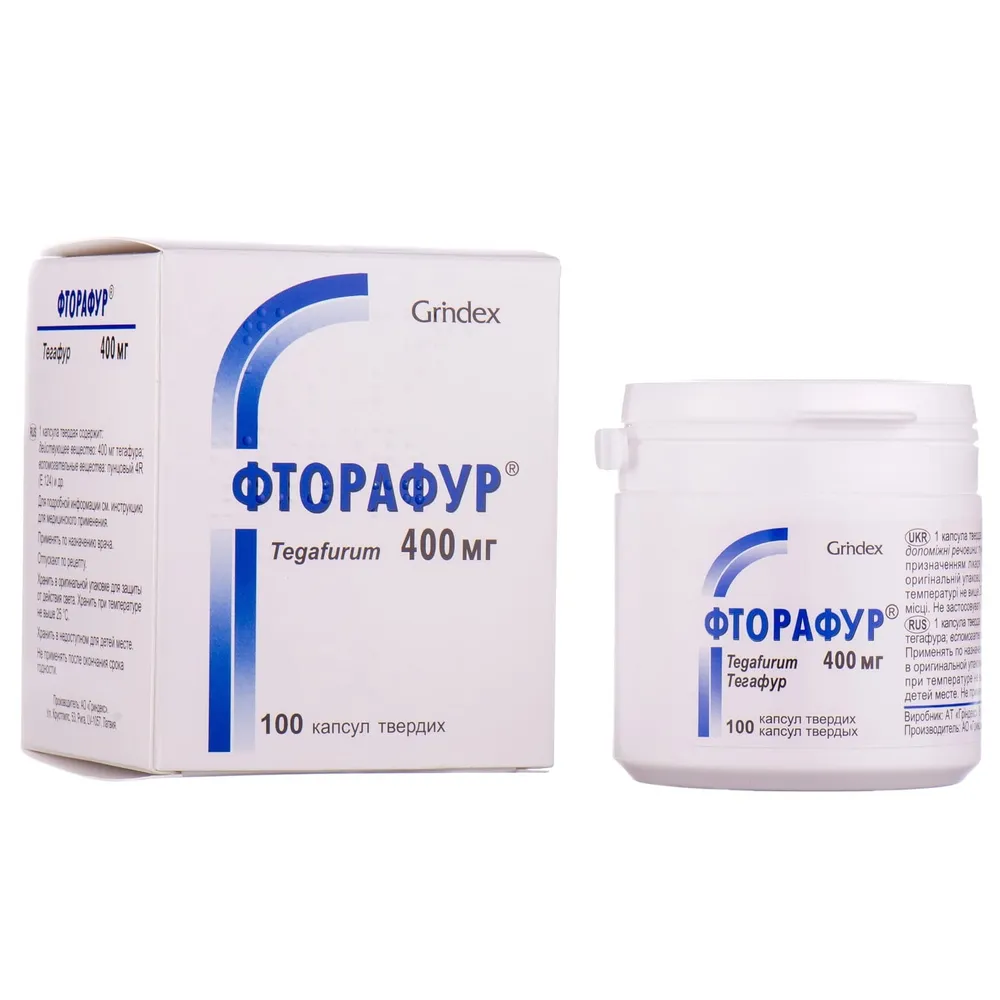
Table of Contents
INSTRUCTIONS for medical use of the medicinal product FTO RAFUR® (FTORAFUR®)
Composition:
active substance: tegafur;
1 hard capsule contains 400 mg of tegafur;
excipient: stearic acid;
capsule:
body: quinoline yellow (E 104), iron oxide red (E 172), titanium dioxide (E 171), gelatin;
cap: ponceau 4R (E 124), quinoline yellow (E 104), titanium dioxide (E 171), gelatin.
Medicinal form. Hard capsules.
Main physico-chemical properties: hard gelatin capsules. The capsule body is yellow, the cap is orange. The contents of the capsule are a white powder.
Pharmacotherapeutic group.
Antineoplastic agents. Antimetabolites. Pyrimidine analogues.
ATC code L01B C03.
Pharmacological Properties
Pharmacodynamics
Tegafur and its sodium salt possess antitumor activity and, in biological characteristics, closely resemble 5-fluorouracil. Tegafur can be considered a prodrug of 5-fluorouracil, which is formed in the body through hepatic microsomal enzyme activation of tegafur. The resulting metabolite circulates in the body for a prolonged period, thereby ensuring high therapeutic efficacy of the drug.
During the metabolism of 5-fluorouracil, 5-fluoro-2'-deoxyuridine-5'-monophosphate is formed, which significantly reduces thymidylate synthase activity. Under these conditions, a deficiency of thymidine-5'-monophosphate—considered a specific precursor of deoxyribonucleic acid (DNA)—develops, thereby inhibiting cell division, including that of malignant cells. Additionally, another metabolite, 5-fluorouracil-5-fluorouridine-5'-triphosphate, is incorporated into the ribonucleic acid (RNA) chain and replaces uracil, resulting in RNA dysfunction. Tegafur causes more pronounced disturbances in biosynthesis than 5-fluorouracil, indicating that tegafur acts not only as a prodrug of 5-fluorouracil but also exerts independent effects. The cytostatic effect of tegafur is primarily based on its ability to interfere with RNA metabolism in tumor cells with low proliferation rates, which grow slowly. Such tumors include gastrointestinal adenocarcinomas.
Best results have been achieved with tegafur in the treatment of gastrointestinal tract tumors (stomach, colon, and rectum) and breast cancer. Duration of remission in most patients with gastric cancer is 1.5–2 months. Remission duration in colorectal cancer is 5–8 months; in breast cancer, it is 10–19 months.
Tegafur demonstrates positive therapeutic effects in malignant tumors of the biliary ducts, pancreas, urinary system, as well as in cutaneous lymphoma and diffuse neurodermatitis.
Tegafur is effective in combined therapy of cervical cancer [in combination with radiotherapy and chemotherapy (cisplatin, xeloda, and laferon)].
In animal experiments, tegafur has demonstrated high antitumor efficacy. High sensitivity to tegafur has been observed in many experimental tumors (e.g., mammary tumors, sarcoma 180, Walker carcinosarcomas, Harding-Passey melanoma). Tegafur exhibits strong antitumor activity against leukemia L-1210, La hemacytoblastosis, and lympholeukemia, whereas Pliss lymphosarcoma, Jensen sarcoma, NK carcinoma, and adenocarcinoma 755 are less sensitive. Leukemia P-388, L-5178, Lewis lung carcinoma, melanoma B16, and sarcoma 45 are resistant to tegafur.
The drug also possesses anti-inflammatory and analgesic effects and reduces itching.
Pharmacokinetics
The pharmacokinetic properties of tegafur are primarily based on its high lipophilicity (250 times higher than that of 5-fluorouracil).
Absorption: After oral administration, tegafur is rapidly absorbed from the gastrointestinal tract (GI tract), reaching maximum plasma concentration within 3 hours. It remains detectable in the blood for at least 24 hours after a single dose.
Distribution: The drug rapidly penetrates biological membranes and distributes throughout the body, including into brain tissue. The bioavailability of tegafur in the gastrointestinal tract is three times higher than that of 5-fluorouracil.
The bioavailability of orally and intravenously administered tegafur is similar (area under the concentration-time curve: 668 and 510 ng/ml/h, respectively).
Metabolism and Elimination: Tegafur is metabolized in the liver, forming metabolites among which the pharmacologically active 5-fluorouracil is predominant. The release of 5-fluorouracil from the tegafur molecule depends on the dose and route of administration; plasma concentrations of 0.1–1 mg/ml are maintained for 48–96 hours. Bioactivation occurs not only in the liver but may also proceed locally within tumor tissue, which is characterized by elevated levels of cytosolic hydrolytic enzymes.
Tegafur is primarily excreted via the urine, with only 0.8% eliminated in feces. Experiments have shown that in urine, 60% is unchanged tegafur, 10% is 5-fluorouracil, and only 5% consists of active tegafur metabolites. A significant reduction in active substance levels occurs within 12 hours; therefore, tegafur is recommended to be administered at 12-hour intervals.
Pharmacokinetics in Special Patient Populations
In elderly patients, tegafur should be used with caution due to possible impairment of liver, kidney, and heart function, as well as the potential presence of concomitant diseases.
Safety and efficacy in children and adolescents have not been established.
In patients with impaired renal and/or hepatic function, organ function should be monitored during tegafur administration. Tegafur is contraindicated in cases of severe renal and/or hepatic insufficiency.
Clinical characteristics.
Indications.
Cancer of the colon and rectum, stomach cancer, breast cancer, cervical cancer, cutaneous lymphomas.
Contraindications.
- Hypersensitivity to the components of the drug;
- Confirmed complete deficiency of dihydropyrimidine dehydrogenase (DPD) (see section "Special precautions");
- Terminal stage of disease;
- Acute profuse hemorrhages;
- Severe functional impairments of the liver and/or kidneys;
- Leukopenia (less than 3 × 10⁹/L), thrombocytopenia (less than 100 × 10⁹/L), and anemia (hemoglobin level less than 30 g/L);
- Recent treatment with brivudine or concomitant administration of brivudine (see sections "Special precautions" and "Interaction with other medicinal products and other forms of interaction").
Interaction with other medicinal products and other forms of interaction.
High efficacy and relatively good tolerability allow tegafur to be included in combined therapy regimens. In combined chemotherapy, tegafur successfully replaces 5-fluorouracil.
Combined chemotherapy is more effective in patients who have not previously received specific treatment with tegafur. As a result of combined chemotherapy, inoperable tumors may become operable, and metastases may regress during prolonged remission.
Cytostatic effects of tegafur are enhanced by uracil, thymidine, methotrexate, cisplatin, N-(phosphonoacetyl)-L-aspartic acid, leucovorin, tamoxifen, and other antineoplastic agents that do not exhibit cross-resistance with tegafur.
Leucovorin
Combination of tegafur with leucovorin provides greater therapeutic efficacy and better tolerance of adverse effects in patients with gastrointestinal tract cancers.
Non-specific immunomodulators and agents enhancing the body's defense properties
Concomitant use of tegafur with non-specific immunomodulators and agents enhancing the body's defense properties (levamisole, interferon) exerts a favorable effect.
Radiation therapy
Under certain conditions, tegafur can be used as an adjunctive agent in radiation therapy. The best treatment outcomes have been observed in patients with small, localized tumors of the stomach and rectum.
Phenytoin
Concomitant administration of tegafur and phenytoin may enhance the effect of phenytoin.
Tegafur must not be administered simultaneously with the antiviral agent sorivudine or its chemical analogue brivudine, as these substances increase the toxicity of tegafur.
Brivudine
A clinically significant interaction between brivudine and fluoropyrimidines (e.g., capecitabine, 5-fluorouracil, tegafur) has been described, resulting from inhibition of dihydropyrimidine dehydrogenase (DPD) by brivudine. This interaction may lead to markedly increased fluoropyrimidine toxicity and potentially fatal outcomes. Therefore, brivudine must not be administered concomitantly with tegafur (see sections "Contraindications" and "Special precautions"). Tegafur administration may be initiated no earlier than 4 weeks after discontinuation of brivudine treatment. Brivudine treatment should not be initiated earlier than 24 hours after the last dose of tegafur.
Warfarin
Concomitant use of tegafur and coumarins (warfarin) may enhance the anticoagulant effect of warfarin. Therefore, prothrombin time or INR (international normalized ratio) should be monitored regularly in patients receiving both tegafur and warfarin.
Filgrastim
Concomitant administration of filgrastim and tegafur may increase the severity of neutropenia.
Metronidazole
Metronidazole may increase the risk of developing toxic effects of tegafur.
Tegafur, being a cytotoxic agent, must not be administered concomitantly with clozapine (risk of agranulocytosis).
Special precautions for use.
When prescribing tegafur, special attention should be paid to patients with disorders of hematopoietic function, liver and kidney function, glucose metabolism, peptic ulcer disease of the stomach and duodenum, predisposition to hemorrhages, and infectious diseases. Blood counts, as well as liver and kidney function, should be monitored regularly. Adverse effects of the drug increase with prolonged use.
Diarrhea is a common adverse effect of tegafur. Patients with severe diarrhea require careful monitoring, and fluid and electrolyte replacement therapy should be administered to prevent potentially fatal dehydration.
Dizziness, nausea, and vomiting may be reduced by fractionating the daily dose. If serious adverse effects occur, administration of the drug must be discontinued.
It should be noted that the drug suppresses the patient's reproductive function.
Brivudine
Brivudine must not be prescribed concurrently with tegafur. Fatal cases have been reported with concomitant use of these medicinal products. A minimum interval of four weeks should be maintained between the end of brivudine therapy and the initiation of tegafur treatment. Brivudine therapy should not be started earlier than 24 hours after the last dose of tegafur (see sections "Contraindications" and "Interaction with other medicinal products and other forms of interaction"). In case of accidental administration of brivudine to patients receiving tegafur, effective measures to reduce tegafur toxicity should be taken. Immediate hospitalization is recommended. All necessary measures should be taken to prevent systemic infections and dehydration.
Deficiency of dihydropyrimidine dehydrogenase (DPD)
DPD enzyme activity is the rate-limiting factor in the catabolism of 5-fluorouracil (see section "Pharmacokinetics"). Patients with DPD deficiency have an increased risk of toxicity associated with fluoropyrimidines, including stomatitis, diarrhea, mucositis, neutropenia, and neurotoxicity.
Toxicity due to DPD deficiency usually manifests during the first treatment cycle or after dose escalation.
Complete DPD deficiency
Complete deficiency of DPD activity is rare (0.01–0.5% in individuals of Caucasian ethnicity). Patients with complete DPD deficiency have an increased risk of life-threatening or fatal toxicity; therefore, treatment with Fluorafur® is contraindicated in this patient group (see section "Contraindications").
Partial DPD deficiency
Partial DPD deficiency occurs in 3–9% of individuals of Caucasian ethnicity. Patients with partial deficiency of DPD activity have an increased risk of severe and potentially life-threatening toxicity. To avoid severe toxicity in these patients, consideration should be given to reducing the initial dose of the medicinal product.
DPD deficiency should be considered as a parameter to be taken into account in conjunction with other standard dose-reduction measures. Reducing the initial dose may affect treatment efficacy. Subsequent doses may be increased under close monitoring if no serious toxicity occurs.
Testing for DPD deficiency
Despite uncertainty regarding optimal pre-treatment testing methods, phenotyping and genotyping are recommended before starting treatment with Fluorafur®. Relevant clinical guidelines should be considered.
Genotypic characteristics of DPD deficiency
Pre-treatment testing for mutations in the DPYD gene locus allows identification of patients with DPD deficiency.
Four DPYD gene variants: c.1905+1G>A [also known as DPYD*2A], c.1679T>G [DPYD*13], c.2846A>T, and c.1236G>A/HapB3 — may cause complete or partial absence of DPD enzymatic activity. Other rare variants may also trigger severe or life-threatening toxicity.
Patients with certain homozygous or complex heterozygous mutations in the DPYD gene locus (e.g., combinations of the four variants, including at least one allele of c.1905+1G>A or c.1679T>G) may have complete or partial absence of DPD enzymatic activity.
Patients with certain heterozygous DPYD gene variants (including c.1905+1G>A, c.1679T>G, c.2846A>T, and c.1236G>A/HapB3) have an increased risk of developing severe toxicity during fluoropyrimidine treatment.
The frequency of the heterozygous genotype c.1905+1G>A in the DPYD gene among Caucasian patients is approximately 1%, c.2846A>T is 1.1%, c.1236G>A/HapB3 variants range from 2.6% to 6.3%, and c.1679T>G ranges from 0.07% to 0.1%.
Data on the frequency of these four DPYD variants in populations other than Caucasian are limited. Currently, the four DPYD gene variants (c.1905+1G>A, c.1679T>G, c.2846A>T, and c.1236G>A/HapB3) are considered virtually absent in African and Asian populations.
Phenotypic characteristics of DPD deficiency
For phenotypic assessment of DPD deficiency, testing of endogenous DPD substrate uracil (U) levels in blood plasma is recommended before initiating treatment.
Elevated pre-treatment uracil concentration is associated with an increased risk of toxicity. Despite uncertainty regarding threshold values defining complete or partial DPD deficiency, a plasma uracil level ≥ 16 ng/mL and < 150 ng/mL should be considered indicative of partial DPD deficiency associated with an increased risk of fluoropyrimidine toxicity. A plasma uracil level ≥ 150 ng/mL should be considered indicative of complete DPD deficiency associated with a risk of life-threatening or fatal fluoropyrimidine toxicity.
The capsule cap contains the colorant Ponceau 4R (E 124), which may cause allergic reactions.
Use during pregnancy or breastfeeding.
There are no clinical studies on the use of tegafur during pregnancy. Tegafur, like other cytostatic agents, may adversely affect the fetus; therefore, its use during pregnancy is contraindicated.
Women of childbearing potential and men must use effective contraception during treatment with this medicinal product and for 3 months after discontinuation of treatment.
It is unknown whether tegafur is excreted in breast milk. If tegafur therapy is necessary for the mother, breastfeeding must be discontinued.
Ability to affect reaction speed when driving or operating machinery.
If drowsiness or dizziness occurs during tegafur treatment, patients should refrain from driving or operating machinery.
Dosage and Administration
Take capsules orally, 1 hour before or after a meal. The dose should be individually adjusted depending on patient tolerance.
Monotherapy with tegafur
For oral administration, the daily dose of tegafur is 20–30 mg/kg body weight (1.2–1.6 g or 3–4 capsules), but may be increased up to 2 g (5 capsules). The total daily dose should be divided into 2 doses administered every 12 hours, or 2–4 times daily. The cumulative course dose for oral administration is 30–40 g. The treatment course usually lasts 28 days, with a 7-day interval between courses.
Elderly patients and patients with hepatic and/or renal impairment, as well as those undergoing long-term therapy or with advanced disease, require a reduced tegafur dose.
In combined therapy regimens and as an adjunct to radiation therapy, tegafur should be administered at a dose equal to or lower than that used in monotherapy.
In chemoradiotherapy for cervical cancer, administer 800–1200 mg of tegafur twice daily. Depending on individual tolerance to chemoradiotherapy, the daily tegafur dose may be increased during the treatment course from 800 mg to 1200 mg in two divided doses (12–20 mg/kg tegafur daily, based on an average patient weight of 60 kg). The exact tegafur dose for radio-modification should be determined by the physician according to body weight and concomitant diseases.
Children
The safety of tegafur use in children and adolescents has not been established; therefore, its use is contraindicated in this population.
Overdose
Symptoms: Exaggerated toxic effects on the gastrointestinal tract (GIT), central nervous system, and bone marrow suppression (leukopenia, anemia).
Treatment: Monitor hematopoietic function for at least 4 weeks; symptomatic therapy should be administered as needed.
There is no known specific antidote.
Note also that impaired activity of certain enzyme systems involved in tegafur metabolism may lead to accumulation of active tegafur metabolites, resulting in increased drug toxicity.
In subsequent treatment courses, tegafur is metabolized less effectively, as evidenced by excretion of a significant amount of unchanged tegafur from the body. Additionally, tumors may become more resistant to tegafur.
Adverse Reactions
Adverse effects are classified by organ system and frequency: very common (> 1/10), common (> 1/100 to < 1/10), uncommon (> 1/1000 to < 1/100), rare (> 1/10,000 to < 1/1000), very rare (> 1/10,000), including individual cases.
Patients should immediately discontinue Fluorafur® and consult a physician if severe stomatitis (mouth and/or throat ulcers), mucositis, diarrhea, neutropenia (reduced neutrophil count increasing infection risk), or neurotoxicity occurs during the first treatment cycle, as these may be associated with DPD deficiency (see section "Special Warnings and Precautions for Use").
Infections and infestations
Rare: symptoms of leukoencephalopathy.
Blood and lymphatic system disorders
Very common: bone marrow suppression, anemia, thrombocytopenia, leukopenia.
Uncommon: febrile neutropenia.
Immune system disorders
Common: hypersensitivity reactions.
Fluorafur® administered at therapeutic course doses produces mild immunosuppressive effects on overall body reactivity and on parameters of non-specific cellular and humoral immunity.
Metabolism and nutrition disorders
Common: dehydration.
Nervous system disorders
Common: dizziness, drowsiness, loss of smell, taste alterations.
When administered orally, the drug demonstrates lower toxicity and milder adverse effects, particularly regarding CNS-related adverse symptoms, compared to intravenous administration.
Cardiac disorders
Very rare: angina pectoris, including angina at rest.
Respiratory, thoracic and mediastinal disorders
Rare: interstitial pneumonia.
Gastrointestinal disorders
Very common: nausea, vomiting, anorexia, diarrhea, intestinal colic, especially at the beginning of therapy.
If drug toxicity increases, daily dose adjustment of Fluorafur® or discontinuation of treatment is required.
Common: stomatitis.
Particularly severe adverse effects include stomatitis and diarrhea, which usually develop at the later stages of therapy when the cumulative dose of Fluorafur® reaches 50 g or more.
Uncommon: in particularly severe cases, ulcerative esophagopharyngitis, duodenitis, or duodenal ulcer may develop.
Very rare: acute pancreatitis.
Hepatobiliary disorders
Common: liver function abnormalities.
Rare: acute hepatitis.
Skin and subcutaneous tissue disorders
Common: dermatitis with pruritic maculopapular rash; alopecia, nail damage, dry skin.
Renal and urinary disorders
Uncommon: renal function abnormalities.
In case of impaired renal function, tegafur metabolites may accumulate in the body, sometimes leading to increased drug toxicity.
Investigations
Common: increased alanine aminotransferase (ALT) and aspartate aminotransferase (AST) levels.
Fluorafur® does not exhibit cumulative toxic effects.
Shelf life. 4 years.
Do not use after the expiry date.
Storage conditions.
Store in the original packaging to protect from light.
Store at a temperature not exceeding 25 °C.
Keep out of reach of children.
Packaging.
100 capsules in a container; 1 container in a cardboard box.
Prescription status.
Prescription only.
Manufacturer.
JSC "Grindeks", Latvia.
Manufacturer's address and place of business.
53 Krustpils Street, Riga, LV-1057, Latvia.
Tel./Fax: +371 67083205 / +371 67083505
Email: [email protected]
Marketing Authorization Holder.
JSC "Grindeks".
Address of Marketing Authorization Holder.
53 Krustpils Street, Riga, LV-1057, Latvia.