Folic acid
Ukraine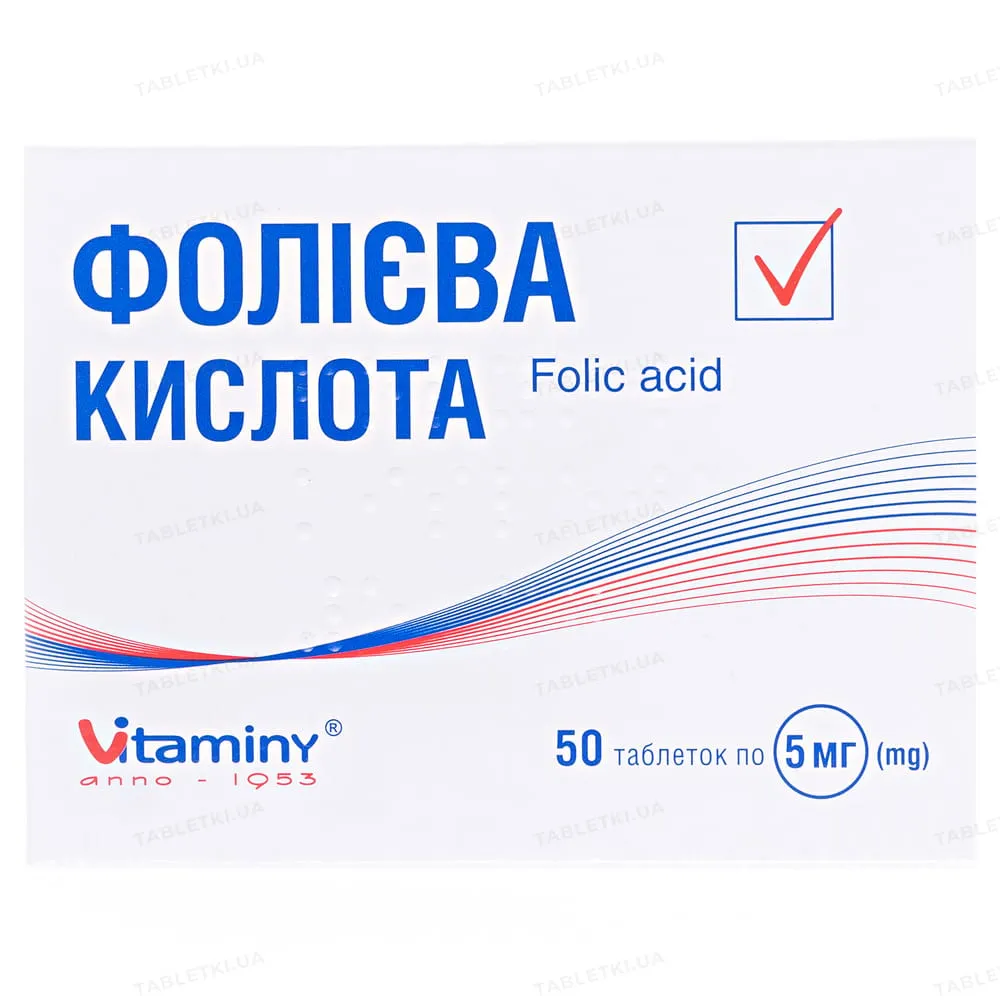
Table of Contents
INSTRUCTION FOR MEDICAL USE OF THE MEDICINAL PRODUCT FOLIC ACID
Composition:
Active substance: folic acid;
1 tablet contains folic acid equivalent to 100% anhydrous substance 1 mg or
5 mg;
Excipients: lactose monohydrate, microcrystalline cellulose, pregelatinized starch, magnesium stearate.
Pharmaceutical form. Tablets.
Main physicochemical properties:
tablets of 1 mg dosage – single-layer, round-shaped tablets, from light yellow to yellow in color, with flat upper and lower surfaces and beveled edges. Slight specks on the tablet surface are permissible. Under magnification, a relatively homogeneous structure is visible at the break;
tablets of 5 mg dosage – single-layer, round-shaped tablets, from yellow to dark yellow in color, with flat upper and lower surfaces and beveled edges. Slight specks on the tablet surface are permissible. Under magnification, a relatively homogeneous structure is visible at the break.
Pharmacotherapeutic group. Folic acid and its derivatives. Folic acid.
ATC code B03B B01.
Pharmacological Properties.
Pharmacodynamics.
After administration of the medicinal product, folic acid is reduced to tetrahydrofolate, which functions as a coenzyme involved in various metabolic processes. It is necessary for the normal maturation of megaloblasts and formation of normoblasts. It stimulates erythropoiesis, participates in the synthesis of amino acids (including methionine, serine, glycine, and histidine), nucleic acids, purines, and pyrimidines, and is involved in choline metabolism. It provides protective effects against teratogenic factors. In addition, it promotes normal maturation and functioning of the placenta.
Folic acid plays an important role in the maturation process of spermatozoa and can be used for the treatment of male infertility.
In case of folic acid deficiency, megaloblastic hematopoiesis develops; in pregnant women, this may lead to congenital malformations in the fetus (neural tube defects, hydrocephalus). The most significant consequence of folic acid deficiency is reduced capacity for tissue repair.
Pharmacokinetics.
Folic acid is well and completely absorbed from the gastrointestinal tract, primarily in the duodenum and small intestine. It is evenly distributed throughout all tissues and selectively concentrates in cerebrospinal fluid. The highest plasma concentration is reached within 30 to 60 minutes after oral administration.
It is metabolized in plasma and liver to 5-methyltetrahydrofolate, the active substance, which binds to glutamic acid and forms a coenzyme. Approximately 50% of the total body stores of folic acid are stored in the liver. About 70% is bound to plasma proteins. It is excreted in urine via glomerular filtration. After administration of a 5 mg dose, folic acid is eliminated in urine within 5 hours.
Clinical characteristics.
Indications.
- Treatment and prevention of anemias associated with folate deficiency: macrocytic anemia and leukopenia caused by drugs and ionizing radiation; megaloblastic anemia, post-resection anemia, sideroblastic anemia in elderly patients; anemias in inflammatory bowel diseases (Crohn's disease, ulcerative colitis), malabsorption syndrome (gluten-sensitive enteropathy or celiac disease), sprue;
- Prevention of congenital fetal abnormalities (neural tube defects: hydrocephalus, encephalocele, "cleft palate", "harelip") in women planning pregnancy who are at risk;
- Long-term treatment with folate antagonists (methotrexate, sulfamethoxazole/trimethoprim combination), anticonvulsant drugs (phenytoin, primidone, phenobarbital);
- Folate deficiency associated with unbalanced or inadequate nutrition;
- Treatment of male infertility due to impaired spermatogenesis (oligospermia);
- Polyneuritis and polyneuropathies, including those of alcoholic etiology.
Contraindications.
Hypersensitivity to folic acid or to any of the excipients, malignant neoplasms, malignant anemias, untreated cobalamin deficiency.
Interaction with other medicinal products and other forms of interaction.
Folic acid may reduce plasma concentrations of phenobarbital, phenytoin, and primidone, thereby increasing the risk of epileptic seizures. Chloramphenicol and cotrimoxazole may affect folate metabolism. Sulfasalazine may reduce the absorption of folic acid. Folic acid may influence the toxic and therapeutic effects of methotrexate. Antibacterial agents, cycloserine, and glutethimide may affect folate metabolism. Ethanol and acetylsalicylic acid may increase the elimination of folic acid. When folic acid is administered concomitantly with cholestyramine, reduced or altered absorption may occur. Therefore, the medicinal product should be taken 1 hour before or 4–6 hours after cholestyramine.
Folates enhance the efficacy of lithium. Nitrous oxide may cause acute folic acid deficiency. Avoid simultaneous combination with fluorouracil. Antacid preparations containing aluminum or magnesium may reduce the absorption of folic acid; therefore, patients should be advised to take antacids 2 hours after administration of folic acid. Folic acid may reduce intestinal zinc absorption. Folic acid deficiency may be induced by drugs such as oral contraceptives, antituberculosis agents, alcohol, folate antagonists (e.g., pyrimethamine, triamterene, trimethoprim, sulfonamides), anticonvulsants, chloramphenicol, cytostatics, and analgesics.
The medicinal product must not be used together with mineral acids, alkaline substances, or reducing agents, as inactivation of folic acid occurs.
Special precautions for use.
The medicinal product should be prescribed with caution to patients with anemias of unknown etiology, since folic acid may interfere with the diagnosis of pernicious anemia by improving hematological manifestations of the disease, while allowing neurological complications to progress. In cases of pernicious anemia, the drug must be used only in combination with cyanocobalamin, as folic acid, although stimulating hematopoiesis, does not prevent the development of neurological complications (such as funicular myelosis); in sprue – in combination with ascorbic acid, cyanocobalamin, and with conduction of hematotherapy.
Prolonged use of folic acid, especially in high doses, is not recommended due to the risk of decreasing cyanocobalamin concentration in blood.
Systematic monitoring of blood status is required during treatment with folic acid.
The tablets contain lactose and therefore should not be used in patients with rare hereditary galactose intolerance, severe lactase deficiency, or glucose-galactose malabsorption.
In elderly patients, a cobalamin absorption test should be performed prior to initiating long-term therapy.
Use during pregnancy or breastfeeding.
This medicinal product is not intended for healthy pregnant women. The drug is prescribed to pregnant women with folic acid deficiency and to women at risk who are planning pregnancy, for prevention of fetal congenital malformations: neural tube defects (hydrocephalus, encephalocele, cleft palate, cleft lip).
The drug may be used during breastfeeding at recommended doses.
Folic acid passes into breast milk.
Deficiency of folic acid or disturbances in folic acid metabolism are associated with the occurrence of congenital defects and certain neural tube defects. Interference with folic acid metabolism or folic acid deficiency caused by certain medicinal products (e.g., anticonvulsants, antineoplastic agents) in early pregnancy may lead to congenital abnormalities.
Lack of the vitamin or its metabolites may also contribute to spontaneous abortion and intrauterine growth retardation.
Ability to influence reaction rate when driving or operating machinery.
When used appropriately, folic acid does not affect the ability to drive or operate machinery.
Administration and Dosage
The medicinal product should be taken orally.
For therapeutic purposes, adults and breastfeeding women should be prescribed up to 5 mg per day. The treatment course lasts 20–30 days. It is recommended to perform 2–3 courses with a one-month interval between them. Long-term use of the drug is recommended to be combined with vitamin B12 (cyanocobalamin) supplementation.
Women planning pregnancy and at risk of having a child with neural tube defects should take 5 mg daily for 4 weeks prior to conception and continue for the first 3 months of pregnancy for preventive purposes.
For prevention of folic acid deficiency associated with unbalanced or inadequate nutrition: 1–5 mg per day. The treatment course is 20–30 days.
One month after completing a course, treatment should be repeated.
In megaloblastic anemia, 5 mg of folic acid per day should be administered for 4 months.
Patients with sprue, macrocytic anemia, malabsorption, inflammatory bowel diseases, or celiac disease are recommended to take 5–15 mg per day.
For treatment of male infertility due to impaired spermatogenesis (oligospermia), a dose of 5 mg (1 tablet) per day is recommended. The duration of treatment should be determined individually by the physician.
Children
Do not use in children.
Overdose
No cases of overdose have been reported. Administration in very large doses is not expected to harm the patient.
Overdose of folic acid may mask vitamin B12 deficiency.
Prolonged and significant exceeding of recommended doses may lead to dangerous accumulation of folacin crystals, resulting in body intoxication and increased adverse effects.
Treatment: discontinue the drug, symptomatic therapy.
Adverse reactions.
The medicinal product is well tolerated.
Gastrointestinal disorders: anorexia, nausea, vomiting, bloating, flatulence, bitter taste in the mouth.
Immune system disorders: hypersensitivity reactions, including erythema, skin rash, pruritus, urticaria, dyspnea due to bronchospasm, arterial hypotension, anaphylactic reactions, including shock.
Central nervous system disorders: chills, sleep disturbances, seizures.
Urinary system disorders: hypertrophy of epithelial cells in renal tubules and impairment of their function.
Shelf life. 3 years.
Storage conditions.
Store in the original packaging at a temperature not exceeding 25 °C. Keep out of reach of children.
Packaging.
50 tablets in a container; 1 container in a carton.
10 tablets in a blister pack; 5 blisters in a carton.
Prescription status. Prescription only.
Manufacturer.
PJSC "Tekhnolohiya".
Manufacturer's address and place of business.
8 Stara Prorizna Street, City of Uman, Cherkasy Region, 20300, Ukraine.