Flеbodia 600
Ukraine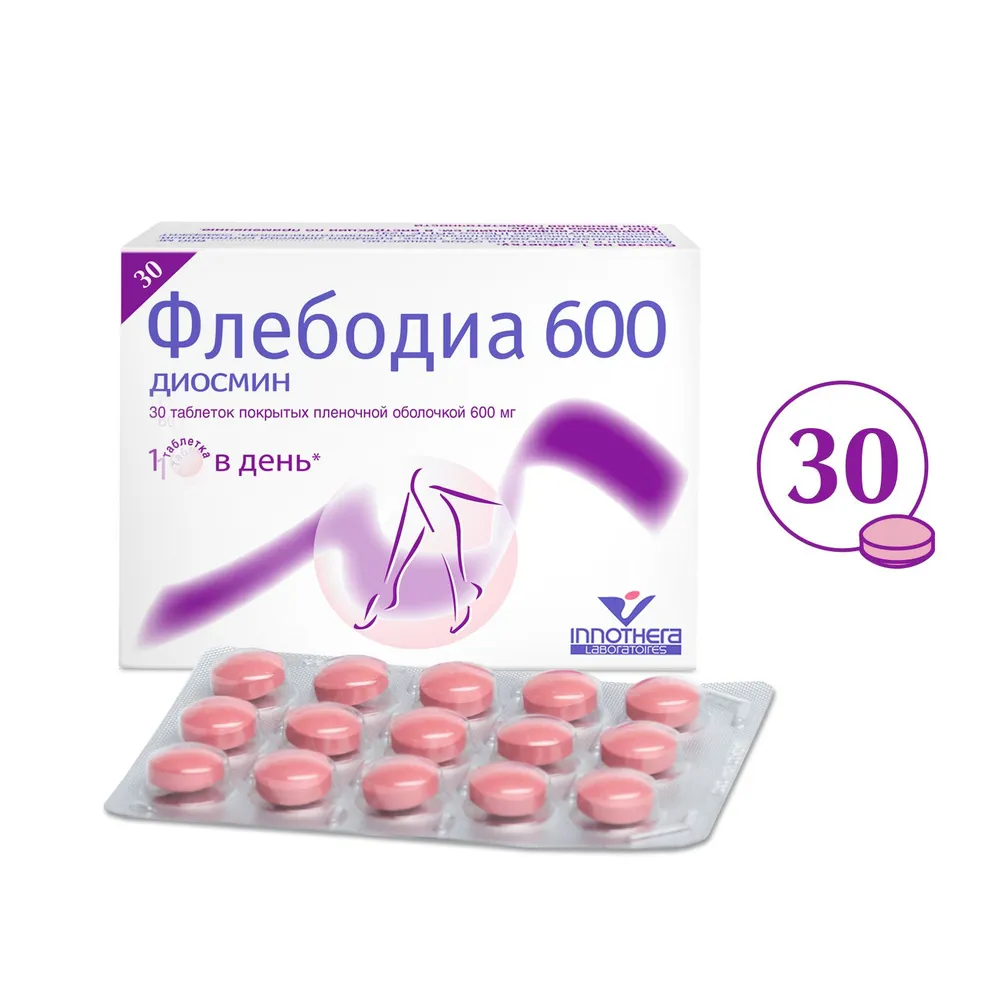
Table of Contents
INSTRUCTIONS FOR MEDICAL USE OF THE MEDICINAL PRODUCT FLEBODIA 600 (PHLEBODIA 600)
Composition:
Active ingredient: diosmin (diosmine);
1 tablet contains diosmin equivalent to 600 mg of pure anhydrous diosmin;
Excipients: microcrystalline cellulose, talc, stearic acid, colloidal anhydrous hydrophobic silicon dioxide, coating (hypromellose, microcrystalline cellulose, macrogol stearate 400), Opaglos 6000 (palm wax, white beeswax, gum lac, anhydrous ethanol), colorant Sepisperse (carmoisine A (E 124), propylene glycol, hypromellose, titanium dioxide (E 171), red iron oxide (E 172), black iron oxide (E 172)).
Pharmaceutical form. Film-coated tablets.
Main physicochemical properties: film-coated tablets, pink in color.
Pharmacotherapeutic group. Angioprotectors. Capillary-stabilizing agents. Bioflavonoids. ATC code C05CA03.
Pharmacological Properties
Pharmacodynamics
A venotonic and angioprotective agent that improves venous return, increases vascular resistance, reduces vascular permeability, and exerts anti-edematous and anti-inflammatory effects.
Flébodia 600 enhances the tone of small-caliber veins, thereby improving venous return and lymphatic drainage. The increase in venous tone is due to enhanced tropism of wall-bound norepinephrine to venous myocytes (increased synthesis and/or release of norepinephrine; inhibition of catechol-O-methyltransferase activity; moderate reduction in phosphodiesterase activity). The vasoconstrictive effect of the drug affects only the venous and lymphatic systems. The drug does not affect arterial tone. In animals, Flébodia 600 improves tissue trophism and microcirculation and reduces tissue edema by decreasing capillary permeability and increasing their resistance. The drug exerts moderate anti-aggregatory and anti-inflammatory effects. In humans, the anti-inflammatory effect is mediated via anti-complement activity, inhibition of peroxide anion release, and reduction in leukotriene production.
Pharmacodynamic studies in humans have demonstrated the following properties of the drug.
Venotonic properties demonstrated in clinical pharmacology:
- Enhances the vasoconstrictive effects of adrenaline, noradrenaline, and serotonin on superficial veins of the upper limbs or on isolated subcutaneous veins.
- Increases venous tone, confirmed by measurement of venous capacity using strain-gauge plethysmography; reduces venous stasis.
- The venotonic effect is dose-dependent.
- Reduces mean venous pressure (in both superficial and deep venous systems), as demonstrated in a double-blind study compared to placebo under Doppler monitoring.
- Increases systolic and diastolic arterial pressure in cases of postoperative orthostatic hypotension.
- Demonstrates efficacy after venectomy.
Angioprotective properties:
- Increased capillary resistance is dose-dependent.
Pharmacokinetics
Absorption
After oral administration, diosmin is metabolized by intestinal bacteria to form diosmetin. Diosmetin is then absorbed and detected in the blood compartment as glucuronide and sulfate conjugates. The main metabolite of diosmin has been identified as diosmetin-3-O-glucuronide.
Maximum plasma concentration is reached 12–15 hours after drug administration.
Distribution
Pharmacokinetic studies using C14-labeled diosmin in animals have shown that the drug is rapidly absorbed from the gastrointestinal tract. Diosmin is evenly distributed throughout all layers of the venous wall, predominantly in the cavernous veins and subcutaneous veins of the lower limbs, and to a lesser extent in the kidneys, liver, and lungs. In other tissues, the drug is detected in negligible amounts. Selective accumulation of diosmin in venous vessel walls reaches its maximum at 9 hours after administration and persists for up to 96 hours thereafter.
Elimination
In animals, the drug is excreted in urine (79%), and via enterohepatic circulation in feces (11%) and bile (2.4%).
In humans, diosmin is excreted in urine and is detected as diosmetin-3-O-glucuronide.
Clinical characteristics.
Indications.
- Complex treatment of functional conditions associated with increased capillary permeability.
- Treatment of symptoms of venous and lymphatic insufficiency, including: sensation of heaviness in the legs, edema, pain, and trophic disorders.
- Treatment of functional symptoms of acute hemorrhoids.
Contraindications.
Hypersensitivity to the active substance or to any of the excipients of the medicinal product.
Interaction with other medicinal products and other forms of interaction.
Diosmin may enhance the vasoconstrictive effect of adrenaline and noradrenaline.
Special precautions for use
Chronic venous and lymphatic insufficiency. This medicinal product is most effective when a healthy lifestyle is maintained. Prolonged exposure to sunlight and overheating, prolonged standing or sitting, and lifting excessive weight should be avoided. Walking and, in some cases, wearing medical support stockings promote normalization of microcirculation and improve blood circulation.
Acute hemorrhoids. The use of this drug does not replace specific treatment of other proctological diseases and does not interfere with the treatment of other conditions.
Treatment should be carried out in short courses.
If symptoms persist after a short course of treatment, a proctological examination should be performed and the ongoing therapy reviewed.
This medicinal product contains cochineal red A (E 124), which may cause allergic reactions.
Use during pregnancy or breastfeeding
Animal studies have not shown any teratogenic effects of diosmin on the fetus. In clinical practice, there have been no reports of adverse effects associated with the use of this drug in pregnant women. Nevertheless, it should be used with caution during pregnancy. Consult your doctor before use. As a precautionary measure, it is advisable to avoid using this medicinal product during pregnancy.
Due to lack of data on the passage of the drug into breast milk, use of this drug during breastfeeding should be avoided. The decision whether to discontinue breastfeeding or to discontinue/decline treatment with the medicinal product Flebodia 600 should be made by considering the benefits of breastfeeding for the child and the benefits of therapy for the woman.
Ability to influence reaction speed when driving vehicles or operating machinery
No studies on the effect of diosmin on the ability to drive vehicles or operate machinery have been conducted. Nevertheless, based on the safety profile of diosmin in various countries worldwide, the medicinal product Flebodia 600 has little or no effect on reaction speed when driving vehicles or operating machinery.
Method of administration and dosage.
For oral use.
Dosage
- In venous and lymphatic insufficiency: 1 tablet daily taken with food. The duration of treatment is determined by the physician depending on the course of the disease. The first symptoms disappear after the first month of treatment. Treatment may last from 1 to 6 months. The average duration of treatment is 2–3 months.
- In acute hemorrhoids: 2–3 tablets daily taken with food for 7 days. If symptoms of hemorrhoids persist after treatment, consult a physician for adjustment of therapy. Maximum daily dose – 1800 mg (3 tablets).
Children.
The safety and efficacy of the medicinal product Flebodia 600 in children and adolescents (under 18 years of age) have not been established; therefore, the drug is not used in pediatric patients.
Overdose.
No cases of overdose have been reported.
Adverse reactions.
Gastrointestinal disorders:
Common (≥ 1/100 to < 1/10): abdominal pain;
Uncommon (≥ 1/1000 to < 1/100): bloating, diarrhea, dyspepsia, nausea;
Rare (≥ 1/10000 to < 1/1000): vomiting.
In individual cases, gastrointestinal disorders rarely lead to discontinuation of treatment.
To reduce the frequency of adverse reactions, the medicinal product should be taken with food.
Skin and subcutaneous tissue disorders:
Uncommon (≥ 1/1000 to < 1/100): allergic reactions such as rash, pruritus, urticaria, angioneurotic edema.
Reporting of suspected adverse reactions
It is important to report suspected adverse reactions after the medicinal product has received marketing authorization. This enables ongoing monitoring of the benefit-risk balance of the medicinal product. Healthcare professionals should report any suspected adverse reactions through the national pharmacovigilance reporting system.
Shelf life. 5 years. Do not use the medicinal product after the expiry date stated on the packaging.
Storage conditions.
Store in the original packaging at a temperature not exceeding 25 °C, in a place inaccessible to children.
Packaging.
15 tablets in a blister, 1 or 2 blisters per cardboard box.
Authorization category. Over-the-counter (without prescription).
Manufacturer.
Innothera Chouzy, France.
Manufacturer's address.
Rue Rene Chantereau, Chouzy-sur-Cisse, Valloire-sur-Cisse, 41150, France.
Marketing Authorization Holder.
Laboratoire Innotech International, France.
Address of the Marketing Authorization Holder.
22 avenue Aristide Briand, 94110 Arcueil, France.