Pharsil
Ukraine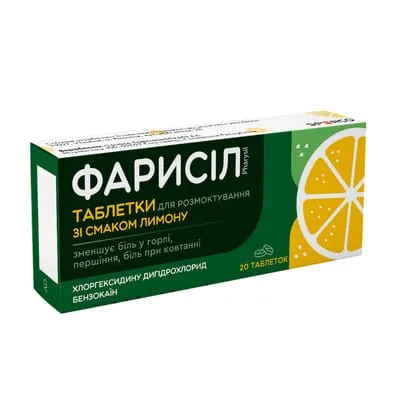
Table of Contents
- INSTRUCTIONS FOR MEDICAL USE OF THE MEDICINAL PRODUCT PHARYSIL (PHARYSIL)
- Composition:
- Pharmacological properties.
- Clinical characteristics.
- Special precautions for use.
- Dosage and Administration
- Side effects.
- Composition:
- Pharmacological properties.
- Clinical characteristics.
- Special precautions for use.
- Dosage and Administration.
- Side effects.
INSTRUCTIONS FOR MEDICAL USE OF THE MEDICINAL PRODUCT PHARYSIL (PHARYSIL)
Composition:
Active substances: chlorhexidine, benzocaine;
1 tablet contains 5 mg of chlorhexidine dihydrochloride, 5 mg of benzocaine;
Excipients: mannitol (E 421), microcrystalline cellulose, povidone, magnesium stearate, sodium cyclamate, sodium saccharin, orange flavor or lemon flavor, menthol flavor.
Pharmaceutical form. Effervescent tablets with orange or lemon flavor.
Main physicochemical properties: yellowish-white tablets, round, with beveled edges and a score line on one side.
Pharmacotherapeutic group. Preparations used in throat diseases. Antiseptics.
ATC code R02A A.
Pharmacological properties.
Pharmacodynamics.
Pharycyl is a combined antiseptic preparation for local use in infectious and inflammatory diseases of the oral cavity and throat. The effect of the preparation is provided by the action of its components.
Chlorhexidine is an antiseptic agent whose action is due to its surface cationic activity, leading to disruption of microbial cell membranes. The preparation is active against many bacteria, fungi, and viruses, resulting in a microbicidal effect.
Benzocaine, included in the composition of the preparation, exerts a local anesthetic (analgesic) effect. It reduces throat pain, irritation, and pain during swallowing.
Pharmacokinetics.
Approximately 30% of chlorhexidine is absorbed in the oral cavity and is excreted with saliva over 24 hours, significantly prolonging its effect. Benzocaine is almost not absorbed in the oral cavity.
Clinical characteristics.
Indications.
Local treatment of acute infectious and inflammatory diseases of the oral cavity and throat.
Contraindications.
Hypersensitivity to chlorhexidine, benzocaine, or other components of the drug, or to other agents with anesthetic activity. Phenylketonuria.
Interaction with other medicinal products and other forms of interaction.
The drug should not be used with other local antiseptics. It should be noted that benzocaine metabolites significantly reduce the antibacterial effect of sulfonamide derivatives.
Concomitant use with iodine-containing products is not recommended. Due to the presence of benzocaine, the drug interacts with cholinesterase inhibitors, which suppress the metabolism of local anesthetics, thereby increasing the risk of systemic toxicity.
Interaction with diagnostic tests.
An interaction may occur with diagnostic tests for pancreatic function that use bentiromide. Test results are invalid because benzocaine is metabolized to arylamines and also increases the amount of para-aminobenzoic acid (PABA). It is recommended to discontinue treatment at least 3 days before the test.
Special precautions for use.
Patients who are intolerant of ester-type anesthetics (e.g., procaine) or parabens may also be intolerant of benzocaine. The product should be used with caution in children, elderly patients, and severely ill patients, as they are more sensitive to benzocaine, and overdose may lead to methemoglobinemia. The tablets should not be chewed or swallowed, as the action of the drug is local and can only occur upon direct contact with the affected area. When using local anesthetics, including benzocaine, there is an increased risk of systemic toxicity in acute illnesses. Patients with hypersensitivity to ester-type local anesthetics (particularly para-aminobenzoic acid (PABA) derivatives, parabens, or paraphenylenediamine (hair dyes)) may also exhibit increased sensitivity to benzocaine.
The benefit-risk ratio should be assessed in the following situations: severe mucosal injuries (increased absorption of anesthetics); on filling surfaces or uneven edges, irreversible staining may occur due to chlorhexidine.
The product contains benzocaine, which may cause a positive doping test result in athletes.
In patients with periodontitis, chlorhexidine may lead to increased dental calculus formation.
Proper oral hygiene should be maintained using anti-calculus toothpaste to prevent calculus buildup and tooth discoloration caused by chlorhexidine.
Use during pregnancy or breastfeeding.
Although chlorhexidine and benzocaine do not exhibit embryotoxic or fetotoxic effects, clinical data on use during pregnancy are insufficient. Therefore, the need for administration during pregnancy should be determined by a physician, taking into account the expected benefit for the woman and the potential risk for the fetus/child. It is unknown whether the active components of the drug are excreted in breast milk.
Ability to influence reaction rate while driving or operating machinery.
No effect.
Dosage and Administration
One tablet should be slowly dissolved in the mouth.
For adults and children aged 12 years and older: take 1 tablet every 2–3 hours, but not more than 8 tablets per day.
The duration of treatment depends on the course of the disease and usually lasts from 3 to 7 days. However, if symptoms persist or worsen after 2 days of starting treatment, medical advice should be sought.
Children
Pharycyl is indicated for children aged 12 years and older.
Overdose
Due to the low systemic absorption of the drug, overdose is unlikely. Theoretically, chlorhexidine overdose may be associated with symptoms of alcohol intoxication (slurred speech, unsteady gait), particularly in children. Overdose of benzocaine may cause symptoms related to the central nervous system (dizziness, double vision, excitement, seizures, depression).
Treatment is symptomatic. Gastric lavage and administration of sorbents may be performed. In case of methemoglobinemia, methylene blue should be administered.
Side effects.
Respiratory system: Frequency unknown – nasal congestion.
Gastrointestinal tract: Frequency unknown – taste disturbances and irritation of the oral mucosa; with prolonged use of the drug, discoloration of teeth and tongue may occur, which gradually disappears after discontinuation of the drug.
Allergic reactions: Frequency unknown – itching, urticaria, exanthema, angioneurotic edema.
Skin and subcutaneous tissue: Frequency unknown – skin rashes, contact dermatitis.
With chronic use, possible side effects include edema, arterial hypertension, dental plaque, parotitis, gastric mucosa irritation, diarrhea, pain in the tongue and oral mucosa, irritation or inflammation of the oral mucosa and tongue, as well as burning, itching, swelling, or redness of the oral mucosa or skin around the mouth.
Reporting suspected adverse reactions.
Reporting of suspected adverse reactions after drug registration is of great importance. It enables ongoing monitoring of the benefit-risk balance of the drug. Medical and pharmaceutical professionals, as well as patients or their legal representatives, should report all suspected adverse reactions and lack of drug efficacy via the Automated Pharmacovigilance Information System at the following link: https://aisf.dec.gov.ua.
Shelf life.
3 years.
Do not use the drug after the expiry date stated on the packaging.
Storage conditions.
Store at a temperature not exceeding 30 °C. Keep out of reach and sight of children.
Packaging.
10 tablets per blister. 2 blisters per cardboard box.
Availability.
Over-the-counter.
Manufacturer.
Laboratorios Alcalá Pharma, S.L.
Manufacturer's location and address of its business site.
Ctra. Madrid, 82, Alcalá de Henares, 28802 Madrid, Spain.
Marketing Authorization Holder.
SPERCO INTERNATIONAL LIMITED.
Holder's location and address of its business site.
Spiru Kiprianou, 57, BIBLOSERV BUSINESS CENTER, 2nd floor, 6051, Larnaca, Cyprus.
INSTRUCTION
for medical use of medicinal product
PHARYSIL
(PHARYSIL)
Composition:
Active substances: chlorhexidine, benzocaine;
1 tablet contains chlorhexidine dihydrochloride 5 mg, benzocaine 5 mg;
Excipients: mannite (E 421), microcrystalline cellulose, povidone, magnesium stearate, sodium cyclamate, sodium saccharin, orange flavor or lemon flavor, menthol flavor.
Pharmaceutical form. Effervescent tablets with orange or lemon flavor.
Main physicochemical properties: yellowish-white tablets, round, with beveled edges and a score line on one side.
Pharmacotherapeutic group. Preparations used for throat disorders. Antiseptics.
ATC code R02A A.
Pharmacological properties.
Pharmacodynamics.
Pharicil is a combined antiseptic preparation for local use in infectious and inflammatory diseases of the oral cavity and throat. The effect of the preparation is provided by the action of its components.
Chlorhexidine is an antiseptic agent whose action is due to its surface cationic activity, leading to disruption of microbial membrane integrity. The preparation is active against many bacteria, fungi, and viruses, providing a microbicidal effect.
Benzocaine, one of the components of the preparation, exerts a local anesthetic (analgesic) effect. It reduces throat pain, irritation, and pain during swallowing.
Pharmacokinetics.
Approximately 30% of chlorhexidine is absorbed in the oral cavity and is subsequently excreted with saliva over 24 hours, significantly prolonging its effect. Benzocaine is almost not absorbed in the oral cavity.
Clinical characteristics.
Indications.
Local treatment of acute infectious-inflammatory diseases of the oral cavity and throat.
Contraindications.
Hypersensitivity to chlorhexidine, benzocaine, or other components of the drug, or to other agents with anesthetic activity. Phenylketonuria.
Interaction with other medicinal products and other forms of interaction.
The drug should not be used with other local antiseptics. It should be noted that benzocaine metabolites significantly reduce the antibacterial effect of sulfanilamide derivatives.
Concomitant use with drugs containing iodine is not recommended. Due to the presence of benzocaine, the drug interacts with cholinesterase inhibitors, which suppress the metabolism of local anesthetics, thus increasing the risk of systemic toxicity.
Interaction with diagnostic tests.
Interaction may occur with diagnostic tests used to assess pancreatic function that involve the use of bentiromide. Test results may be invalid because benzocaine is metabolized to arylamines and also increases the levels of para-aminobenzoic acid (PABA). It is recommended to discontinue treatment at least 3 days prior to the test.
Special precautions for use.
Patients who are intolerant of ester-type anesthetics (e.g., procaine) or parabens may also be intolerant of benzocaine. The product should be used with caution in children, elderly patients, and severely ill patients, as they are more sensitive to benzocaine, and overdose may lead to methemoglobinemia. The tablets should not be chewed or swallowed, as the drug acts locally and efficacy is possible only upon direct contact with the affected area. When using local anesthetics, including benzocaine, there is an increased risk of systemic toxicity in acute illnesses. Patients with hypersensitivity to ester-type local anesthetics (particularly para-aminobenzoic acid (PABA) derivatives, parabens, or paraphenylenediamine (hair dyes)) may also exhibit increased sensitivity to benzocaine.
The benefit-risk ratio should be carefully evaluated in the following situations: severe mucosal injuries (increased absorption of anesthetics); potential for irreversible staining from chlorhexidine on filling surfaces or irregular edges.
The product contains benzocaine, which may cause a positive doping test result in athletes.
In patients with periodontitis, chlorhexidine may promote increased dental calculus formation.
Proper oral hygiene should be maintained using anti-calculus toothpaste to prevent calculus accumulation and tooth discoloration due to chlorhexidine.
Use during pregnancy or breastfeeding.
Although chlorhexidine and benzocaine have not shown embryotoxic or fetotoxic effects, clinical data on use during pregnancy are insufficient. Therefore, the decision to prescribe the drug to pregnant women should be made by a physician, weighing the expected benefit to the woman against the potential risk to the fetus/child. It is unknown whether the active components of the drug are excreted in breast milk.
Ability to influence reaction speed when driving or operating machinery.
No effect.
Dosage and Administration.
One tablet should be slowly dissolved in the oral cavity.
For adults and children aged 12 years and older: take 1 tablet every 2–3 hours, but no more than 8 tablets per day.
The duration of treatment depends on the course of the disease and usually lasts from 3 to 7 days. However, if symptoms persist or worsen after 2 days of starting the medication, consult a physician.
Children.
Pharycyl may be used in children aged 12 years and older.
Overdose.
Due to the low systemic absorption of the drug, overdose is unlikely. Theoretically, chlorhexidine overdose may cause symptoms of alcohol intoxication (slurred speech, unsteady gait), particularly in children. Overdose of benzocaine may lead to symptoms related to the central nervous system (dizziness, double vision, excitement, seizures, depression).
Treatment is symptomatic, including gastric lavage and use of sorbents. In case of methemoglobinemia, methylene blue should be administered.
Side effects.
Respiratory system: Frequency unknown – nasal congestion.
Gastrointestinal tract: Frequency unknown – altered taste sensations and irritation of the oral mucosa; with prolonged use of the medication, discoloration of teeth and tongue may occur, which gradually disappears after discontinuation of the medication.
Allergic reactions: Frequency unknown – itching, urticaria, exanthema, angioneurotic edema.
Skin and subcutaneous tissue: Frequency unknown – skin rashes, contact dermatitis.
With chronic use, possible side effects include edema, arterial hypertension, dental plaque, parotitis, gastric mucosa irritation, diarrhea, tongue pain, oral mucosal pain, irritation or inflammation of the oral mucosa and tongue, as well as burning, itching, swelling, or redness of the oral mucosa or skin around the mouth.
Reporting suspected adverse reactions.
Reporting suspected adverse reactions after marketing authorization is important. It allows ongoing monitoring of the benefit-risk balance of the medicinal product. Healthcare and pharmaceutical professionals, as well as patients or their legal representatives, are encouraged to report all suspected adverse reactions and lack of efficacy through the Automated Pharmacovigilance Information System at: https://aisf.dec.gov.ua.
Shelf life.
3 years.
Do not use the medicinal product after the expiry date stated on the packaging.
Storage conditions.
Store below 30 °C. Keep out of reach and sight of children.
Packaging.
10 tablets in a blister. 2 blisters in a cardboard box.
Availability.
Over-the-counter.
Manufacturer.
Saneca Pharmaceuticals a.s.
Manufacturer's address.
Nitrianska 100, 92027 Glogovec, Slovak Republic.
Marketing Authorization Holder.
SPERKO INTERNATIONAL LIMITED.
Address of the Marketing Authorization Holder.
Spiru Kyprianou, 57, BIBLESERV BUSINESS CENTER, 2nd floor, 6051, Larnaca, Cyprus.