Farestim
Ukraine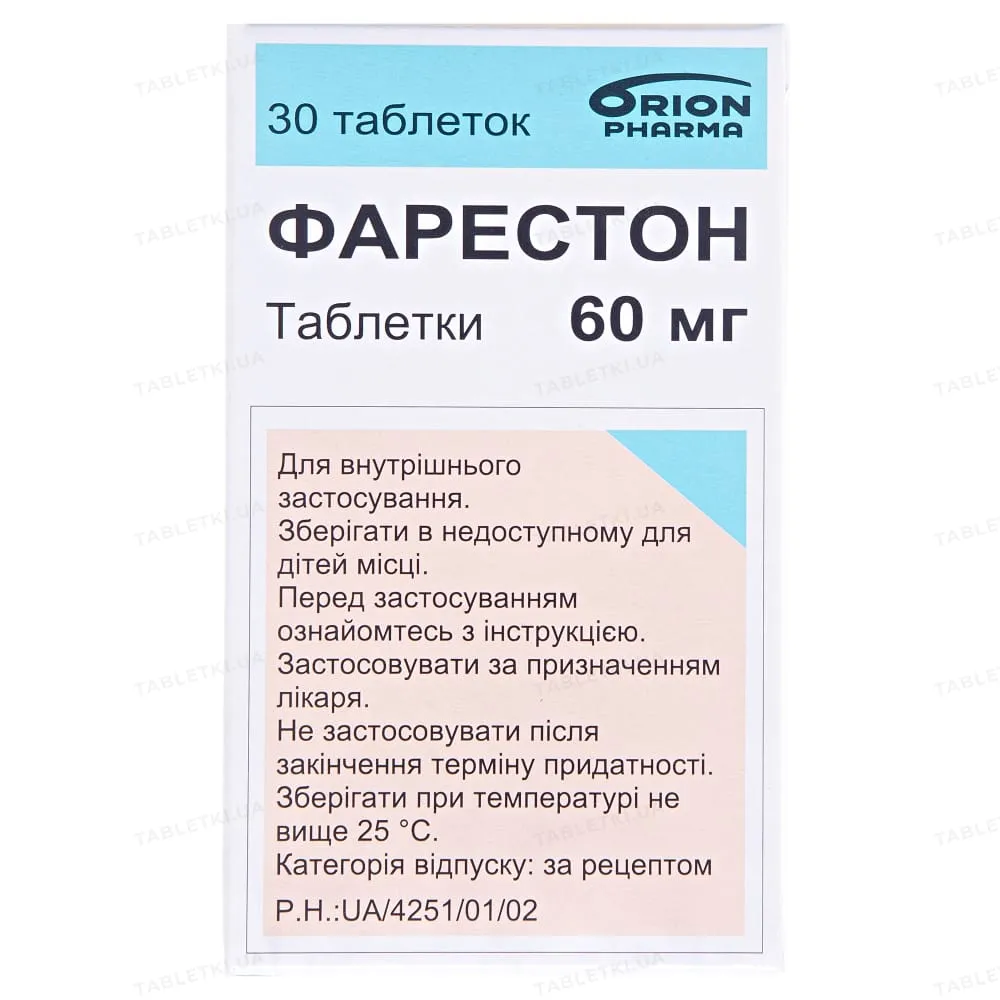
Table of Contents
INSTRUCTIONS FOR MEDICAL USE OF THE MEDICINAL PRODUCT FARESTON (FARESTON)
Composition:
Active substance: 1 tablet contains toremifene citrate equivalent to 20 mg or 60 mg of toremifene.
Excipients: maize starch, lactose monohydrate, povidone, sodium starch glycolate (type A), magnesium stearate, microcrystalline cellulose, colloidal anhydrous silicon dioxide.
Pharmaceutical form. Tablets.
Main physicochemical properties:
20 mg tablets: white or almost white, round, flat tablets with bevelled edges, marked "TO 20" on one side;
60 mg tablets: white or almost white, round, flat tablets with bevelled edges, marked "TO 60" on one side.
Pharmacotherapeutic group. Anti-estrogens.
ATC code: L02B A02.
Pharmacological properties.
Pharmacodynamics.
Toremifene is a nonsteroidal derivative of triphenylethylene. Like other agents in this class (e.g., tamoxifen and clomiphene), toremifene binds to estrogen receptors and exerts estrogenic and/or antiestrogenic effects, depending on duration of treatment, gender, target organ, and other factors.
In postmenopausal patients with breast cancer treated with toremifene, a moderate reduction in serum cholesterol and LDL cholesterol has been observed.
Toremifene competitively binds to estrogen receptors and inhibits estrogen-mediated stimulation of DNA synthesis and cellular replication. In experimental cancer models, toremifene has demonstrated an estrogen-independent antitumor effect when administered at high doses.
The antitumor effect of toremifene in breast cancer is primarily mediated by its antiestrogenic action; however, other mechanisms (such as changes in oncogene expression, growth factor secretion, induction of apoptosis, and effects on cell cycle kinetics) cannot be excluded from contributing to the antitumor effect.
Pharmacokinetics.
Absorption. Toremifene is rapidly absorbed after oral administration. Peak plasma concentrations are reached on average within 3 hours (range: 2–5 hours). Food does not affect the extent of absorption but may delay the time to peak concentration by 1.5–2 hours. These food-related changes are not clinically significant.
Distribution. Plasma concentration is described by a biexponential curve. The half-life in the first phase (distribution) is 4 hours (range: 2–12 hours), and in the second phase (elimination) is 5 days (range: 2–10 days). Systemic clearance (CL) and volume of distribution (V) have not been determined due to the lack of intravenous infusion studies. Over 99.5% of toremifene is bound to plasma proteins (mainly albumin). The pharmacokinetics of toremifene in plasma following oral doses ranging from 11 to 680 mg per day are linear. The mean steady-state plasma concentration of toremifene at the recommended dose of 60 mg per day is 0.9 (0.6–1.3) µg/mL.
Metabolism. Toremifene is extensively metabolized. The main metabolite in plasma is N-desmethyltoremifene, with a mean elimination half-life of 11 days (range: 4–20 days). This metabolite has a similar, though slightly less potent, antiestrogenic effect compared to toremifene. It is more than 99.9% bound to plasma proteins. Three other minor metabolites are detectable in plasma: deaminohydroxytoremifene, 4-hydroxytoremifene, and N,N-didesmethyltoremifene.
Elimination. Toremifene is primarily eliminated in the form of metabolites via feces. Enterohepatic recirculation may occur. More than 10% of the administered dose is excreted in urine as metabolites. Due to slow elimination, steady-state plasma concentrations are achieved within 4–6 weeks.
Clinical Characteristics.
Indications.
Treatment of hormone-dependent metastatic breast cancer in postmenopausal women as a first-line agent.
Fareston is not recommended for patients with estrogen receptor-negative tumors.
Contraindications.
Endometrial hyperplasia in medical history and severe hepatic impairment are contraindications for long-term use of toremifene.
Hypersensitivity to toremifene or to any of the excipients.
Changes in cardiac electrical conductivity, namely QT interval prolongation, have been observed during treatment with toremifene; therefore, the medicinal product is contraindicated in patients with:
- congenital or acquired QT interval prolongation;
- electrolyte imbalances, particularly uncorrected hypokalemia;
- clinically significant bradycardia;
- clinically significant heart failure with reduced left ventricular ejection fraction;
- symptomatic arrhythmias in medical history.
Toremifene is not recommended for concomitant use with drugs that prolong the QT interval.
Interaction with other medicinal products and other forms of interaction.
Additional QT-prolonging effect cannot be excluded when Fareston is used concomitantly with other medicinal products that may prolong the QT interval. This increases the risk of ventricular arrhythmias, including torsade de pointes/ventricular fibrillation. Therefore, concomitant use of Fareston with the following medicinal products is contraindicated:
- class IA antiarrhythmics (e.g., quinidine, hydroquinidine, disopyramide);
- class III antiarrhythmics (e.g., amiodarone, sotalol, dofetilide, ibutilide);
- neuroleptics (e.g., phenothiazines, pimozide, sertindole, haloperidol, sulpiride);
- certain antibacterial agents (e.g., moxifloxacin, intravenous (i.v.) erythromycin, pentamidine, antimalarials, particularly halofantrine);
- certain antihistamines (e.g., terfenadine, astemizole, mizolastine);
- others (cisapride, i.v. vincamine, bepridil, difemanel).
Concomitant use of drugs that reduce renal calcium excretion (e.g., thiazide diuretics) may lead to hypercalcemia.
Enzyme-inducing agents in the liver (e.g., phenobarbital, phenytoin, carbamazepine) may accelerate hepatic metabolism of toremifene and lead to reduced steady-state plasma concentrations of toremifene. In such cases, doubling the daily dose may be necessary.
Concomitant use of antiestrogens and warfarin-like anticoagulants may significantly increase bleeding time. Their concomitant use should be avoided.
Theoretically, certain drugs that inhibit the CYP3A enzyme system may slow down the metabolism of toremifene. These include antifungal agents – imidazole derivatives (ketoconazole) and other antifungal agents with similar activity (itraconazole, voriconazole, posaconazole), protease inhibitors (ritonavir, nelfinavir), and macrolides (clarithromycin, erythromycin, and telithromycin). This possibility should be taken into account when prescribing such drugs concomitantly (e.g., ketoconazole, erythromycin, troleandomycin).
Special precautions for use.
Before starting treatment, patients should undergo a gynecological examination. Particular attention should be paid to the condition of the endometrial mucosa. Subsequently, gynecological examinations should be repeated at least once a year. Patients with arterial hypertension, diabetes mellitus, a high body mass index (> 30), or those who have received long-term hormone replacement therapy are at increased risk of endometrial cancer and therefore require careful monitoring.
Cases of anemia, leukopenia, and thrombocytopenia have been reported. Red blood cells, white blood cells, or platelets should be monitored during treatment with the medicinal product Fareston.
Liver injury, including elevated liver enzymes (more than 10 times the upper limit of normal), hepatitis, and jaundice, has been reported during treatment with toremifene. Most of these cases occurred within the first months of treatment. The predominant pattern of liver injury was hepatocellular.
Toremifene is not recommended for the treatment of patients with a history of severe thromboembolic disorders.
In some patients, Fareston may cause dose-dependent prolongation of the QT interval.
Fareston should be used with caution in patients with proarrhythmic conditions (especially in elderly patients), such as myocardial ischemia or QT prolongation, which may increase the risk of ventricular arrhythmias (including flutter/fibrillation) and cardiac arrest. If symptoms suggestive of cardiac arrhythmia occur during treatment with Fareston, therapy should be discontinued and an ECG should be performed.
The drug should not be used if QTc interval > 500 ms.
Patients with decompensated heart failure or patients with severe angina pectoris require careful monitoring.
Since hypercalcemia may develop at the beginning of treatment in patients with bone metastases, these patients require careful monitoring.
There is no information available on the use of the drug in patients with unstable diabetes, heart failure, or severe general condition.
The product contains lactose (20 mg tablets – 19.0 mg/tablet, 60 mg tablets – 28.5 mg/tablet). The drug is contraindicated in patients with rare hereditary galactose intolerance, lactase deficiency, or glucose-galactose malabsorption.
Use during pregnancy or breastfeeding.
The medicinal product is recommended for use in postmenopausal patients.
Fareston should not be used during pregnancy or breastfeeding due to lack of information on its safety and efficacy. Animal studies have demonstrated reproductive toxicity. The potential risk to humans is unknown.
Ability to influence reaction rate while driving or operating machinery.
The drug generally does not affect reaction speed while driving or operating machinery. However, dizziness may occur in individual cases. In such cases, patients should refrain from driving or operating machinery.
Dosage and Administration.
The drug is intended for oral administration, independent of food intake.
The recommended dose is 60 mg once daily.
Renal impairment.
Dose adjustment is not required in patients with renal impairment.
Hepatic impairment.
Torsemide should be administered with caution in patients with hepatic impairment.
Children.
There is no information regarding use of the drug in children; therefore, its use in this patient population is not recommended.
Overdose.
Dizziness, headache, and vertigo may occur following administration of the drug at a dose of 680 mg per day. Prolongation of the QT interval, which may occur in overdose, should also be considered.
Treatment of overdose is symptomatic; no specific antidote is available.
Side effects.
The most commonly occurring side effects are hot flushes, increased sweating, uterine bleeding, vaginal discharge, increased fatigue, nausea, rash, itching, dizziness, and depression. These side effects are usually mild in severity and are caused by the antiestrogenic effect of toremifene.
The frequency of side effects is classified as follows: very common (≥1/10);
common (≥1/100, <1/10); uncommon (≥1/1000, <1/100); rare (≥1/10,000, <1/1000); very rare (<1/10,000); frequency not known (cannot be estimated from available data).
Benign and malignant neoplasms.
Very rare: endometrial cancer.
Blood and lymphatic system disorders.
Frequency not known: thrombocytopenia, anemia, leukopenia.
Metabolism and nutrition disorders.
Uncommon: loss of appetite.
Frequency not known: hypertriglyceridemia.
Psychiatric disorders.
Common: depression.
Uncommon: insomnia.
Nervous system disorders.
Common: dizziness.
Uncommon: headache.
Eye disorders.
Very rare: transient corneal opacity.
Ear and labyrinth disorders.
Rare: vertigo.
Vascular disorders.
Very common: hot flushes.
Uncommon: thromboembolic events.
Respiratory system disorders.
Uncommon: dyspnea.
Gastrointestinal disorders.
Common: nausea, vomiting.
Uncommon: constipation.
Hepatobiliary disorders.
Rare: increased transaminase levels.
Very rare: jaundice.
Frequency not known: hepatitis, hepatic steatosis.
Skin and subcutaneous tissue disorders.
Very common: increased sweating.
Common: rash, itching.
Very rare: alopecia.
Reproductive system and breast disorders.
Common: uterine bleeding, vaginal discharge.
Uncommon: endometrial hypertrophy.
Rare: endometrial polyps.
Very rare: endometrial hyperplasia.
General disorders.
Common: increased fatigue, edema.
Uncommon: weight gain.
Hypersensitivity reactions.
Thromboembolic events include deep venous thrombosis, thrombophlebitis, and pulmonary embolism.
Toremifene treatment is associated with changes in liver enzyme levels (elevated transaminases) and, very rarely, with severe liver dysfunction (jaundice).
At the beginning of therapy, cases of hypercalcemia have been reported in patients with bone metastases.
Endometrial hypertrophy may occur during toremifene therapy due to the partial estrogenic effect of toremifene. There is a risk of endometrial changes such as hyperplasia, polyps, and cancer. These may be caused by the drug's primary mechanism of action—estrogenic stimulation.
QT interval prolongation with the use of the medicinal product Fareston is dose-dependent.
Shelf life. 5 years.
Storage conditions.
Store at temperatures not exceeding 25 °C. Keep out of the reach of children.
Packaging.
20 mg – 30 tablets in a bottle; 1 bottle in a cardboard box;
60 mg – 30 tablets in a bottle; 1 bottle in a cardboard box.
Prescription category. Prescription only.
Manufacturer.
Orion Corporation.
Manufacturer's address.
Joensuunkatu 7, 24100 Salo, Finland.