Famvir®
Ukraine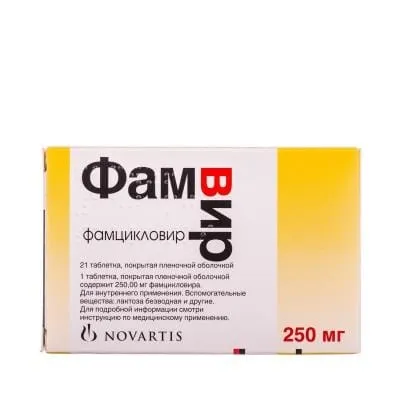
Table of Contents
INSTRUCTIONS FOR MEDICAL USE OF THE MEDICINAL PRODUCT FAMVIR® (FAMVIR®)
Composition:
Active substance: famciclovir;
1 tablet of 125 mg contains 125 mg of famciclovir;
1 tablet of 250 mg contains 250 mg of famciclovir;
1 tablet of 500 mg contains 500 mg of famciclovir;
Excipients: hydroxypropylcellulose, anhydrous lactose, sodium starch glycolate, magnesium stearate, hypromellose, titanium dioxide (E 171), polyethylene glycol 4000, polyethylene glycol 6000 (500 mg tablets do not contain anhydrous lactose).
Pharmaceutical form. Film-coated tablets.
Main physico-chemical properties: 125 mg and 250 mg tablets – white, round, biconvex, film-coated tablets with beveled edges, embossed with "FV" on one side and "125" or "250" on the other;
500 mg tablets – white, oval, biconvex, film-coated tablets with beveled edges, embossed with "FV 500" on one side and smooth on the other.
Pharmacotherapeutic group. Direct-acting antiviral agents. Nucleosides and nucleotides. Famciclovir. ATC code J05A B09.
Pharmacological Properties.
Pharmacodynamics.
Famciclovir is rapidly converted in vivo to penciclovir, which demonstrates in vitro antiviral activity against herpes simplex viruses (types 1 and 2), varicella-zoster virus, Epstein-Barr virus, and cytomegalovirus.
The antiviral effect of orally administered famciclovir has been observed in various animal models. In virus-infected cells, penciclovir is rapidly and efficiently converted into its triphosphate form (this process is mediated via virus-induced thymidine kinase). This triphosphate remains present in infected cells for over 12 hours and inhibits viral DNA replication. The half-life of penciclovir triphosphate is 10 hours in HSV-1-infected cells, 20 hours in HSV-2-infected cells, and 7 hours in VZV-infected cells cultured in vitro.
In uninfected cells exposed to penciclovir, concentrations of penciclovir triphosphate are barely detectable. Therefore, the likelihood of its toxic effects on mammalian cells is very low, and damage to uninfected cells is unlikely at therapeutic concentrations of penciclovir.
As with acyclovir, resistance to penciclovir is primarily associated with mutations in the thymidine kinase (TK) gene, leading to deficiency or altered substrate specificity of this enzyme, and to a lesser extent with mutations in the DNA polymerase gene. Most clinical isolates of HSV and VZV that are resistant to acyclovir are also resistant to penciclovir; however, cross-resistance is not universal.
The most common form of acyclovir resistance among herpes simplex virus strains is deficiency in thymidine kinase (TK) enzyme synthesis. In such TK-deficient strains, cross-resistance to both penciclovir and acyclovir is observed. However, activity of penciclovir has been demonstrated against recently isolated acyclovir-resistant herpes simplex virus strains with impaired DNA polymerase.
In studies on suppression of recurrent genital herpes, where patients with normal immune function received famciclovir for 4 months, no resistance to penciclovir was detected upon analysis of isolated cultures from 71 patients.
Studies evaluating the use of penciclovir and famciclovir, including treatment durations of up to 12 months, showed a low frequency of penciclovir-resistant isolates: 0.2% of 913 tested cultures from immunocompetent patients and 2.1% of 288 viral cultures isolated from immunocompromised patients.
Resistant isolates were identified before treatment initiation or in the placebo group; only 2 cases of resistance in immunocompromised patients occurred during or after treatment with famciclovir or penciclovir.
A placebo-controlled study demonstrated that famciclovir significantly reduced the duration of postherpetic neuralgia in patients over 50 years of age with herpes zoster when administered as early as possible after rash onset (within 72 hours).
In placebo-controlled studies involving immunocompromised patients with AIDS, famciclovir at a dose of 500 mg twice daily significantly reduced the ratio of days with symptoms of HSV-related lesions to asymptomatic days.
In a large-scale clinical trial, the efficacy and good tolerability of famciclovir in the treatment of ophthalmic zoster were demonstrated.
Pharmacokinetics.
After oral administration, famciclovir is rapidly and efficiently absorbed and converted into the active antiviral compound penciclovir. The bioavailability of penciclovir following oral administration of famciclovir is 77%. Mean plasma concentrations of penciclovir after oral doses of 125 mg, 250 mg, and 500 mg of famciclovir were 0.8 µg/mL, 1.6 µg/mL, and 3.3 µg/mL, respectively, with peak levels observed on average 45 minutes after dosing. The plasma concentration-time curves (AUC) for penciclovir were 2.2 µg·h/mL, 4.3 µg·h/mL, and 9.3 µg·h/mL, or 14.1 h·µg/mL. In another study, the mean peak plasma concentration of penciclovir after administration of 250 mg, 500 mg, or 1000 mg of famciclovir was 1.5 µg/mL, 3.2 µg/mL, or 5.8 µg/mL, respectively, and the mean AUC of penciclovir was 4.0 µg·h/mL, 8.7 µg·h/mL, or 16.9 µg·h/mL. These parameters were consistent after both single and repeated (three times daily and twice daily) dosing.
Food intake reduces the Cmax and delays Tmax of penciclovir, but does not affect the overall bioavailability of penciclovir.
The terminal half-life of penciclovir after both single and repeated doses of famciclovir is approximately 2 hours. No accumulation of penciclovir occurs after repeated dosing. Penciclovir and its 6-deoxy precursor bind weakly (<20%) to plasma proteins.
The volume of distribution (Vd) of penciclovir is approximately 1 L/kg.
There are no significant differences in the distribution and elimination characteristics of penciclovir after oral or parenteral administration of famciclovir in immunocompetent patients or in immunocompromised patients.
Famciclovir is primarily excreted as penciclovir and its 6-deoxy precursor, which are eliminated in urine; unchanged famciclovir is not detected in urine. Tubular secretion contributes to the renal elimination of the compound.
The terminal elimination half-life of penciclovir is approximately 2 hours. Renal clearance accounts for 80% of the total clearance of penciclovir.
Patients with Herpes Zoster Infection
Uncomplicated herpes zoster infection does not significantly affect the pharmacokinetics of penciclovir after oral administration of famciclovir. The terminal half-life of penciclovir in patients with herpes zoster infection was 2.8 hours and 2.7 hours after single and repeated doses of famciclovir, respectively.
Patients with Renal Impairment
Plasma clearance, renal clearance, and elimination rate constant of penciclovir decrease linearly with decreasing renal function, both after single and repeated doses. Dose adjustment is required for patients with renal impairment (see section "Dosage and Administration").
Patients with Hepatic Impairment
Chronic compensated liver disease does not affect the extent of systemic bioavailability of penciclovir after oral administration of famciclovir. Dose adjustment is not required for patients with compensated liver disease (see sections "Dosage and Administration" and "Special Warnings and Precautions"). Pharmacokinetics of penciclovir have not been studied in patients with severe decompensated liver disease.
Elderly Patients
According to data from a comparative crossover study, the mean AUC of penciclovir was approximately 40% higher, and renal clearance of penciclovir approximately 20% lower, after oral administration of famciclovir in elderly volunteers (65–79 years) compared to younger volunteers. This difference may be attributed to differences in renal function between the two age groups. Dose adjustment based on age is not required if renal function is normal (see section "Dosage and Administration").
Gender
Minor differences in renal clearance of penciclovir between women and men were observed, related to gender differences in renal function. Dose adjustment based on gender is not required.
Ethnicity
No differences in the pharmacokinetics of penciclovir were observed between Black volunteers and those of Caucasian ethnicity.
Non-clinical Safety Data.
Carcinogenicity
In 2-year studies, no changes were observed at doses of 200 mg/kg/day. At the maximum tolerated dose of 600 mg/kg/day, an increased incidence of adenocarcinoma of the mammary gland was observed in female rats, a tumor type typical for this strain of rats. No effect on neoplasia incidence was observed in male rats at doses up to 240 mg/kg/day or in mice of both sexes at doses up to 600 mg/kg/day.
Genotoxicity
Famciclovir showed no genotoxicity in in vivo and in vitro tests designed to detect gene mutations, chromosomal damage, and DNA damage. Penciclovir, like other drugs in this class, may cause chromosomal damage but did not induce gene mutations in bacterial or mammalian cell systems, and there was no evidence of increased DNA repair in vitro.
Reproductive Toxicity
Famciclovir is well tolerated in laboratory animals. As with other drugs in this class, degenerative changes in testicular epithelium were observed.
It has been shown that famciclovir does not significantly affect sperm count, morphology, or motility in men. Impaired fertility was observed in male rats at 500 mg/kg/day. No effect on fertility was observed in female rats receiving famciclovir at doses up to 1000 mg/kg/day.
Clinical characteristics.
Indications.
Infections caused by Varicella Zoster virus (VZV), – herpes zoster
- herpes zoster, including herpes zoster with ophthalmic involvement in immunocompetent adults;
- herpes zoster in adult patients with compromised immunity.
Infections caused by Herpes Simplex virus (HSV), – genital herpes
- treatment of initial episodes and recurrences of genital herpes in immunocompetent adults;
- treatment of recurrences of genital herpes in immunocompromised adults;
- suppression of recurrent genital herpes in immunocompetent adults and in immunocompromised adults.
Contraindications.
Known hypersensitivity to famciclovir or any of the excipients of the medicinal product, as well as hypersensitivity to penciclovir.
Interaction with other medicinal products and other forms of interaction.
Effect of other medicinal products on famciclovir
Probenecid and other drugs affecting renal physiology may alter plasma levels of penciclovir (the active metabolite of famciclovir).
Therefore, patients receiving Famvir® 500 mg three times daily concomitantly with probenecid for consecutive days should be monitored, particularly for toxicity, and dose reduction of Famvir® may be considered for such patients.
No clinically significant changes in penciclovir pharmacokinetics were observed after a single 500 mg dose of famciclovir administered following prior treatment with multiple doses of allopurinol, cimetidine, theophylline, zidovudine, or promethazine, or after administration shortly after antacids (magnesium hydroxide and aluminium hydroxide), or when co-administered with emtricitabine. No clinically significant effect on penciclovir pharmacokinetics was observed after multiple (three times daily) administration of famciclovir (500 mg) with multiple doses of digoxin.
The conversion of the inactive metabolite 6-deoxypenciclovir to penciclovir (via deacetylation of famciclovir) is catalyzed by aldehyde oxidase. Potential interactions with other drugs metabolized by this enzyme and/or inhibitors of this enzyme are possible. Clinical interaction studies of famciclovir with cimetidine and promethazine, inhibitors of aldehyde oxidase, in vitro, showed no significant effect on penciclovir formation. However, raloxifene, a more potent inhibitor of aldehyde oxidase investigated in vitro, may affect penciclovir formation and thus the efficacy of famciclovir.
Effect of famciclovir on other medicinal products
The pharmacokinetics of digoxin were not altered when a single or multiple (three times daily) doses of famciclovir (500 mg) were co-administered. No clinically significant effect on the pharmacokinetics of zidovudine, its metabolite zidovudine glucuronide, or emtricitabine was observed after a single oral dose of 500 mg famciclovir co-administered with zidovudine or emtricitabine.
Although famciclovir is only a weak inhibitor of aldehyde oxidase in vitro, interactions with drugs metabolized by aldehyde oxidase are potentially possible. Preclinical studies showed no potential for induction of cytochrome P450 or inhibition of CYP3A4.
Special precautions for use.
Use in patients with renal impairment
Particular attention should be paid to patients with impaired kidney function, who require dose adjustment (see sections "Dosage and administration" and "Overdose").
Acute renal failure has been observed in patients with renal impairment after administration of doses that are high relative to the degree of renal function deterioration.
Use in patients with hepatic impairment
Patients with mild to moderate hepatic impairment do not require dose adjustment. This also applies to elderly patients without renal impairment. The effect of famciclovir has not been studied in patients with severe hepatic impairment. The conversion of famciclovir into its active metabolite penciclovir may be impaired in such patients, which could lead to reduced plasma concentrations of penciclovir and, consequently, to decreased efficacy of famciclovir.
Use in the treatment of herpes zoster
Close monitoring of clinical response is required, especially in immunocompromised patients. Consideration should be given to the use of intravenous antiviral therapy if the response to oral treatment is considered inadequate.
Patients with complicated herpes zoster, such as those with visceral organ involvement, disseminated herpes zoster, motor neuropathy, encephalitis, or cerebrovascular complications, should receive intravenous antiviral therapy.
Furthermore, intravenous antiviral therapy should be administered to immunocompromised patients with ocular forms of herpes zoster or to patients at high risk of disease dissemination and visceral organ involvement.
Transmission of genital herpes
Genital herpes is a sexually transmitted disease. The risk of transmission increases during the acute phase of the disease. Patients should be advised to avoid sexual contact when symptoms are present, even if antiviral therapy has already been initiated. During suppressive antiviral therapy, the frequency of viral shedding is significantly reduced. However, the theoretical risk of transmission remains, so patients should use appropriate contraceptive measures.
Other
Famvir® 125 mg and 250 mg tablets contain lactose (26.9 mg and 53.7 mg, respectively). Patients with rare hereditary galactose intolerance, such as those with acute lactase deficiency or glucose-galactose malabsorption, should not take Famvir® 125 mg and 250 mg.
Use during pregnancy or breastfeeding.
Pregnancy
Although animal studies have not shown any embryotoxic or teratogenic effects of Famvir® or penciclovir, the safety of famciclovir use during pregnancy has not been established.
Lactation
Studies in rats have shown that penciclovir is excreted in the milk of nursing females treated orally with Famvir®. It is unknown whether penciclovir is excreted in human breast milk. Therefore, famciclovir should be used during pregnancy or breastfeeding only if the expected benefit to the woman outweighs the potential risk to the infant.
Fertility
Based on clinical data, no effect of famciclovir on male fertility has been observed after long-term oral administration of the drug at a dose of 250 mg twice daily.
Ability to affect reaction speed when driving or operating machinery.
There are no data on the influence of Famvir® on patients' ability to drive or operate machinery. However, patients who experience dizziness, somnolence, confusion, or other central nervous system disorders during treatment with Famvir® should refrain from driving or operating machinery.
Dosage and Administration
Since the systemic bioavailability of penciclovir was not altered when famciclovir was administered with food, famciclovir may be administered independently of meals.
Herpes Zoster in Immunocompetent Patients
For the treatment of herpes zoster – 500 mg three times daily for 7 days. For the treatment of herpes zoster with ocular complications – 500 mg three times daily for 7 days. Treatment is most effective when initiated as soon as possible after the onset of rash.
Herpes Zoster in Immunocompromised Patients
500 mg three times daily for 10 days. Treatment should be initiated as soon as possible after the onset of rash.
Genital Herpes in Immunocompetent Patients
- First Episode of Genital Herpes
250 mg three times daily for 5 days. Treatment should be initiated as soon as possible after the first signs of genital herpes.
- Recurrent Genital Herpes
125 mg twice daily for 5 days. Treatment should be initiated during the prodromal phase (tingling, itching, burning, pain) or immediately upon the first signs of genital herpes.
Recurrent Genital Herpes in Immunocompromised Patients
500 mg twice daily for 7 days. Treatment should be initiated during the prodromal phase (tingling, itching, burning, pain) or immediately after the onset of rash.
Suppression of Recurrent Genital Herpes in Immunocompetent Patients
250 mg twice daily. The duration of treatment depends on the severity of the disease, but therapy should be discontinued after 12 months of continuous treatment to reassess the frequency and severity of recurrences. The re-evaluation period should cover at least two recurrences. The dosage of 500 mg twice daily has been shown to be effective in immunocompromised patients.
Suppression of Recurrent Genital Herpes in Immunocompromised Patients
500 mg twice daily.
Dosage in Patients with Renal Impairment
Since the reduction in penciclovir clearance is associated with impaired renal function, dosage adjustment is required according to creatinine clearance.
The following dosage regimen is recommended:
Table 1
- Herpes Zoster in Patients with Normal Immune Function and in Immunocompromised Patients
| Creatinine clearance (mL/min/1.73 m2) |
Dosage |
| ≥ 60 |
500 mg three times daily for 7 or 10 days∗ |
| From 40 to 59 |
500 mg twice daily for 7 or 10 days∗ |
| From 20 to 39 |
500 mg once daily for 7 or 10 days∗ |
| < 20 |
250 mg once daily for 7 or 10 days∗ |
| Patients undergoing dialysis |
250 mg after each dialysis session for 7 or 10 days∗ |
∗7 days – for patients with normal immunity, 10 days – for patients with impaired immune system.
Table 2
- First episode of genital herpes
| Creatinine clearance (mL/min/1.73 m2) |
Dosage |
| ≥ 40 |
250 mg three times daily for 5 days |
| From 20 to 39 |
250 mg twice daily for 5 days |
| < 20 |
250 mg once daily for 5 days |
| Patients undergoing dialysis |
250 mg after each dialysis session for 5 days |
Table 3
- Recurrent genital herpes in patients with normally functioning immune systems
| Creatinine clearance (mL/min/1.73 m2) |
Dosage |
| ≥ 20 |
125 mg twice daily for 5 days |
| < 20 |
125 mg once daily for 5 days |
| Patients undergoing dialysis |
125 mg after each dialysis session for 5 days |
Table 4
- Recurrent genital herpes in patients with impaired immune system
| Creatinine clearance (ml/min/1.73 m²) |
Dosage |
| ≥ 40 |
500 mg twice daily for 7 days |
| From 20 to 39 |
500 mg once daily for 7 days |
| < 20 |
250 mg once daily for 7 days |
| Patients undergoing dialysis |
250 mg after each dialysis for 7 days |
Table 5
- Suppression of recurrent genital herpes in patients with normally functioning immune systems
| Creatinine clearance (mL/min/1.73 m²) |
Dosage |
| ≥ 40 |
250 mg twice daily |
| From 20 to 39 |
125 mg twice daily |
| < 20 |
125 mg once daily |
| Patients on dialysis |
125 mg after each dialysis |
Table 6
- Suppression of recurrent genital herpes in patients with compromised immune systems
| Creatinine clearance (mL/min/1.73 m2) |
Dosing |
| ≥ 40 |
500 mg twice daily |
| From 20 to 39 |
500 mg twice daily |
| < 20 |
250 mg once daily |
| Patients on dialysis |
250 mg after each dialysis |
Patients with impaired renal function undergoing hemodialysis
A 4-hour hemodialysis reduces plasma concentrations of penciclovir by approximately 75%. The dose of famciclovir should be administered immediately after dialysis. The dosing regimen for patients undergoing dialysis is included in the tables above, according to each specific indication.
Since reduced penciclovir clearance is associated with renal impairment, as determined by creatinine clearance, special caution is required for patients with impaired renal function.
Patients with hepatic impairment
Dose adjustment is not required for patients with mild to moderate hepatic impairment. Data in patients with severe hepatic impairment are lacking.
Elderly patients (≥ 65 years of age)
Dose adjustment is not required unless renal function is impaired.
Maximum tolerated daily dose and duration of treatment
Normal tolerability was observed in patients with herpes zoster who received 750 mg three times daily for 7 days. Similar tolerability was observed in patients with genital herpes who received up to 750 mg three times daily for 5 days and up to 500 mg three times daily for 10 days. Normal tolerability was demonstrated in 2- and 12-month studies in which patients with genital herpes received 250 mg three times daily.
Similar responses were observed in immunocompromised patients with herpes zoster who received up to 500 mg three times daily for 10 days, and in immunocompromised patients with herpes simplex who received 500 mg twice daily for 7 days and 500 mg twice daily for 8 weeks.
Children
The efficacy and safety of famciclovir in children and adolescents (under 18 years of age) have not been established. Therefore, famciclovir is not recommended for patients in this age group.
Overdose
Data regarding famciclovir overdose are limited. Reports of accidental acute overdose (10.5 g) are limited. Long-term administration (10 g per day for 2 years) of famciclovir did not result in complications. In case of overdose, supportive therapy should be administered. Isolated cases of acute renal failure have been reported in patients with a history of renal disease who did not receive appropriate dose reduction of Famvir®. Drug concentrations are reduced by approximately 75% during a 4-hour hemodialysis session.
Adverse Reactions
Headache, nausea, diarrhea, and somnolence have been reported during clinical trials. These were generally mild to moderate in severity and occurred in patients receiving placebo as well.
The adverse effects observed during clinical studies and the post-marketing period, classified according to frequency, are listed below: very common (≥ 1/10); common (≥ 1/100, < 1/10); uncommon (≥ 1/1,000, < 1/100); rare (≥ 1/10,000, < 1/1,000); very rare (< 1/10,000), including isolated cases.
Blood and lymphatic system disorders:
Rare – thrombocytopenia.
Psychiatric disorders:
Uncommon – confusion (mainly in elderly patients);
Rare – hallucinations.
Central nervous system (CNS) disorders:
Very common – headache;
Common – dizziness;
Uncommon – somnolence (mainly in elderly patients);
Rare – seizures*.
Cardiac disorders:
Rare – palpitations.
Gastrointestinal disorders:
Common – nausea, vomiting, abdominal pain, diarrhea;
Isolated cases – pancreatitis*.
Hepatobiliary disorders:
Common – altered liver function tests;
Rare – cholestatic jaundice.
Immune system disorders:
Rare – anaphylactic shock*, anaphylactic reactions*.
Skin and subcutaneous tissue disorders:
Common – rash, pruritus;
Uncommon – angioneurotic edema, facial swelling, eyelid edema, periorbital edema, laryngeal edema, urticaria;
Rare – severe skin reactions* (e.g., erythema multiforme, Stevens-Johnson syndrome, toxic epidermal necrolysis (Lyell’s syndrome), necrotizing vasculitis*).
Renal and urinary disorders:
Acute renal failure is rarely observed in patients with kidney disease when the dose has not been appropriately adjusted.
Famciclovir is also well tolerated in patients with impaired immune systems.
Overall, the adverse events reported during clinical trials in immunocompromised patients were similar to those reported in patients with intact immune systems. Nausea, vomiting, and changes in liver function tests were more frequently reported, especially with higher doses.
* Adverse reactions identified from spontaneous post-marketing reports and publications related to the use of FAMVIR® that were not recorded during clinical trials. Reports of such adverse reactions were received voluntarily from a population of undefined size.
Shelf life.
3 years.
Storage conditions. Store at temperatures not exceeding 25 °C in the original packaging to protect from moisture. Keep out of reach of children.
Packaging.
125 mg tablets: 10 tablets in a blister, 1 blister in a cardboard box.
250 mg tablets: 7 tablets in a blister; 3 blisters in a cardboard box.
500 mg tablets: 7 tablets in a blister; 2 or 8 blisters in a cardboard box;
or 10 tablets in a blister; 3 blisters in a cardboard box.
Prescription category. Prescription only.
Manufacturer.
Cosmo S.p.A.
Manufacturer's address and location of operations. Via Cristoforo Colombo 1, Lainate, 20045, Italy.