Eucabal® syrup
Ukraine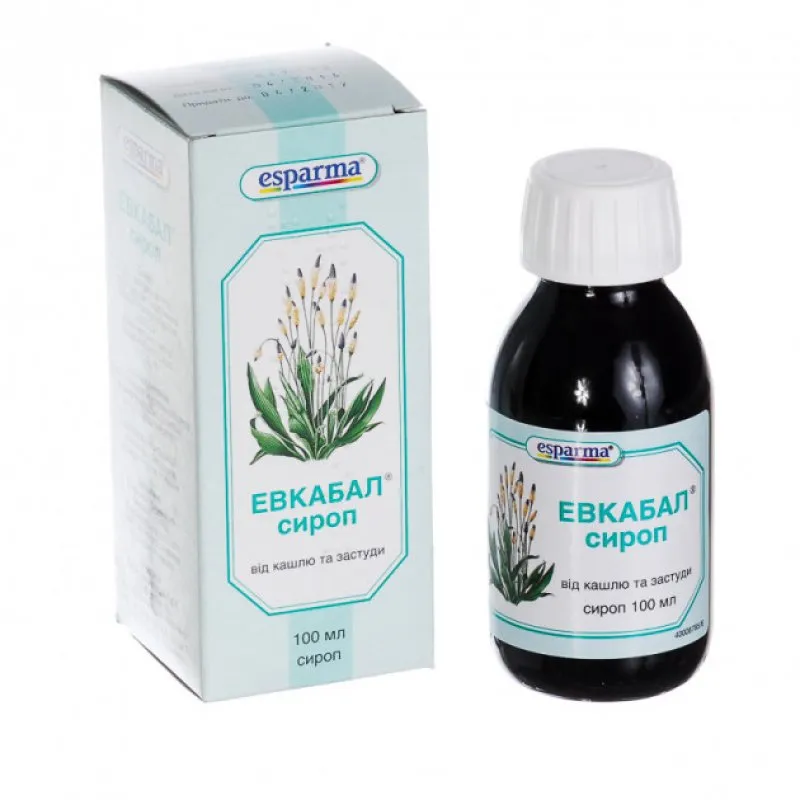
Table of Contents
INSTRUCTION FOR MEDICAL USE OF THE MEDICINAL PRODUCT Eucabal® syrup (Eucabal® syrup)
Composition:
Active substances: 100 g of syrup contains: liquid extract of Plantain (Plantago lanceolata)
(Extractum Plantaginis liquidum) (1:2–2.5) 3 g, liquid extract of Thyme (Thymus vulgaris)
(Extractum Thymi liquidum) (1:2–2.5) 15 g;
Excipients: methyl 4-hydroxybenzoate (E 218), propyl 4-hydroxybenzoate (E 216), inverted sugar syrup (glucose monohydrate, fructose, sucrose, purified water).
Medicinal form. Syrup.
Main physicochemical characteristics. Dark brown liquid, from clear to slightly cloudy.
Pharmacotherapeutic group. Medicinal products used in cough and colds. ATC code R05C A10.
Pharmacological properties.
Pharmacodynamics.
The substances contained in the liquid extracts of plantain and thyme (thymus), particularly the essential oils, act as expectorants affecting the properties, formation, and transport of bronchial secretions.
Both an indirect reflex effect via the gastric mucosa and a direct effect of essential oils on bronchial glands enhance their activity. This promotes an increase in bronchial secretion, its liquefaction and dissolution, as well as enhanced transport of secretions via the ciliated epithelium. This is particularly important in the later stages of acute bronchitis and in chronic bronchitis, when there is increased secretion of viscous mucus by submucosal glands. In addition, due to their surface activity, essential oils reduce the adhesive properties of highly viscous mucus on the tracheobronchial mucosa.
Thyme exhibits pronounced antimicrobial potential due to thymol and carvacrol. Plantain's plant-derived mucilaginous substances help protect the damaged bronchial mucosa from further irritation.
Pharmacokinetics.
Not studied.
Clinical characteristics.
Indications. Symptomatic treatment of inflammatory diseases of the respiratory tract. Expectorant for symptomatic treatment of productive cough. Supportive treatment in whooping cough.
Contraindications. Hypersensitivity to the components of the drug, fructose intolerance; hypersensitivity to alkyl-4-hydroxybenzoates. Hypersensitivity to plants of the Lamiaceae family, celery, and birch pollen (cross-reactivity possible).
Gastroesophageal reflux disease, including reflux esophagitis, gastritis with increased gastric juice acidity, gastric and duodenal ulcer, severe liver or kidney diseases.
Special precautions. The syrup in the bottle should be shaken well before use. The presence of plant-derived ingredients in the preparation may cause cloudiness of the syrup; however, this does not reduce the therapeutic efficacy of the drug.
Eukabal® syrup contains 6.5% v/v ethanol, which poses a risk for patients with epilepsy, chronic alcoholism, liver disease, or organic brain disorders.
Do not use in patients with fructose intolerance, glucose-galactose malabsorption, or sucrose-isomaltase deficiency. Due to sugar content, may be harmful to teeth (caries).
If first signs of hypersensitivity reactions occur, administration of the drug should be discontinued.
Use with caution in patients with diabetes mellitus.
Advice for patients with diabetes
Eukabal® syrup contains glucose, fructose, and sucrose, with a total sugar content expressed as sucrose of 0.6 g/mL. Thus, 1 teaspoon (5 mL) contains 3 g of sucrose or 0.25 bread units, and 1 dessert spoon (10 mL) contains 6 g of sucrose or 0.5 bread units.
Interaction with other medicinal products and other types of interactions. Do not use simultaneously with antitussive agents and medicinal products that reduce sputum secretion. Due to ethanol content (6.5% v/v), there is a possibility of worsening or enhancement of the effect of other medicinal products.
Special precautions for use.
If symptoms worsen and/or dyspnea, fever, or purulent sputum occur during treatment with the medicinal product, consult a physician.
If symptoms persist for more than one week, consult a physician.
Use during pregnancy or breastfeeding.
Due to insufficient data, the use of the medicinal product during these periods is not recommended.
Ability to influence reaction rate while driving or operating machinery. Has no effect when used at recommended doses; however, it should be noted that the excipients contain ethanol 6.5% v/v.
Dosage and Administration.
For children aged 1 to 5 years: 1 teaspoon (5 ml) 3–5 times daily.
For children aged 6 to 12 years: 1 dessert spoon (10 ml) 3–5 times daily.
For children aged 12 years and adults: 1–2 dessert spoons (10–20 ml) 3–5 times daily.
The duration of treatment is determined individually by a physician, depending on the course of the disease and the patient's condition.
Children. Do not administer to children under 1 year of age.
Overdose.
Symptoms. In case of overdose, nausea accompanied by coughing may occur.
Treatment. Discontinue the drug. Symptomatic therapy.
Side effects.
Possible gastrointestinal disorders (including nausea, vomiting, diarrhea), hypersensitivity reactions, including skin rash, urticaria, itching, angioedema, dyspnea, exanthema.
**Shelf life. **2 years.
Do not use the medicinal product after the expiry date stated on the packaging. After opening the bottle, the medicinal product is suitable for use within 12 weeks.
Storage conditions.
Keep out of reach of children and store at a temperature not exceeding 25 °C.
Packaging.
100 ml of syrup in a glass bottle. 1 bottle in a cardboard box.
Supply category. Over-the-counter.
Manufacturer: Pharma Vernigerode GmbH.
Manufacturer's address and place of business.
Dornburgsweg 35, 38855 Vernigerode, Germany.
Marketing Authorization Holder: Esparma GmbH, Germany.
Address of the Marketing Authorization Holder.
Bielefelder Strasse 1, 39171 Schöningen, Germany.