Euvax b vaccine for prevention of hepatitis b, recombinant liquid
Ukraine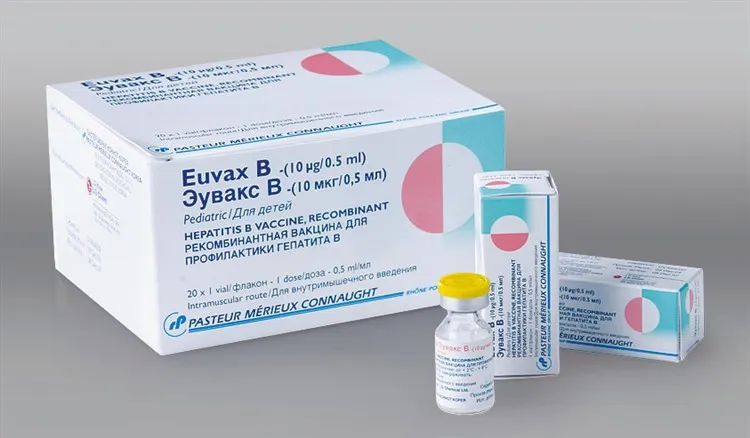
Table of Contents
INSTRUCTIONS FOR MEDICAL USE OF THE MEDICINAL PRODUCT EUVAX B Recombinant Liquid Vaccine for Prevention of Hepatitis B
Composition:
Active substance: Hepatitis B vaccine, purified antigen (HBsAg);
One dose of vaccine (1.0 ml) (one immunizing dose for children aged 16 years and older and for adults) contains purified HBsAg – 20 mcg;
Excipients:
- aluminium hydroxide gel……………0.500 mg
- potassium dihydrogen phosphate……0.950 mg
- sodium hydrogen phosphate heptahydrate…0.800 mg
- sodium chloride………………………8.500 mg
- water for injections…………………up to 1.000 ml
One dose of vaccine (0.5 ml) (one immunizing dose for children) contains purified HBsAg – 10 mcg;
Excipients:
- aluminium hydroxide gel……………0.250 mg
- potassium dihydrogen phosphate……0.475 mg
- sodium hydrogen phosphate heptahydrate…0.400 mg
- sodium chloride………………………4.250 mg
- water for injections…………………up to 0.500 ml
Pharmaceutical form. Injection suspension.
Main physicochemical properties: white, slightly opalescent suspension, which on standing separates into a colorless transparent liquid and a white sediment that completely disperses upon shaking.
Pharmacotherapeutic group. Antiviral vaccines. Purified hepatitis B virus antigen. ATC code J07BC01.
Immunological and biological properties.
Pharmacodynamics.
Surface antigen of hepatitis B virus (HBsAg) adsorbed onto aluminium salts (adjuvant). The vaccine is produced using recombinant DNA technology in yeast cell culture and complies with the requirements of the World Health Organization (WHO) for production of recombinant hepatitis B vaccines; it contains no human-derived substances.
Pharmacokinetics.
Not applicable.
Clinical characteristics.
Indications.
Vaccination for the prevention of infection caused by known subtypes of hepatitis B virus.
When conducting immunization in Ukraine, vaccination schedules, contraindications, and interactions with other medicinal products should follow the current orders of the Ministry of Health of Ukraine regarding preventive vaccinations.
Contraindications.
Euvax B is contraindicated in patients with hypersensitivity to any of its components, including yeast, and in patients who have experienced a hypersensitivity reaction after previous administration of Euvax B. Acute illnesses and elevated body temperature (see section "Special precautions").
Immunodeficiency
Euvax B should not be administered to children at clinical stages III and IV of HIV infection or those with moderate to severe immunosuppression.
Interaction with other medicinal products and other types of interactions.
Generally, hepatitis B vaccine can be administered simultaneously with other vaccines: DTP (vaccine for the prevention of pertussis, diphtheria, tetanus); MMR (vaccine for the prevention of measles, rubella, mumps); poliomyelitis vaccine.
Vaccination for the prevention of tuberculosis (BCG) should not be performed on the same day as other vaccinations.
If Euvax B is administered simultaneously with other vaccines, it must be given separately from other vaccines and injected into different body sites or different limbs, provided this does not violate the immunization schedule recommended by national health authorities.
Special precautions for use.
Under no circumstances should EuVax B be administered intravenously. The vaccine should not be injected into the gluteal muscle.
Vaccination with EuVax B should be postponed in patients with acute illnesses or elevated body temperature.
In patients suffering from multiple sclerosis, any immune system stimulation may trigger an exacerbation of the disease. Therefore, when vaccinating such patients, the benefit of hepatitis B vaccination must be carefully weighed against the potential risk of multiple sclerosis exacerbation.
Immunization is considered ineffective in patients with latent or progressive stages of hepatitis B.
As with all injectable vaccines, appropriate medical support and supervision must always be readily available in case of rare anaphylactic reactions following administration of EuVax B. Therefore, patients should remain under medical observation for at least 30 minutes after vaccination.
Syncope (fainting) may occur during or shortly after any injectable vaccination as a psychogenic response to needle injection. Vaccination should be performed only while the recipient is in a sitting or lying position, and the person should remain in this position (sitting or lying) for 15 minutes after vaccination to prevent potential injury due to syncope.
The vaccine should be shaken well before use, as a white sediment with clear supernatant liquid may form during storage.
As with any vaccine, a sufficient immune response may not be achieved in all vaccinated individuals.
When administering primary immunization to very premature infants (≤28 weeks of gestation), the potential risk of apnea development should be considered, and respiratory function should be monitored for 48–72 hours after vaccination, especially in infants with a history of respiratory immaturity. Since the benefit of vaccination in this group of infants is high, vaccination should not be refused or delayed.
In preterm infants (body weight <2000 g), it is recommended to check protective antibody levels (anti-HBs) one month after administration of the third vaccine dose to assess the need for a booster dose.
Thiomersal (an organic mercury compound) is used during the manufacturing process of this medicinal immunobiological product and residual amounts are present in the final product. Therefore, sensitization reactions may occur; inform the physician if the child/adult has had or develops allergic reactions.
This medicinal immunobiological product contains less than 1 mmol (23 mg)/dose of sodium and less than 1 mmol (39 mg)/dose of potassium, i.e., it is practically free of sodium and potassium.
Use during pregnancy or breastfeeding.
The effect of HBsAg on fetal development has not been established. Use of EuVax B during pregnancy should only be considered if clearly needed.
Controlled clinical studies on the effects of EuVax B on breastfed infants following maternal vaccination have not been conducted.
Ability to affect reaction speed when driving or operating machinery.
Unknown.
Method of Administration and Dosage.
Euvax B vaccine should be administered intramuscularly into the deltoid muscle in adults and older children, and into the anterolateral aspect of the thigh in newborns, infants, and younger children.
The vaccine dose for immunization depends on the patient's age.
One pediatric dose (0.5 mL) for immunization of newborns and children up to and including 15 years of age contains 10 mcg of HBsAg.
One dose (1.0 mL) for immunization of individuals aged 16 years and older contains 20 mcg of HBsAg.
The immunization schedule consists of three doses administered as follows:
- 1st dose: chosen date;
- 2nd dose: 1 month after the first dose;
- 3rd dose: 6 months after the first dose.
Booster Dose
The WHO does not recommend routine administration of a booster dose, as it has been demonstrated that a three-dose hepatitis B vaccination series provides protection for up to 15 years. Furthermore, even if protective antibody levels decline after this period, the immune system of a vaccinated individual remains capable of mounting a protective antibody response upon exposure to hepatitis B virus. However, some official immunization programs do include administration of a booster dose.
In specific population groups (e.g., newborns of mothers infected with hepatitis B virus, individuals suspected of exposure to the virus, or travelers to regions with high hepatitis B prevalence), an alternative vaccination schedule involving three doses administered at monthly intervals (0, 1, and 2 months) may be used. This schedule includes a booster dose administered 12 months after the first dose.
Administration of a booster dose of Euvax B vaccine (according to age-appropriate dosing) may be indicated for patients undergoing hemodialysis and for immunocompromised patients, as these patient groups may fail to achieve protective antibody levels (>10 mIU/mL) following primary immunization.
Children.
The vaccine is used in pediatric practice (see section "Method of Administration and Dosage").
Overdose.
Not known.
Adverse Reactions
Listed below are adverse reactions observed during controlled clinical trials.
The frequency of adverse reactions is defined as follows:
very common (≥ 1/10); common (≥ 1/100, < 1/10); uncommon (≥ 1/1,000, < 1/100); rare (≥ 1/10,000, < 1/1,000); very rare (< 1/10,000), including isolated cases.
Blood and lymphatic system disorders: very rare – neutropenia.
Gastrointestinal disorders: common – abdominal pain, diarrhea, vomiting; rare – nausea.
General disorders and administration site conditions: very common – injection site pain; common – fever, injection site induration, swelling, tenderness, inflammation; rare – discomfort, fatigue.
Infections and infestations: uncommon – candidiasis, rhinitis.
Laboratory abnormalities: rare – transient increase in transaminases.
Metabolism and nutrition disorders: common – anorexia.
Musculoskeletal and connective tissue disorders: rare – myalgia, arthritis.
Nervous system disorders: common – incessant piercing cry, somnolence; rare – headache, dizziness; very rare – optic neuritis, facial paralysis, Guillain–Barré syndrome, exacerbation of multiple sclerosis.
Pregnancy, puerperium and perinatal conditions: uncommon – neonatal jaundice.
Psychiatric disorders: common – insomnia, restlessness, irritability.
Skin and subcutaneous tissue disorders: common – erythematous rash, erythema; uncommon – maculopapular rash, rash, pityriasis rosea.
Vascular disorders: common – hematoma.
Immune system disorders: very rare – hypersensitivity reactions.
Shelf life
3 years.
Storage conditions
Store in the original packaging at 2 to 8 °C (in the refrigerator).
Do not freeze.
Keep out of reach of children.
Incompatibilities
No data available.
Packaging
Injection suspension, 10 μg/dose, 0.5 mL (1 dose) in a vial; 1, 10 or 20 vials per cardboard pack.
Injection suspension, 20 μg/dose, 1.0 mL (1 dose) in a vial; 1, 10 or 20 vials per cardboard pack.
Prescription status
Prescription only.
Manufacturer
LG Chem, Ltd., Korea
Manufacturer's address and place of business
129, Seokam-ro, Iksan-si, Jeollabuk-do, Korea
151, Osongsaengmyeong 1-ro, Osong-eup, Heungdeok-gu, Cheongju-si, Chungcheongbuk-do, Republic of Korea
Legal address: 128, Yeoui-daero, Yeongdeungpo-gu, Seoul, Korea
Marketing Authorization Holder
Pharma Life LLC, Ukraine
Address of the Marketing Authorization Holder
2 D. Apostola St., Lviv, Ukraine, 79040; tel. (032) 297-16-88