Espa-bastin®
Ukraine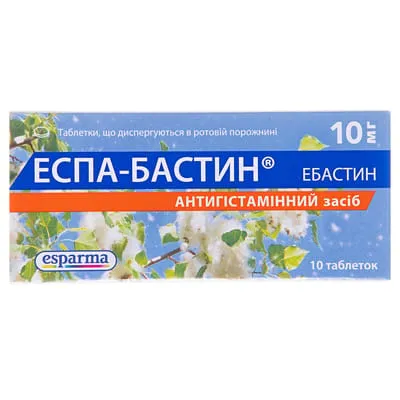
Table of Contents
INSTRUCTION FOR MEDICAL USE OF THE MEDICINAL PRODUCT ESPA-BASTINE®
Composition:
Active substance: ebastine;
1 tablet contains 10 mg or 20 mg of ebastine;
Excipients: mannitol (E 421), maize starch, peppermint flavoring,
aspartame (E 951), colloidal anhydrous silicon dioxide, sodium stearyl fumarate.
Pharmaceutical form. Orodispersible tablets.
Main physicochemical properties: white or almost white, round tablets.
Pharmacotherapeutic group.
Antihistamines for systemic use. Ebastine. ATC code: R06AX22.
Pharmacological Properties
Pharmacodynamics
Studies in vitro and in vivo have demonstrated that ebastine has relevant affinity for H1-receptors, resulting in rapid and selective blockade of these receptors that lasts over an extended period.
After oral administration, neither ebastine nor its active metabolite crosses the blood-brain barrier. This characteristic is associated with a low level of sedative effect, which is confirmed by experimental studies evaluating the impact of ebastine on the central nervous system.
Data obtained from in vitro and in vivo studies indicate that ebastine exerts a potent, long-lasting, and highly selective antagonistic action on H1-receptors, without undesirable central nervous or anticholinergic effects.
Clinical properties: studies using histamine-induced skin reactions have demonstrated a statistically and clinically significant antihistaminic effect, which appears within one hour after administration and persists for more than 48 hours. After completion of a five-day treatment course, the antihistaminic effect remains for up to 72 hours. This effect correlates with plasma concentrations of the primary active metabolite—carebastine.
With repeated administration, blockade of peripheral receptors remained stable without rapid decline in therapeutic effect (tachyphylaxis). These results confirm that ebastine, at doses of at least 10 mg, provides rapid, potent, and prolonged blockade of peripheral H1-receptors, and ebastine administration can be performed once daily.
Sedative effects were evaluated using pharmacological electroencephalography, cognitive testing, oculomotor coordination tests, and subjective assessments.
When the recommended therapeutic dose was used, no significant increase in sedative effects was observed. These findings are consistent with results from double-blind clinical trials: the level of sedative effect with ebastine is comparable to that of placebo.
Pharmacokinetics
After oral administration, ebastine is rapidly absorbed in the gastrointestinal tract, with a first-pass effect observed. Ebastine is almost completely metabolized into the pharmacologically active metabolite carebastine. After a single 10 mg dose, the maximum plasma concentration of the metabolite is approximately 80–100 ng/mL. Peak plasma levels of the metabolite are reached within 2.5–4 hours after drug intake. The elimination half-life of the metabolite is 15–19 hours. About 66% of ebastine is excreted in the urine, primarily as conjugated metabolites. With repeated daily administration of a single 10 mg dose, a steady-state equilibrium is achieved within 3–5 days, with maximum plasma concentrations ranging from 130 to 160 ng/mL.
After oral administration of a single 20 mg dose, the maximum plasma concentration of ebastine is reached within 1–3 hours, with a mean value of 2.8 ng/mL. The maximum concentration of carebastine averages 157 ng/mL.
In vitro studies using human liver microsomes demonstrate that the conversion of ebastine to carebastine is primarily mediated by CYP3A4. The binding of ebastine and carebastine to plasma proteins exceeds 95%. In elderly patients, there are no relevant changes in the pharmacokinetic profile. The pharmacokinetics of ebastine and its active metabolite carebastine are linear within the recommended therapeutic dosage range of 10–20 mg.
Clinical Characteristics.
Indications.
Symptomatic treatment of:
- allergic rhinitis (seasonal and perennial), associated or not associated with allergic conjunctivitis;
- chronic idiopathic urticaria and allergic dermatitis.
Contraindications.
Hypersensitivity to the active substance or to any of the excipients. Children under 12 years of age.
Interaction with other medicinal products and other forms of interaction.
Concomitant use of ebastine with ketoconazole or erythromycin results in QT interval prolongation on ECG. In both cases, pharmacokinetic and pharmacodynamic interactions have been observed, leading to increased plasma levels of ebastine and, to a lesser extent, of carebastine, without clinically significant pharmacodynamic consequences. The QT interval increased by only 10 ms when used concomitantly, compared to ketoconazole or erythromycin used separately. The drug should be used with particular caution in combination with azole antifungal agents (e.g., ketoconazole, itraconazole) and macrolides (e.g., erythromycin).
A pharmacokinetic interaction has been observed when ebastine is used concomitantly with rifampicin, which may lead to reduced plasma concentrations of antihistamines and a consequent decrease in their therapeutic effect.
No interactions between ebastine and theophylline, warfarin, cimetidine, diazepam, or alcohol have been reported.
When ebastine is taken with food, plasma levels of the main metabolite of ebastine and the AUC (area under the concentration-time curve) increase by 1.5–2 times. This increase does not alter the Tmax (time to reach maximum concentration). Administration of ebastine with food does not affect its clinical efficacy.
The drug may influence the results of skin allergy tests; therefore, it is recommended to discontinue the drug 5–7 days before testing.
The drug may potentiate the effects of other antihistamines.
Special precautions for use
The medicinal product should be used with caution in patients with QT interval prolongation syndrome, hypokalemia, and when co-administered with other medicinal products that prolong the QT interval or inhibit the CYP3A4 enzyme, such as azole antifungal agents (e.g., ketoconazole, itraconazole) and macrolides (e.g., erythromycin).
Concomitant use of ebastine with rifampicin may result in a pharmacokinetic interaction (see section "Interaction with other medicinal products and other forms of interaction").
No dose adjustment is required for patients with mild, moderate, or severe renal impairment, as well as those with mild or moderate hepatic impairment (treatment duration of 5–7 days). There is no experience with administration of doses exceeding 10 mg in patients with severe hepatic impairment; therefore, the dose of the drug should not exceed 10 mg in such patients.
Since the therapeutic effect of the drug occurs 1–3 hours after administration, it should not be used for acute allergic reactions in emergency situations.
The medicinal product contains aspartame, a phenylalanine derivative, which may be hazardous for patients with phenylketonuria.
Use during pregnancy or breastfeeding
Pregnancy. There are only limited data on the use of ebastine in pregnant women. Animal studies do not indicate any direct or indirect toxic effects of the drug on reproductive function. Therefore, the use of ebastine during pregnancy is not recommended.
Breastfeeding period. The high degree of protein binding of ebastine and its main metabolite carebastine (> 97%) suggests that the drug is unlikely to pass into breast milk. As a precautionary measure, the use of ebastine during breastfeeding should be avoided.
Fertility. There are no data on the effect of ebastine on human fertility.
Ability to influence reaction rate while driving or operating machinery
Detailed studies on the effects on human psychomotor function have confirmed the absence of any negative effect of ebastine. The medicinal product at recommended therapeutic doses does not impair reaction speed when driving or operating complex machinery.
However, individuals who are particularly sensitive to ebastine are advised to undergo additional evaluation for individual reactions before driving or performing complex tasks, as the drug may cause somnolence or dizziness (see section "Adverse reactions").
Dosage and Administration.
Place the tablet on the tongue. No liquid is required. Food intake does not affect the efficacy of the medicinal product.
The recommended dose for adults and children aged 12 years and older is 10 mg (1 tablet) once daily. In severe cases, the daily dose may be increased to 20 mg.
Elderly patients do not require dose adjustment.
Patients with renal impairment do not require dose adjustment.
Patients with mild to moderate hepatic impairment do not require dose adjustment. Patients with severe hepatic impairment should not exceed the maximum recommended dose of 10 mg per day, as there are no safety data available for higher doses in this patient population.
The duration of treatment may be extended until symptoms resolve and is determined individually by the physician.
Children.
The medicinal product is not recommended for use in children under 12 years of age.
Overdose.
In clinical studies using high doses of the drug, no clinically significant signs or symptoms were observed with single daily doses up to 100 mg. There is no specific antidote. In case of overdose, gastric lavage is recommended, along with medical monitoring of vital functions (ECG) and symptomatic treatment.
Adverse reactions.
Based on the results of pooled placebo-controlled clinical studies involving 5708 patients treated with ebastine, the most commonly reported adverse reactions were headache, dry mouth, and somnolence.
The adverse reactions reported in clinical studies involving children (460 pediatric patients) were of the same nature as those observed in adults.
The following frequency categories were used to evaluate adverse events:
Very common (≥ 1/10), common (≥ 1/100, < 1/10), uncommon (≥ 1/1000, < 1/100), rare (≥ 1/10,000, < 1/1000), very rare (< 1/10,000), not known (cannot be estimated from the available data).
Immune system disorders
Rare: hypersensitivity reactions (anaphylaxis and angioedema).
Psychiatric disorders
Rare: nervousness, insomnia.
Nervous system disorders
Common: somnolence, headache.
Rare: dizziness, hypesthesia, dysgeusia.
Cardiac disorders
Very rare: palpitations, tachycardia.
Respiratory, thoracic and mediastinal disorders
Uncommon: epistaxis, pharyngitis, rhinitis.
Very rare: sinusitis.
Gastrointestinal disorders
Common: dry mouth.
Rare: nausea, vomiting, abdominal pain, dyspepsia.
Hepatobiliary disorders
Rare: hepatitis, cholestasis, changes in liver function test parameters (elevated levels of transaminases, gamma-glutamyl transferase, alkaline phosphatase, and bilirubin).
Skin and subcutaneous tissue disorders
Very rare: exanthema, urticaria, eczema, rash, dermatitis.
Reproductive system and breast disorders
Very rare: menstrual cycle disturbances, dysmenorrhea.
General disorders and administration site conditions
Rare: edema, asthenia.
Not known: increased appetite, weight gain.
Reporting of adverse reactions after marketing authorization is important. It allows continuous monitoring of the benefit-risk balance of the medicinal product. Healthcare professionals, pharmacists, patients, and their legal representatives are encouraged to report all suspected adverse reactions and lack of efficacy via the automated pharmacovigilance information system at the following link: https://aisf.dec.gov.ua
Shelf life. 3 years.
Storage conditions.
Store in the original packaging at a temperature not exceeding 25 ºC.
Keep out of the reach of children.
Packaging.
10 tablets per blister pack, 1 blister pack per cardboard box.
Supply category. Over-the-counter (without prescription).
Manufacturer.
Laboratorios Medicamentos Internacionales, S.A.
Manufacturer's address.
Calle Solana, 26, Torrejón de Ardoz, 28850, Madrid, Spain.
Marketing Authorization Holder.
Esparma GmbH.
Address of the Marketing Authorization Holder.
Bielefelder Strasse 1, 39171 Seußetal, Germany.