Esphatil
Ukraine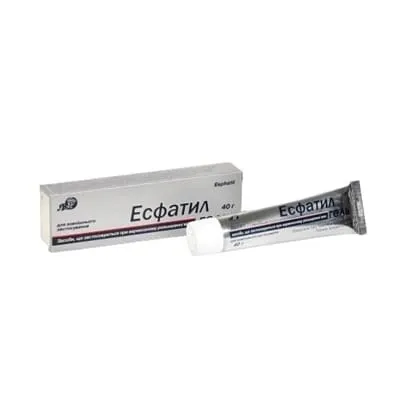
Table of Contents
INSTRUCTION FOR MEDICAL USE OF THE MEDICINAL PRODUCT ESFATYL
Composition:
Active substances: 1 g contains: β-escin calculated to 100 % substance – 10 mg, sodium heparin calculated to heparin activity of 133 IU/mg – 0.75 mg (100 IU), epikuron 130 R calculated to dry substance – 10 mg;
Excipients: isopropyl alcohol, methylparaben (methyl p-hydroxybenzoate) (E 218),
propylparaben (propyl p-hydroxybenzoate) (E 216), carbomer, glycerol, 15 % ammonia solution, lavender oil, purified water.
Pharmaceutical form. Gel.
Main physicochemical properties: yellowish gel of homogeneous consistency, with a specific odor.
Pharmacotherapeutic group.
Agents used in varicose veins. Heparins or heparinoids for topical use. Heparin, combinations. ATC code C05BA53.
Pharmacological Properties.
Pharmacodynamics.
The drug exerts anti-inflammatory, anti-edematous, and analgesic effects, improves microcirculation and tissue trophism.
Heparin is an acidic mucopolysaccharide with a relative molecular mass of approximately 16,000 daltons. It belongs to direct-acting anticoagulants. It inhibits blood coagulation by inactivating coagulation factors (factors V, VII, IX, and Hageman factor) and blocking thrombin biosynthesis. The drug reduces platelet aggregation, inhibits hyaluronidase activity, and enhances fibrinolysis.
β-Aescin, from a physicochemical standpoint, is an amorphous water-soluble mixture of isomeric triterpene saponins derived from horse chestnut seeds, Aesculus hippocastanum L. It is an angioprotective, capillary-stabilizing, anti-edematous, and anti-inflammatory agent. The mechanism of action of β-aescin is due to stabilization of lysosomal membranes, inhibition of the release of autolytic cellular enzymes that degrade proteoglycans and promote the biosynthesis of pain and inflammation mediators. The drug reduces capillary permeability and fragility, preventing transcapillary filtration of low-molecular-weight proteins, electrolytes, and water into the interstitial space; accelerates hematoma resorption and reduces lymphostasis, improves venous-lymphatic circulation and increases venous wall tone, thereby preventing venous stasis and thrombosis in varicose nodes (especially in the lower limbs), reduces peripheral edema, and alleviates sensations of heaviness, fatigue, tension, and pain in the affected area.
Pharmacokinetics.
Not studied.
Clinical characteristics.
Indications.
Local treatment of acute and chronic venous insufficiency: varicose veins, superficial phlebitis and thrombophlebitis, hematomas and edema following contusions and sprains.
Contraindications.
Hypersensitivity to the components of the drug. Bleeding trophic ulcers of the legs, open and/or infected wounds, hemorrhagic diathesis, purpura, thrombocytopenia, hemophilia, tendency to bleeding. Pediatric age.
Special precautions.
Avoid contact of the drug with mucous membranes to prevent burning sensation.
Interaction with other medicinal products and other forms of interaction.
The effect of the gel is enhanced by anticoagulants, acetylsalicylic acid, and other nonsteroidal anti-inflammatory agents. The efficacy of the gel is reduced by cardiac glycosides, tetracyclines, nicotine, antihistamines, and thyroxine. Heparin use may contribute to prolongation of prothrombin time in patients taking oral anticoagulants. The drug should not be used concomitantly with topical medicinal products, e.g., those containing tetracycline, hydrocortisone, salicylic acid, or anticoagulants.
Special precautions for use.
Do not apply the gel to the eyes or the areas around the eyes, to inflamed skin, blisters, or mucous membranes. Do not rub in during application (including when treating phlebitis). If skin inflammation, thrombophlebitis, severe pain, sudden swelling of one or both legs, or cardiac or renal insufficiency occurs, consult a physician immediately. Sudden onset of pronounced symptoms of venous insufficiency (swelling, skin discoloration, sensation of tension and pain), especially in one limb, may indicate lower limb venous thrombosis.
The use of the gel is not recommended in deep vein thrombosis.
In patients presenting hemorrhagic symptoms, the potential for using the drug should be carefully considered. In case of coagulation disorders, the gel should not be applied to large skin areas. When the gel is used long-term over large areas and concurrently with medicinal products affecting the blood coagulation system and/or hematopoiesis, coagulation time and prothrombin time should be monitored. For prolonged treatment courses over extensive affected areas in women aged 65 years and older, similar monitoring is recommended.
The use of the medicinal product cannot replace additional preventive or therapeutic measures such as application of cold compresses and wearing elastic stockings.
Wash hands thoroughly after each application of the gel.
The gel contains methylparahydroxybenzoate (E 218) and propylparahydroxybenzoate (E 216) as preservatives, which may cause allergic reactions (which may develop over time), and in exceptional cases, bronchospasm.
Use during pregnancy or breastfeeding.
During pregnancy or breastfeeding, the drug may be used only for a short duration, under medical prescription and only when clearly indicated, if the expected benefit to the mother outweighs the potential risk to the fetus or infant.
Effect on ability to drive or operate machinery.
No effect.
Method of administration and dosage.
For external use in adults.
Apply the gel in a thin layer to swollen and painful areas 2–3 times daily. Treatment duration is 14 days.
Children.
Safety and efficacy of the drug in children have not been studied.
Overdose.
Symptoms of overdose have not been identified.
Side effects.
The medicinal product is usually well tolerated.
Possible local intolerance reactions such as mild itching, redness, burning, skin rash, contact dermatitis, urticaria, angioedema, hemorrhages.
Systemic adverse reactions may occur when applying the gel to large areas of skin.
The use of the product may cause allergic reactions (including delayed-type) due to the presence of excipients such as methylparahydroxybenzoate (E 218) and propylparahydroxybenzoate (E 216).
Shelf life.
4 years.
Storage conditions.
Store at a temperature not exceeding 25 °C.
Keep out of reach of children.
Packaging.
40 g in a tube; 1 tube in a cardboard pack.
Availability.
Over-the-counter.
Manufacturer.
JSC "Lubnipharm".
Manufacturer's address and location of business activity.
16, Barvinкова St., Lubny, Poltava region, 37500, Ukraine.