Ermutsin®
Ukraine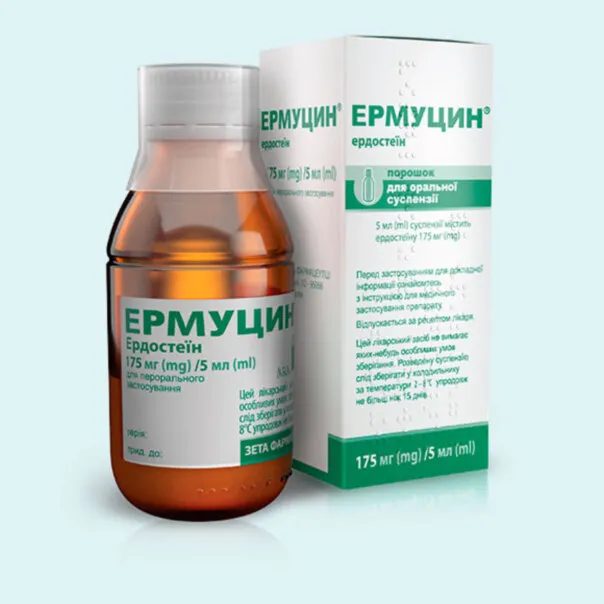
Table of Contents
INSTRUCTIONS FOR MEDICAL USE OF THE MEDICINAL PRODUCT Ermucin® (Ermucin®)
Composition:
Active substance: erdosteine;
5 ml of oral suspension contain erdosteine 175 mg;
Excipients: sucrose, sodium benzoate (E 211), sodium starch glycolate, orange flavor, anhydrous citric acid, sucralose, flavoring agent Mask CLD nat.
Pharmaceutical form. Powder for oral suspension.
Main physicochemical properties: fine, free-flowing white powder with a characteristic pleasant odor and orange taste.
Pharmacotherapeutic group. Medicinal products used for cough and colds. Expectorants excluding combined preparations containing antitussives. Mucolytic agents. Erdosteine. ATC code R05C B15.
Pharmacological properties.
Pharmacodynamics.
Erdosteine is a mucolytic compound whose action is mediated by its active metabolites. These metabolites possess free thiol groups that break disulfide bridges linking glycoprotein fibers, thereby reducing the elasticity and viscosity of mucus. As a result, the agent facilitates the clearance of respiratory tract secretions and enhances the effectiveness of the mucociliary clearance mechanism for removing mucus and mucopurulent secretions from both upper and lower respiratory tracts.
In addition to its mucolytic properties, erdosteine exhibits antagonistic effects on local formation of free radicals and inhibits the activity of the enzyme elastase.
Erdosteine also reduces the adhesive capacity of Gram-positive and Gram-negative bacteria to the respiratory epithelium. Due to this antibacterial anti-adhesive effect, which has been demonstrated in in vitro studies, bacterial colonization may be reduced and the risk of bacterial superinfection decreased.
Erdosteine also acts as an acceptor of oxygen free radicals, prevents their local formation, and significantly reduces the level of 8-isoprostane, a marker of lipid peroxidation. The anti-inflammatory effect of erdosteine, both in vitro and in vivo, is further supported by reduced synthesis of certain proinflammatory cytokines (IL-6, IL-8).
Erdosteine prevents inhibition of alpha-1-antitrypsin by tobacco smoke, thus protecting against damage caused by smog or smoking.
Moreover, erdosteine increases IgA concentration in the respiratory tract of patients with chronic obstructive pulmonary disease (COPD) and prevents smoking-induced inhibition of granulocytes. Erdosteine also increases amoxicillin concentration in bronchial secretions; therefore, the therapeutic effect when these agents are used concomitantly is faster compared to monotherapy with amoxicillin. In patients with COPD, 8-month erdosteine therapy has been shown to reduce the frequency of disease exacerbations and improve quality of life.
The effect of the drug becomes apparent approximately 3–4 days after the start of therapy.
Erdosteine itself does not contain free SH radicals responsible for its activity, as they are chemically blocked and become free only after metabolism or in an alkaline environment. Therefore, when administered at recommended doses, erdosteine has minimal gastrointestinal (GI) tract effects, lacks an unpleasant aftertaste or burping, is well tolerated, and its adverse effect profile related to the GI tract does not differ from that observed with placebo.
Pharmacokinetics.
Erdosteine is rapidly absorbed and metabolized in the liver, forming at least three active metabolites, the most abundant (in percentage terms) and active of which is N-thiodiglycolylhomocysteine (metabolite 1, or M1). The main pharmacokinetic parameters (for M1) are: Cmax 3.46 µg/mL; Tmax 1.48 hours; AUC (0–24 hours) 12.09 mg/L/h. The plasma protein binding of erdosteine is 64.5%. Elimination occurs via urine and feces, where only inorganic sulfates have been detected.
The elimination half-life (overall for the drug, i.e., for erdosteine and its metabolites) is >5 hours. Repeated administration and food intake do not alter the pharmacokinetic profile of the drug. No signs of accumulation or enzyme induction have been observed.
In cases of impaired liver function, increased Cmax and AUC values have been observed.
Furthermore, in severe liver dysfunction, an increased elimination half-life of the drug has been observed. In severe renal insufficiency, there is a risk of metabolite accumulation.
Clinical Characteristics
Indications. Reduction of viscosity and facilitation of expectoration of bronchial secretions in the treatment of acute and chronic diseases of the upper and lower respiratory tract, such as bronchitis, rhinitis, sinusitis, laryngopharyngitis, exacerbations of chronic bronchitis, chronic obstructive pulmonary disease (COPD), hypersecretory bronchial asthma, and bronchiectasis.
Contraindications.
- Hypersensitivity to the active substance or to any of the listed excipients, or to substances containing free SH-groups;
- liver disorders (e.g., increased levels of alkaline phosphatase or transaminases in serum, etc.), including liver cirrhosis;
- renal insufficiency (creatinine clearance < 25 mL/min);
- homocystinuria (this medicinal product is a source of homocysteine, and currently there are no available data on the use of erdosteine in congenital disorders of amino acid metabolism, especially in patients required to follow a methionine-free diet) and cystathionine synthetase deficiency—due to possible effects on methionine metabolism;
- active phase peptic ulcer;
- phenylketonuria.
Interaction with other medicinal products and other forms of interaction.
No undesirable interactions have been observed with other medicinal products commonly used in respiratory tract infections and COPD, such as theophylline, bronchodilators, erythromycin, amoxicillin, or sulfamethoxazole/trimethoprim. Erdosteine potentiates the effect of certain antibiotics (e.g., amoxicillin, clarithromycin) that may be used therapeutically, and can also be used concomitantly with bronchodilators (theophylline or beta-2 agonists), antitussives, and others. A synergistic effect of erdosteine has been demonstrated when administered concurrently with budesonide and salbutamol.
Special precautions for use
If classical signs and symptoms of hypersensitivity occur, erdosteine therapy should be discontinued immediately.
Concomitant use of antitussive agents is not advisable, as it may lead to accumulation of secretions in the bronchial tree, increasing the risk of superinfection or bronchospasm.
Ermucin® contains sucrose. Sucrose is unsuitable for patients with hereditary fructose intolerance, glucose-galactose malabsorption syndrome and associated digestive disorders, or patients with sucrase-isomaltase deficiency (deficiency of enzymes that break down sucrose and isomaltose). If a patient is known to have intolerance to certain sugars, medical advice should be sought before taking this medicinal product.
This medicinal product contains less than 1 mmol (23 mg) of sodium per dose, i.e. it is practically sodium-free.
This medicinal product contains 10 mg of sodium benzoate per 5 ml dose, equivalent to 2 mg/ml by volume.
A sulfurous odor may be present, which is a characteristic feature of the active substance and not an indication of degradation of the medicinal product.
Use during pregnancy or breastfeeding
The safety of erdosteine use during pregnancy and breastfeeding has not been established; therefore, its use is not recommended.
Ability to influence reaction speed when driving or operating machinery
No negative effect on the ability to concentrate has been observed.
Administration and Dosage.
Children. The dose is determined according to body weight and age of the child:
15–20 kg (3–6 years) — 2.5 ml twice daily;
21–30 kg (7–12 years) — 5 ml twice daily;
over 30 kg (over 12 years) — 5 ml three times daily.
Adults. The adult dose is 10 ml of suspension twice daily.
Add water to the vial containing the dry powder up to the mark and gently shake until the powder is completely converted into a homogeneous suspension. Check the liquid level; if it does not reach the mark, add the required amount of water and shake the vial again. After reconstitution, the suspension can be stored for no more than 15 days at a temperature of 2–8 °C. The suspension must be shaken before each use.
Children. This medicinal form is not recommended for children under 3 years of age.
Overdose.
No cases of overdose have been reported to date.
Exceeding the recommended dose (intake of 1200 mg/day) has been associated with sweating, dizziness, and flushing.
In case of overdose or accidental ingestion of this product by a child, symptomatic therapy is recommended.
Adverse Reactions
The frequency of adverse reactions is defined as follows: very common (≥1/10); common (≥1/100, <1/10); uncommon (≥1/1,000, <1/100); rare (≥1/10,000, <1/1,000); very rare (<1/10,000); not known (cannot be estimated from available data).
Nervous system disorders: very rare – headache.
Respiratory, thoracic and mediastinal disorders: very rare – dyspnea; not known – bronchial obstruction.
Gastrointestinal disorders: very rare – taste disturbances (ageusia or dysgeusia), nausea, vomiting, diarrhea, sensation of heartburn and stomach pain.
Skin and subcutaneous tissue disorders: very rare – urticaria, erythema, eczema.
Immune system disorders: rare – Quincke's edema.
General disorders: rare – unexpected hyperpyrexia.
Reporting of suspected adverse reactions
Reporting suspected adverse reactions after medicine authorization is highly important. It allows continued monitoring of the benefit-risk balance of the medicine. Healthcare professionals, pharmacists, patients, and their legal representatives are encouraged to report all suspected adverse reactions and lack of efficacy via the Automated Pharmacovigilance Information System at: https://aisf.dec.gov.ua
Shelf life. 3 years.
Storage conditions.
This medicinal product does not require any special storage conditions. The reconstituted suspension should be stored in a refrigerator at 2–8 °C for no longer than 15 days.
Packaging. A 100 ml amber glass bottle with a fill line, hermetically sealed with a protective aluminum screw cap with a PE insert, packed in a cardboard box. A measuring container is also included.
Prescription status. Prescription only.
Manufacturer. ZETA FARMACEUTICI S.P.A., Italy.
Marketing Authorization Holder. UAB "MRA", Republic of Lithuania.
Manufacturer's location and address of place of business. Via Galvani, 10 - 36066 Sandrigo (VI), Italy.
Marketing Authorization Holder's location. Totoriu St. 20-9, LT-01121, Vilnius, Republic of Lithuania.