Hermital 36 000
Ukraine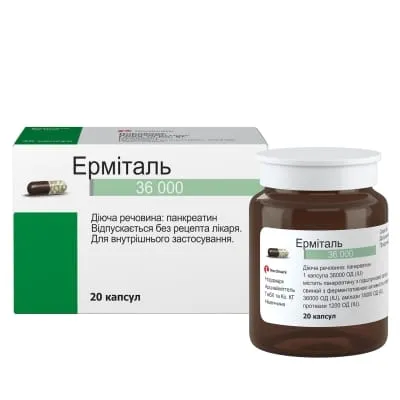
Table of Contents
INSTRUCTION FOR MEDICAL USE OF THE MEDICINAL PRODUCT ERMITAL 10 000 ERMITAL 10 000 ERMITAL 25 000 ERMITAL 25 000 ERMITAL 36 000 ERMITAL 36 000
Composition:
Active substance: pancreatin;
1 capsule 10000 IU contains pancreatin from porcine pancreas with enzymatic activity of lipase 10000 IU, amylase 9000 IU, protease 500 IU;
1 capsule 25000 IU contains pancreatin from porcine pancreas with enzymatic activity of lipase 25000 IU, amylase 22500 IU, protease 1250 IU;
1 capsule 36000 IU contains pancreatin from porcine pancreas with enzymatic activity of lipase 36000 IU, amylase 18000 IU, protease 1200 IU;
Excipients: microcrystalline cellulose, crospovidone, colloidal anhydrous silicon dioxide, magnesium stearate, methacrylic acid copolymer dispersion, triethyl citrate, talc, simethicone, montan-glycol wax, gelatin, iron oxide red (E 172), iron oxide black (E 172), titanium dioxide (E 171), sodium lauryl sulfate.
Pharmaceutical form. Gastric-resistant hard capsules.
Main physicochemical properties:
ERMITAL 10 000: elongated hard gelatin capsule size 2, brown opaque cap, colorless transparent body; capsule contents: whitish-gray round biconvex microtablets coated with a film coating, with a characteristic odor;
ERMITAL 25 000: elongated hard gelatin capsule size 0, brown opaque cap, colorless transparent body; capsule contents: whitish-gray round biconvex microtablets coated with a film coating, with a characteristic odor;
ERMITAL 36 000: elongated hard gelatin capsule size 00, brown opaque cap, colorless transparent body; capsule contents: whitish-gray round biconvex microtablets coated with a film coating, with a characteristic odor.
Pharmacotherapeutic group. Digestive enzymes and other digestive aids. Pancreatic enzyme preparations. ATC code A09AA02.
Pharmacological Properties
Pharmacodynamics
The preparation contains pancreatin from porcine pancreatic glands in the form of microtablets coated with an enteric (acid-resistant) coating, enclosed in gelatin capsules. The capsules dissolve rapidly in the stomach, releasing microtablets according to a multiple-dose principle, which ensures good mixing with gastric contents, transport from the stomach along with its contents, and, after release, adequate distribution of enzymes within the intestinal contents. When the microtablets reach the small intestine, the coating dissolves rapidly (at pH > 5.5), releasing enzymes with lipolytic, amylolytic, and proteolytic activity, thereby enabling the breakdown of fats, carbohydrates, and proteins. The products of pancreatic digestion are subsequently absorbed either directly or after further hydrolysis by intestinal enzymes.
Pharmacokinetics
Animal studies have shown no evidence of unchanged enzyme absorption; therefore, classical pharmacokinetic studies have not been conducted. Pancreatic enzyme supplements do not require absorption to exert their effect. On the contrary, their full therapeutic action occurs within the lumen of the gastrointestinal tract. Moreover, as proteins, they undergo proteolytic digestion in the gastrointestinal tract before being absorbed in the form of peptides and amino acids.
Preclinical data indicate no relevant acute, subchronic, or chronic toxicity. Studies on genotoxicity, carcinogenicity, or toxic effects on reproduction have not been performed.
Clinical characteristics.
Indications.
Treatment of exocrine pancreatic insufficiency in adults and children caused by various diseases, including but not limited to the following:
- chronic pancreatitis;
- pancreatectomy;
- gastrectomy;
- gastrointestinal anastomosis surgery (e.g. Billroth II gastroenterostomy);
- Shwachman–Diamond syndrome;
- post-acute pancreatitis phase and resumption of enteral or oral feeding.
Contraindications.
Hypersensitivity to the active substance pancreatin, pork proteins or any other component of the medicinal product.
Interaction with other medicinal products and other forms of interaction.
Folic acid. Absorption of folic acid may be reduced in patients taking pancreatic enzyme preparations; therefore, monitoring of folic acid levels is recommended when used concomitantly.
Acarbose, miglitol. A reduction in the effect of these antidiabetic agents by pancreatic enzyme preparations cannot be excluded. Therefore, during concomitant treatment with pancreatin, monitoring of the antidiabetic agents' effect on the patient's blood glucose levels is recommended.
Special precautions for use
Pancreatin preparations contain active proteins that may cause damage to the mucous membranes (e.g., development of oral ulcers) if released in the oral cavity (e.g., during chewing). Therefore, it is essential to ensure that the medication is taken without chewing.
ERMITAL 36 000 should not be used in cases of acute pancreatitis or during acute exacerbations of chronic pancreatitis.
Like other pancreatin preparations of porcine origin currently available on the market, ERMITAL 10 000, ERMITAL 25 000, and ERMITAL 36 000 are manufactured from pancreatic tissue of pigs intended for human consumption. Although the risk of transmitting infectious agents with the product is reduced through testing and inactivation of certain viruses during the manufacturing process, there remains a theoretical risk of transmission of viral infections, including those caused by new or unidentified viruses. The presence of porcine viruses capable of infecting humans cannot be entirely ruled out.
However, to date, no cases of transmission of infectious diseases have been reported following the use of porcine pancreatin preparations, despite their long-term use.
The medication should be used with caution in patients with renal insufficiency, hyperuricemia, or those with known allergies to porcine-derived proteins.
Use during pregnancy or breastfeeding
Due to the lack of clinical data on the effects of pancreatic enzymes on pregnancy, the medication should be prescribed with caution to pregnant women. Animal studies have shown no evidence of absorption of pancreatic enzymes. Therefore, a toxic effect on reproduction or fetal development is not expected.
Since animal studies indicate no systemic exposure of pancreatic enzymes in breastfeeding mothers, no adverse effects on the breastfed infant are anticipated. Therefore, pancreatic enzymes may be used in women who are breastfeeding.
If necessary, pregnant or breastfeeding women may take the medication at doses sufficient to ensure adequate nutritional status.
Effect on the ability to drive or operate machinery
The effect of the medication on the ability to drive or operate machinery is absent or negligible.
Dosage and Administration.
The dosage of the drug is based on individual patient needs and depends on the degree of digestive impairment and food composition. For selecting an adequate individual dose, three dosage forms of the drug are available – ERMITAL 10 000, ERMITAL 25 000, ERMITAL 36 000.
The drug should be taken during or immediately after a meal.
Capsules and microtablets should be swallowed whole, without breaking or chewing, and taken with an adequate amount of liquid or consumed with a soft snack. If the capsule cannot be swallowed whole (in children or elderly patients), it may be opened and the microtablets mixed with soft food that does not require chewing, such as apple puree, or with a liquid or food of neutral or slightly acidic pH (e.g. yogurt, mashed apple). This mixture should be taken immediately and not stored.
During treatment with ERMITAL 10 000, ERMITAL 25 000, ERMITAL 36 000, it is very important to consume an adequate amount of fluid, especially during periods of increased fluid loss. Fluid deficiency may worsen constipation.
Dosing in exocrine pancreatic insufficiency:
- The dose should be individually adjusted depending on the degree of digestive impairment and fat content of the diet.
The usual starting dose is 10,000 to 25,000 IU of lipase per main meal. However, some patients may require higher doses to control steatorrhea and maintain adequate nutritional status. According to accepted clinical practice, a minimum of 20,000 to 50,000 units of lipase should be taken with each meal. The dose for main meals (breakfast, lunch, or dinner) may range from 25,000 to 80,000 IU of lipase, while for snacks between main meals, half of the individual main-meal dose should be administered.
Children.
The medicinal product can be used in children.
Overdose.
Cases of hyperuricosuria and hyperuricemia have been reported and were associated with the intake of extremely high doses of pancreatin.
Adverse Reactions
Classification of adverse effects by frequency: very common (≥ 1/10), common (≥ 1/100 to < 1/10), uncommon (≥ 1/1000 to < 1/100), rare (≥ 1/10000 to < 1/1000), very rare (< 1/10000), not known (frequency cannot be estimated from available data).
In studies evaluating the effects of drugs containing pancreatin in patients, gastrointestinal disorders were the most frequently reported, predominantly of mild to moderate severity.
The adverse reactions observed during the study of the drug are listed below.
Uncommon:
Metabolism and nutrition disorders:
Anorexia.
Gastrointestinal disorders:
Abdominal pain (gastrointestinal disorders were mainly associated with the underlying disease); nausea, vomiting, constipation, bloating, diarrhoea, stomatitis.
Skin and subcutaneous tissue disorders:
Rash; pruritus, urticaria, erythema.
Immune system disorders:
Hypersensitivity (anaphylactic reactions).
Most allergic reactions, primarily affecting the skin but not exclusively, were identified as adverse reactions during post-marketing use.
General disorders:
Malaise.
Not known (frequency cannot be estimated from available data):
Immune system disorders:
Immediate-type I hypersensitivity (urticaria, sneezing, lacrimation, bronchospasm), gastrointestinal hypersensitivity.
Gastrointestinal disorders:
Adverse events which may be symptoms of prolonged digestive disturbance and therefore may require dose adjustment by a physician: anorexia, diarrhoea, abdominal pain, nausea, vomiting, dyspepsia (pyrosis, heartburn), malaise.
Children
No specific adverse reactions have been identified in children.
Shelf life. 3 years.
Storage conditions.
Store in a place inaccessible to children, at a temperature not exceeding 25 °C.
Packaging.
20, 50, or 100 capsules in a dark glass bottle; 1 bottle in a cardboard box.
Supply category. Over-the-counter.
Manufacturer.
Nordmark Pharma GmbH
Manufacturer's address.
Pinnauallee 4, Uetersen, Schleswig-Holstein, 25436, Germany / Pinnauallee 4, Uetersen, Schleswig-Holstein, 25436, Germany.