Endofalk
Ukraine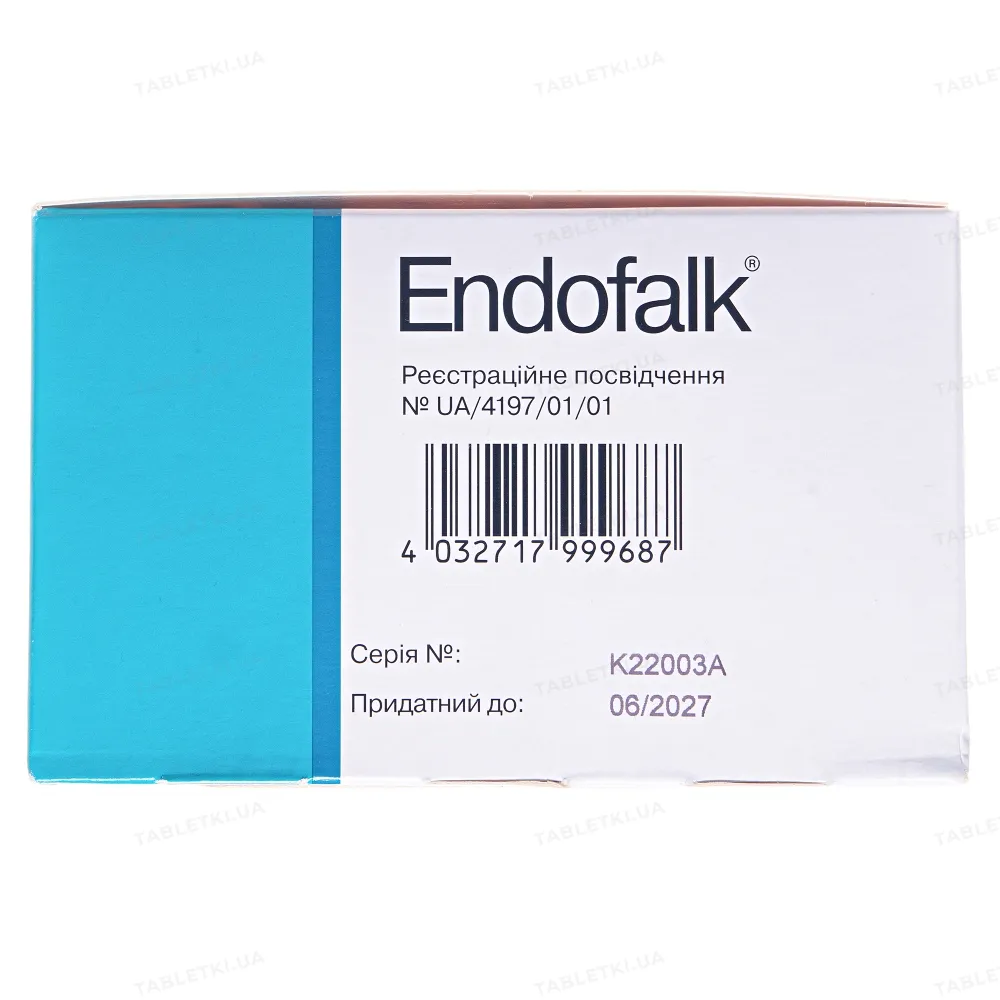
Table of Contents
INSTRUCTIONS FOR MEDICAL USE OF THE MEDICINAL PRODUCT ENDOFALK (ENDOFALK®)
Composition:
Active substances: 1 sachet (55.318 g of powder) contains: macrogol 3350 – 52.500 g, sodium chloride – 1.400 g, sodium bicarbonate – 0.715 g, potassium chloride – 0.185 g;
Excipients: sodium saccharin, colloidal anhydrous silicon dioxide, passion fruit flavor, orange flavor.
Pharmaceutical form. Powder for oral solution.
Main physicochemical characteristics: white, powder-like mixture of various crystalline substances.
Pharmacotherapeutic group. Osmotic laxatives. Macrogol combinations.
ATC code A06AD65.
Pharmacological properties.
Pharmacodynamics.
Endofalk is a mixture of various electrolytes and macrogol for obtaining an isotonic solution for bowel cleansing.
The pharmacodynamic effect consists in inducing diarrhea. The intestine is emptied and cleansed. The electrolytes contained in the ready-to-use solution are balanced so as to prevent the reverse processes of absorption and secretion of water and electrolytes in the gastrointestinal tract. The addition of high-molecular-weight macrogol ensures an increase in isoosmolar concentration, characterized by a particle concentration comparable to that in blood plasma. This prevents significant movement of any fluid between the intestinal lumen and the vascular compartment. Due to this type of balance and osmolarity, the effect on the body's electrolyte or fluid balance is practically absent.
Pharmacokinetics.
Macrogol 3350 is an inert compound that undergoes only minimal absorption in the gastrointestinal tract and is not metabolized. A minimal amount of macrogol 3350, < 1% of the administered dose, is excreted in urine.
Clinical characteristics.
Indications.
For bowel cleansing prior to colonoscopy.
Contraindications.
Intestinal obstruction or suspected intestinal obstruction, gastrointestinal obstruction, gastrointestinal perforation, risk of gastrointestinal tract perforation, ulcerative colitis, toxic megacolon, gastric retention or hypersensitivity to the active substances, other macrogols, or to any of the components of the medicinal product.
Endofalk should not be administered to patients who are unconscious or in a reduced state of consciousness, or to patients at risk of aspiration or regurgitation, as well as in cases of general weakness or impaired swallowing reflex.
Interaction with other medicinal products and other forms of interaction.
Gastrointestinal absorption of other medicinal products may be temporarily reduced when administered concomitantly with Endofalk. There have been isolated reports of reduced efficacy of certain concomitantly administered medicinal products (e.g., antiepileptic agents). If these drugs are essential for life-sustaining therapy, oral administration should be avoided; instead, the medicinal product should be administered in an alternative pharmaceutical form or an alternative treatment should be considered.
Endofalk may interact with food thickeners based on starch. One of the components of this preparation, macrogol, neutralizes the thickening effect of starch, effectively liquefying products intended to remain thick for individuals with swallowing difficulties.
An interaction between macrogol and certain enzymatic tests (e.g., ELISA) is possible during diagnostic examination of expelled intestinal fluid.
Special precautions for use.
Endofalk should be used only under medical supervision in elderly patients, patients with reflux esophagitis, or those with existing cardiac arrhythmia and suspected or confirmed sinoatrial block or sick sinus syndrome.
Endofalk should be administered with caution under physician supervision in patients with chronic inflammatory bowel diseases (except severe forms and toxic megacolon).
Endofalk should not be used in patients with cardiac failure (NYHA class III and IV), renal insufficiency, hepatic disease, or in patients with marked dehydration, as the safety of the drug in these patients has not been sufficiently studied.
When prescribing to patients who have swallowing difficulties and require thickening agents to be added to solutions for proper drug administration, possible interactions should be considered (see section "Interaction with other medicinal products and other forms of interaction").
Endofalk should be taken with caution in patients with diarrhea, particularly in those at higher risk of fluid and electrolyte imbalance (e.g., elderly patients, patients with impaired liver or kidney function, and patients taking diuretics). Electrolyte levels should be monitored in such patients. If symptoms indicating fluid and electrolyte imbalance develop (e.g., edema, dyspnea, increasing fatigue, dehydration, heart failure), Endofalk should be discontinued immediately; such patients should have their electrolyte levels checked and receive appropriate therapy.
Seizures associated with the use of polyethylene glycol 3350 with electrolytes for bowel cleansing have been reported in patients both with and without a history of seizures. These cases were mostly associated with electrolyte disturbances, such as severe hyponatremia (see section "Undesirable effects"). Polyethylene glycol 3350 with electrolytes should be prescribed with caution in patients with a history of seizures, those at increased risk of seizure occurrence, or those at risk of electrolyte imbalance. In the event of neurological symptoms, fluid and electrolyte imbalances should be corrected promptly.
Cases of esophageal rupture (Boerhaave syndrome) associated with excessive vomiting after administration of polyethylene glycol 3350 with electrolytes for bowel cleansing have been reported in the post-marketing period, predominantly in elderly patients. Patients should be advised to discontinue the medicinal product and seek immediate medical attention if they experience uncontrollable vomiting followed by chest, neck, or abdominal pain, dysphagia, hematemesis, or dyspnea.
Ischemic colitis
During the post-marketing period, cases of ischemic colitis, including serious cases, have been reported in patients receiving polyethylene glycol for bowel preparation. Polyethylene glycol should be used with caution in patients with known risk factors for ischemic colitis or when used concomitantly with stimulant laxatives (such as bisacodyl or sodium picosulfate). Patients who experience sudden abdominal pain, rectal bleeding, or other symptoms suggestive of ischemic colitis should seek immediate medical attention.
No other solutions or additives (including sugars or flavorings incompatible with Endofalk solution) should be added to the Endofalk oral solution, as this may alter the osmolarity and electrolyte composition or lead to gas mixture formation in the intestine due to breakdown of added substances by intestinal microflora.
When prescribing to patients who have swallowing difficulties and require thickening agents to be added to solutions for proper drug administration, possible interactions should be considered (see section "Interaction with other medicinal products and other forms of interaction").
One sachet contains 32.5 mmol (or 747 mg) of sodium, equivalent to 37.4% of the WHO recommended maximum daily intake of 2 g sodium for adults.
One sachet contains 2.5 mmol (or 97.5 mg) of potassium. This should be taken into account in patients with impaired renal function or in patients on a potassium-controlled diet.
Use during pregnancy or breastfeeding.
Pregnancy
There is no experience with the use of the drug during pregnancy.
Animal studies have not shown teratogenic effects. Due to the extremely low absorption of polyethylene glycol 3350, Endofalk may be prescribed to pregnant women after careful assessment of the benefit-risk ratio.
Breastfeeding
There are no data on the passage of polyethylene glycol 3350 into breast milk.
However, polyethylene glycol 3350 is poorly absorbed. Endofalk may be used during breastfeeding if necessary.
Ability to affect reaction speed when driving or operating machinery.
Endofalk has no effect or has a negligible effect on the ability to drive a vehicle or operate machinery.
Method of Administration and Dosage
To achieve complete bowel cleansing, it is necessary to drink up to 3, and at most up to 4 liters of Endofalk solution. One sachet corresponds to ½ liter of solution.
The solution should be taken in portions of 200–300 ml every 10 minutes until rectal effluent becomes clear.
Usually, administration of the preparation should be completed 4 hours before the start of the procedure. The total required amount of solution may also be taken the evening before the examination, or partially the evening before and the remainder the following morning on the day of the examination.
Patients should not consume any solid food 2–3 hours before taking Endofalk and until completion of the procedure.
Preparation of the Solution
The solution should be prepared immediately before use. The contents of one sachet should be dissolved in 500 ml of slightly warm water. The freshly prepared solution, ready for administration, may be placed in a refrigerator, as cooled solution is more palatable.
Children
Endofalk should not be administered to children, as the safety of the drug in this age group has not been adequately studied.
Overdose
In case of overdose, severe diarrhea may occur. With significant overdose, disturbances in fluid, electrolyte, and acid-base balance may be expected. Adequate fluid replacement and monitoring of serum electrolytes and pH levels should be performed.
If disturbances in fluid, electrolyte, or acid-base balance occur, electrolyte levels must also be corrected and measures taken to restore acid-base balance.
In case of aspiration, toxic pulmonary edema may develop, requiring immediate intensive treatment, including mechanical ventilation.
Side effects.
| System organ class |
Frequency according to MedDRA |
||
| Very common (≥ 1/10) |
Common (≥ 1/100 to < 1/10) |
Not known (frequency cannot be estimated from the available data) |
|
| Gastrointestinal disorders |
Nausea, bloating and abdominal distension |
Vomiting, gastric cramps and anal irritation |
Oesophageal rupture (Boerhaave syndrome) |
These symptoms are mostly observed as a result of consuming a relatively large amount of fluid over a short period of time. If gastrointestinal symptoms are present, the frequency of Endofalk intake should be temporarily reduced or the administration of the drug should be discontinued until symptoms resolve.
| System organ class |
Frequency according to MedDRA |
||
| Uncommon (≥ 1/1,000 to < 1/100) |
Very rare (< 1/10,000) |
Not known (frequency cannot be estimated from available data) |
|
| Immune system disorders |
Anaphylactic shock |
||
| Metabolism and nutrition disorders |
Dehydration, electrolyte imbalance (hypocalcemia, hypokalemia, hyponatremia) |
||
| Psychiatric disorders |
Insomnia |
||
| Nervous system disorders |
Neurological effects, from mild disorientation to generalized seizures, due to electrolyte imbalance (see "Metabolism and nutrition disorders") |
Seizures |
|
| Cardiac disorders |
Cardiac arrhythmia, tachycardia |
||
| Respiratory, thoracic and mediastinal disorders |
Pulmonary edema, rhinorrhea, likely of allergic origin |
||
| General disorders and administration site conditions |
Malaise |
||
| Skin and subcutaneous tissue disorders |
Urticaria, dermatitis (likely of allergic origin) |
||
Note
In medical literature, two cases of Mallory-Weiss syndrome have been documented, resulting from vomiting after administration of high-volume bowel cleansing solutions.
Reporting suspected adverse reactions
Reporting of suspected adverse reactions following registration of a medicinal product is of great importance. It enables continuous monitoring of the benefit-risk balance of the medicinal product. Medical and pharmaceutical personnel, as well as patients or their legal representatives, should report all suspected adverse reactions and lack of efficacy of the medicinal product via the Automated Pharmacovigilance Information System at the following link: https://aisf.dec.gov.ua.
Shelf life. 5 years. Do not use after the expiry date stated on the packaging.
Storage conditions. No special storage conditions required. Keep out of reach of children. The prepared solution is suitable for use within 3 hours if stored at a temperature not exceeding 25 °C, or within 48 hours if stored at 2–8 °C (in the refrigerator).
Packaging. 55.318 g of powder in a sachet; 6 sachets in a cardboard box.
Availability. Over-the-counter.
Manufacturer.
Dr. Falk Pharma GmbH, Germany.
Manufacturer's address and location of operations.
Leinenweberstrasse 5, 79108 Freiburg Im Breisgau, Germany.