Extralor
Ukraine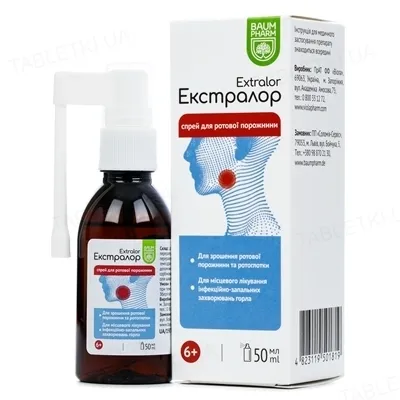
Table of Contents
INSTRUCTIONS FOR MEDICAL USE OF THE MEDICINAL PRODUCT EXTRALOR (EXTRALOR)
Composition:
Active substances:
hexetidine, choline salicylate, chlorobutanol hemihydrate;
100 ml of spray contain: hexetidine, recalculated to 100% substance, 0.1 g; choline salicylate, recalculated to 100% substance, 0.5 g; chlorobutanol hemihydrate, recalculated to 100% anhydrous substance, 0.25 g;
Excipients: sodium saccharin, polysorbate 20, sorbic acid, ethanol 96%,
eucalyptol, methyl salicylate, lime oil, sage oil, glycerin, purified water.
Pharmaceutical form. Oral spray.
Main physicochemical properties: clear, slightly colored solution with a characteristic pleasant odor.
Pharmacotherapeutic group. Agents used for throat disorders. Antiseptics. ATC code R02A A20.
Pharmacological Properties.
Pharmacodynamics.
The action of the drug is due to three active components.
Antibacterial and antifungal activity.
Hexetidine exerts antibacterial effects against both Gram-positive and Gram-negative microbial strains, as well as against both aerobic and anaerobic organisms.
Against aerobic strains, hexetidine generally has a bacteriostatic effect, with weak bactericidal activity. Against anaerobic strains, hexetidine has a pronounced bactericidal effect. The mechanism of action involves competitive interaction with thiamine: the structure of hexetidine resembles that of thiamine, which is essential for microbial growth.
Anti-inflammatory activity.
Choline salicylate provides analgesic, antipyretic, and anti-inflammatory effects. It can be used for the treatment of oral cavity diseases.
Analgesic activity.
Chlorobutanol exerts an analgesic effect. It can be used, in particular, in otorhinolaryngology (nasal drops, rinses) and in dental practice (applications and sprays). Classically, it can be used as a local anesthetic.
The active substances bind to the oral mucosa, from where they are gradually released.
Clinical characteristics.
Indications.
Antibacterial and analgesic agent for local treatment of diseases of the mucous membrane of the oral cavity and oropharynx.
Contraindications.
- Hypersensitivity to any component of the drug;
- Atrophic pharyngitis;
- Bronchial asthma or any other respiratory tract diseases associated with existing airway hyperresponsiveness.
Interaction with other medicinal products and other forms of interaction.
Do not use together with products containing antiseptics.
Hexetidine may be inactivated by alkaline solutions.
Instructions for use.
Do not swallow the preparation and avoid contact with eyes, as it contains ethanol.
The preparation should be used with caution in patients with epilepsy. The preparation may lower the epileptic threshold and may cause seizures in children.
Use with caution in patients with a tendency to allergic reactions, including bronchial asthma, especially in patients allergic to acetylsalicylic acid.
If signs of hypersensitivity to the preparation occur, its use should be discontinued immediately.
Since the preparation contains ethanol, it should be prescribed with caution to patients with liver diseases.
Prolonged use is not recommended, as it may alter the natural microbial balance of the oral cavity and pharynx, with a risk of bacterial and fungal overgrowth.
If general clinical signs of bacterial infection appear, systemic antibacterial therapy should be initiated.
If symptoms persist for more than 5 days and/or body temperature remains elevated, the treatment regimen should be re-evaluated.
If inflammation worsens, treatment with the preparation should be discontinued.
Use during pregnancy or breastfeeding.
There are no human data available on the ability of hexetidine to cross the placenta or to be excreted in breast milk; therefore, the preparation should not be used during pregnancy or breastfeeding.
Ability to influence reaction speed when driving or operating machinery.
The preparation contains ethanol. Drivers are advised not to operate a vehicle or machinery for 30 minutes after using the preparation.
Dosage and Administration.
For topical use as an oral and oropharyngeal spray.
Adults and children aged 15 years and older: 1 spray 4–6 times daily.
Children aged 6 to 15 years: 1 spray 2–3 times daily.
Treatment duration – no longer than 5 days.
Children.
Do not use in children under 6 years of age.
Overdose .
There have been no reports of overdose with this medicinal product.
Alcohol intoxication due to the ethyl alcohol content may occur if a sufficient amount of the solution is absorbed in the oral cavity.
The concentration of hexetidine in the product is not toxic when used as directed.
Acute alcohol intoxication is unlikely. However, if a child swallows a large dose of the product, alcohol intoxication may occur due to the ethyl alcohol content.
No cases of excessive hexetidine exposure leading to hypersensitivity reactions have been reported.
Treatment of overdose is symptomatic and rarely required. If a child has ingested the contents of the bottle, seek immediate medical attention. Consider gastric lavage within 2 hours after ingestion and take measures to manage signs of alcohol intoxication.
Adverse reactions.
Immune system disorders: hypersensitivity reactions, including urticaria, angioedema, laryngospasm, bronchospasm.
Nervous system disorders: ageusia, dysgeusia, altered taste sensations within 48 hours (sweet taste may change twice to bitter taste).
Respiratory, thoracic and mediastinal disorders: cough, dyspnea.
Gastrointestinal disorders: dry mouth, dysphagia, salivary gland enlargement, pain on swallowing. If the product is accidentally swallowed, gastrointestinal disturbances may occur, primarily nausea and vomiting.
Skin and subcutaneous tissue disorders: allergic contact dermatitis, skin reactions (rash).
General disorders and administration site conditions: local reactions (reversible discoloration of teeth and tongue); mucosal sensitivity (burning, numbness sensation); irritation (pain, sensation of heat, itching) of the tongue and/or oral mucosa; decreased sensitivity; mucosal paresthesia; inflammation; blisters; ulceration of the mucosa, throat irritation, swelling at the site of contact, dryness of nasal/throat mucosa.
Reporting of adverse reactions after drug registration is important. It enables continuous monitoring of the benefit-risk balance of the medicinal product. Healthcare and pharmaceutical professionals, as well as patients or their legal representatives, are encouraged to report all suspected adverse reactions and lack of efficacy via the automated pharmacovigilance information system at: https://aisf.dec.gov.ua/.
Shelf life. 2 years.
Storage conditions.
Store in the original packaging at a temperature not exceeding 25 °C.
Keep out of reach of children.
Packaging. 50 ml in a glass bottle, 1 bottle with a spray pump in a carton.
Availability category. Over-the-counter.
Manufacturer.
JSC "FF "Viola".
Manufacturer's address and location of its business activity.
75 Amosova Akademika Street, Zaporizhzhia, Ukraine, 69063.