Ehinasal
Ukraine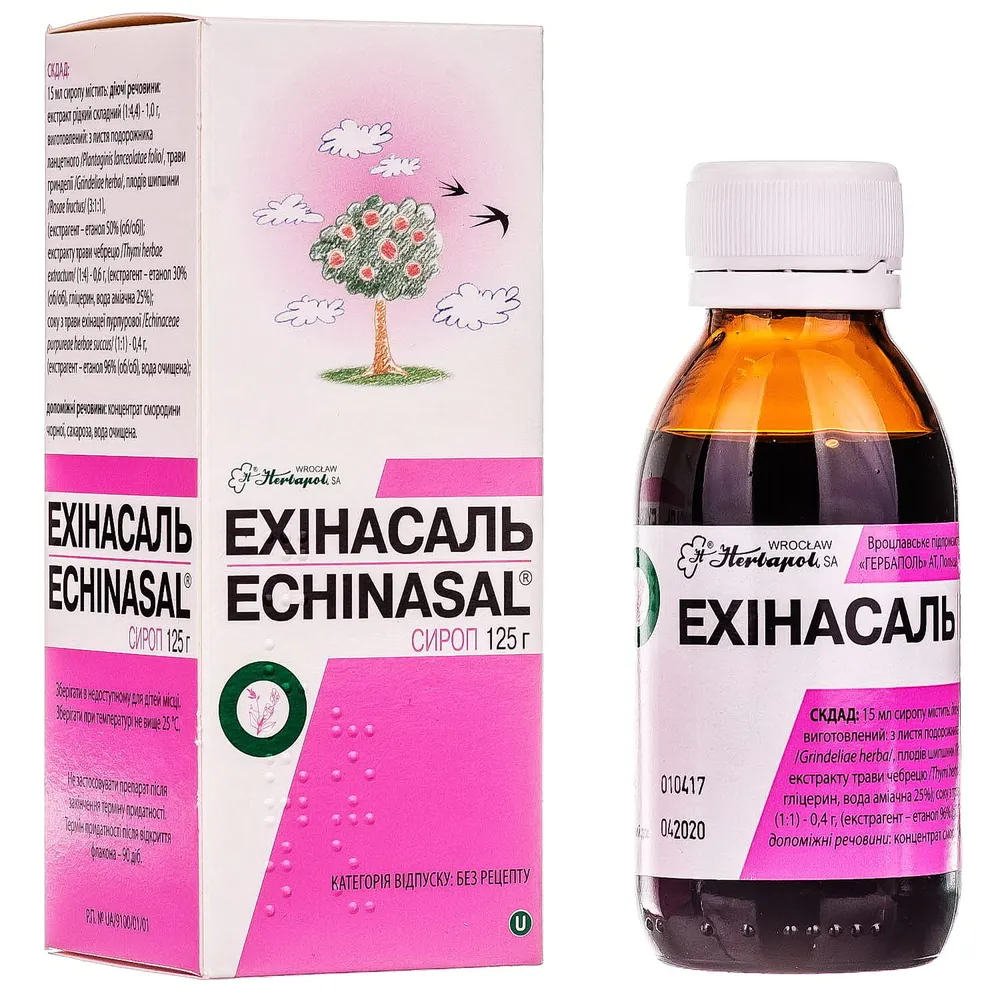
Table of Contents
INSTRUCTIONS FOR MEDICAL USE OF THE MEDICINAL PRODUCT ECHINASAL® (ECHINASAL®)
Composition:
15 ml of syrup contains:
Active substances:
Complex liquid extract (1:4.4) – 1.0 g, prepared from: Plantain leaf (Plantaginis lanceolatae folium), Grindelia herb (Grindeliae herba), and Rosehip fruit (Rosae fructus) (3:1:1) (extractant – ethanol 50% v/v);
Thyme herb extract (Thymi herbae extractum) (1:4) – 0.6 g (extractant – ethanol 30% v/v, glycerin, 25% ammonium solution);
Juice from Purple Coneflower herb (Echinaceae purpureae herbae succus) (1:1) – 0.4 g (extractant – ethanol 96% v/v, purified water);
Excipients: blackcurrant concentrate, sucrose, purified water.
Pharmaceutical form. Syrup.
Main physicochemical properties: clear red-brown syrup with the smell of blackcurrant and thyme; opalescence may be observed.
Pharmacotherapeutic group.
Combined preparations used for cough and colds.
ATC code R05X.
Pharmacological properties.
Pharmacodynamics.
An immunostimulant, anti-inflammatory, and expectorant agent. The main action of the drug is softening of thick and viscous secretions present in the respiratory tract, and stimulation and activation of the expectorant reflex (Grindelia robusta L., Plantago lanceolata L.). The aforementioned components of the drug exhibit anti-inflammatory and antibacterial effects. The extract from rosehip fruits is used in mild forms of upper respiratory tract catarrh. The juice from purple coneflower (Echinacea purpurea) herb activates immune processes.
Pharmacokinetics.
Not studied.
Clinical characteristics.
Indications.
Used in the complex treatment of inflammatory diseases of the upper respiratory tract and bronchitis against the background of weakened protective functions of the body; for prophylaxis in cases of reduced immunity.
Contraindications.
Hypersensitivity to any component of the medicinal product, to flowers of the Asteraceae (Compositae) or Lamiaceae (Labiatae) families. Gastroesophageal reflux disease, including reflux esophagitis; gastritis with increased gastric juice acidity; gastric and duodenal ulcers; severe liver or kidney diseases. Tuberculosis, rheumatism, systemic connective tissue diseases (collagenoses), multiple sclerosis, other autoimmune diseases, chronic viral diseases, HIV infection/AIDS, neoplasms, primary immunodeficiency, immunosuppression, leukocyte blood system disorders (leukemia, agranulocytosis). Thrombophlebitis and predisposition to it, circulatory insufficiency, endocarditis, decompensated diabetes mellitus, severe kidney diseases, cholelithiasis.
Interaction with other medicinal products and other types of interactions.
Due to its immunostimulatory effect, echinacea may reduce the effectiveness of drugs with immunosuppressive activity.
Ehinasal is not recommended to be used simultaneously with hepatotoxic drugs such as amiodarone, methotrexate, ketoconazole, and steroid preparations. The product contains ethanol, which may enhance the absorption and pharmacological effect of certain sedative drugs and, indirectly, by altering the activity of the cytochrome P450 system, may affect the elimination of drugs metabolized by enzymes of this system. Ethanol may cause a disulfiram-like reaction when used concomitantly, for example, with certain antibacterial agents.
Do not use simultaneously with antitussive drugs and medicinal products that reduce sputum secretion.
Special precautions for use
If you have a known intolerance to certain sugars, consult your doctor before taking this medicinal product.
Patients with rare hereditary disorders related to fructose intolerance, glucose-galactose malabsorption, or sucrase-isomaltase deficiency must not take this medicine. The medicinal product contains sucrose, which should be taken into account in patients with diabetes mellitus.
The product contains alcohol; therefore, there is a risk for patients suffering from alcoholism. Alcohol is not recommended for women during pregnancy or breastfeeding, children, and patients at increased risk of developing hepatic insufficiency or epilepsy.
If respiratory diseases recur frequently and are characterized by prolonged symptoms such as dyspnea, fever, or sputum containing blood or pus, medical advice must be sought. If symptoms worsen or body temperature increases during treatment, immediate medical consultation is required.
Patients predisposed to allergies should consult a doctor before taking the medicine, as there is a risk of allergic reactions.
Use during pregnancy or breastfeeding
The medicinal product is contraindicated during pregnancy and breastfeeding.
Ability to influence reaction rate when driving or operating machinery
The medicinal product, at the recommended dose, does not affect reaction speed when driving or operating machinery. However, if dizziness or sleep disturbances occur during treatment, driving or operating machinery should be avoided.
Dosage and Administration.
For oral use, independently of food intake, in adults and children aged 12 years and older.
Children aged 12 years and older and adults – 1 tablespoon (15 ml) 3–4 times daily.
Treatment duration – 10 days.
For prophylactic use, half of the therapeutic dose should be taken:
for children aged 12 years and older and adults – 1 tablespoon twice daily.
Prophylactic use of the drug should not exceed 20 days.
Children.
Do not use in children under 12 years of age.
Overdose.
Symptoms: increased excitability, sleep disturbances, mucous membrane irritation, gastrointestinal disorders, increased intensity of adverse reactions. Due to the alcohol content, alcohol intoxication is possible, especially in children.
Treatment. Symptomatic therapy.
Adverse reactions.
Immune system disorders: hypersensitivity reactions, including angioneurotic edema, anaphylactic shock.
Skin and subcutaneous tissue disorders: skin redness, skin swelling, sensation of itching, rash, urticaria, Stevens-Johnson syndrome.
Respiratory system disorders: bronchospasm with obstruction, asthma, dyspnea.
Nervous system disorders: dizziness, sleep disturbances.
Cardiovascular system disorders: arterial hypotension.
Gastrointestinal disorders: nausea, vomiting, diarrhea, abdominal pain.
There have been isolated reports of possible association with autoimmune diseases (disseminated encephalomyelitis, nodular erythema, immune thrombocytopenia, Evans syndrome, Sjögren-Larsson syndrome with impaired renal tubular function).
With prolonged use (over 8 weeks), leukopenia may occur.
If allergic reactions occur, discontinue use of the product and consult a physician.
Shelf life. 3 years.
Shelf life after opening the bottle – 90 days.
Storage conditions.
Store at a temperature not exceeding 25 °C.
Keep out of reach of children.
Packaging.
125 g of syrup in a dark glass bottle in a cardboard package.
Availability category. Over-the-counter.
Manufacturer.
Wrocław Phytopharmaceutical Company "HERBAPOL" AT.
Manufacturer's address and place of business.
56 Ks. Witolda Street, 50-203 Wrocław, Poland.