Eferox
Ukraine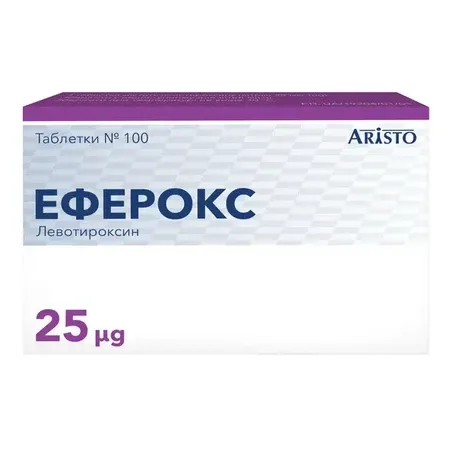
Table of Contents
INSTRUCTIONS FOR MEDICAL USE OF THE MEDICINAL PRODUCT EFEROX®
Composition:
Active substance: levothyroxine sodium;
1 tablet contains 25 mcg, 50 mcg, or 100 mcg of levothyroxine sodium;
Excipients: microcrystalline cellulose, maize starch, sodium carboxymethyl starch (type A), magnesium oxide heavy, magnesium stearate (vegetable).
Pharmaceutical form. Tablets.
Main physicochemical properties: white, round, biconvex tablets, with a break line (tablets can be divided by pressing) and engraved dosage markings «25», «50», or «100».
Pharmacotherapeutic group.
Hormone preparations for systemic use (except sex hormones and insulin). Preparations for the treatment of thyroid disorders. Thyroid preparations. Levothyroxine sodium. ATC code H03A A01.
Pharmacological Properties.
Pharmacodynamics.
Synthetic levothyroxine exhibits effects identical to those of the hormone secreted by the thyroid gland. It is converted into T3 (triiodothyronine) in peripheral organs and, like endogenous hormone, acts on T3 receptors. There is no difference between the functions of endogenous hormone and exogenous levothyroxine.
Pharmacokinetics.
After oral administration, levothyroxine is almost completely absorbed in the upper segment of the small intestine. Depending on the galenical form of the drug, up to 80% of the administered dose is absorbed. Time to reach maximum concentration (Tmax) is approximately 5–6 hours.
The clinical effect of the medicinal product appears 3–5 days after oral administration. Levothyroxine rapidly binds to specific plasma proteins (up to 99.97%). The binding to proteins is non-covalent; thus, the bound hormone in blood plasma is capable of continuously and rapidly exchanging with free hormone fractions.
Due to the high degree of protein binding, levothyroxine is not removed by either hemodialysis or hemoperfusion.
The elimination half-life of the drug is 7 days. In hyperthyroidism, this period is shortened to 3–4 days, whereas in hypothyroidism it is prolonged to 9–10 days. The volume of distribution is 10–12 L.
Approximately one-third of the total administered levothyroxine accumulates in the liver, rapidly equilibrating with levothyroxine present in blood serum. Thyroid hormones are mainly metabolized in the liver, kidneys, brain, and muscles. Metabolites are excreted in urine and feces. Total metabolic clearance of levothyroxine is approximately 1.2 L of plasma per day.
Clinical characteristics.
Indications.
Management of hypothyroidism, congenital hypothyroidism in infants, acquired hypothyroidism in children, and juvenile myxedema.
Contraindications.
- Hypersensitivity to any component of the drug.
- Untreated thyrotoxicosis.
- Adrenal insufficiency, untreated adrenal dysfunction.
Interaction with other medicinal products and other forms of interaction.
Levothyroxine enhances the effect of anticoagulants (e.g., warfarin). Dosage reduction of anticoagulants may be required in case of excess to avoid hypoprothrombinemia and bleeding.
Blood glucose levels may increase, therefore dosage adjustments of antidiabetic medications may be necessary.
Response to tricyclic antidepressants (e.g., amitriptyline, imipramine, dosulepin) may be accelerated, as levothyroxine increases sensitivity to catecholamines. Concomitant use may lead to cardiac arrhythmias.
The effect of sympathomimetic drugs (e.g., epinephrine or phenylephrine) is also enhanced.
Cardiac glycosides: if levothyroxine treatment is initiated in patients already receiving digitalis, the dose of digoxin may require adjustment. Patients with hypothyroidism may require gradual increases in digoxin dosage, as they initially exhibit relative sensitivity to it.
Nonsteroidal anti-inflammatory drugs (NSAIDs): falsely low plasma concentrations have been observed when NSAIDs (phenylbutazone, acetylsalicylic acid) are taken concomitantly with levothyroxine.
Beta-blockers: levothyroxine (thyroxine) accelerates the metabolism of propranolol, atenolol, and sotalol.
General anesthetics: isolated reports have described hypertension and tachycardia associated with concomitant use of ketamine.
Interactions with levothyroxine:
Amiodarone may inhibit the deiodination of thyroxine to triiodothyronine, resulting in reduced triiodothyronine concentration. This leads to decreased thyroid hormone activity.
Anticonvulsants such as carbamazepine and phenytoin enhance the metabolism of thyroid hormones and may displace them from plasma proteins.
Initiation or discontinuation of anticonvulsant therapy may alter levothyroxine dosage requirements.
The effect of levothyroxine may be reduced when used concomitantly with sertraline.
Absorption of levothyroxine (thyroxine) may be reduced by antacids, calcium salts, cimetidine, oral iron, sucralfate, colestipol, polystyrene sulfonate resin, and cholestyramine (administration should be separated by intervals of 4–5 hours).
Concomitant use with proton pump inhibitors (PPIs) may lead to reduced absorption of thyroid hormones due to increased gastric pH caused by PPIs.
During concomitant treatment, regular monitoring of thyroid function and clinical observation are recommended. An increase in thyroid hormone dosage may be required.
Caution should also be exercised when PPI treatment is discontinued.
Metabolism of levothyroxine (thyroxine) is accelerated by rifampicin, barbiturates, and primidone (which may increase the requirement for levothyroxine in hypothyroidism).
Imatinib: may decrease plasma concentration of levothyroxine (thyroxine).
Beta-blockers may reduce peripheral conversion of levothyroxine to triiodothyronine.
Lipid-regulating drugs: according to reports, these drugs may induce either hypothyroidism or hyperthyroidism in patients taking levothyroxine.
Sex hormones: estrogen, estrogen-containing drugs (including hormone replacement therapy), and oral contraceptives may increase the dosage requirement during treatment for hypothyroidism. In contrast, androgens and corticosteroids may reduce serum concentrations of levothyroxine-binding globulins.
Anti-obesity drugs such as orlistat may reduce levothyroxine absorption, potentially leading to hypothyroidism (monitoring of thyroid function is recommended).
Effect of drugs inducing cytochrome P-450: drugs that induce enzymes, such as barbiturates, rifampicin, primidone, and herbal products containing St. John’s wort (Hypericum perforatum L.), may increase hepatic clearance of levothyroxine, leading to decreased serum thyroid hormone concentrations. Thus, patients receiving thyroid hormone replacement therapy may require an increased dose of thyroid hormones when these drugs are used concomitantly.
Several drugs may affect thyroid function test results. This should be considered during monitoring of patients undergoing levothyroxine therapy.
Biotin may interfere with immunoassays of thyroid function based on biotin/streptavidin interaction, leading to falsely low or falsely high test results (see section "Special precautions for use").
Post-marketing reports have indicated potential interactions between ritonavir-containing medicinal products and levothyroxine. In patients treated with levothyroxine, thyroid-stimulating hormone (TSH) levels should be monitored, at least during the first month after initiation or discontinuation of ritonavir therapy.
Special precautions for use.
For patients aged 50 years and older, and those with long-standing hypothyroidism, levothyroxine should be introduced very gradually in order to prevent uncontrolled increase in metabolic demands.
Patients with panhypopituitarism or other causes leading to adrenal insufficiency may react to levothyroxine treatment. Such patients are recommended to start corticosteroid therapy prior to administration of levothyroxine.
Sodium levothyroxine should be used with caution in patients with cardiovascular disorders, including angina pectoris, atherosclerotic heart disease, and hypertension, as well as in elderly patients who are more likely to have undiagnosed heart disease.
To reduce the risk of adverse outcomes from unrecognized overdose, such as atrial fibrillation and fractures associated with low serum thyroid-stimulating hormone (TSH) levels, it is important to monitor serum TSH concentrations and adjust the dose accordingly during long-term treatment in elderly patients.
For individuals suspected of having cardiovascular disease or at high risk of such disease, performing an ECG before initiating levothyroxine therapy is important to detect changes that could lead to ischemia. In such cases, levothyroxine therapy should be initiated at a lower dose, with careful dose titration to prevent negative progression of ischemia or acceleration of infarction.
Special monitoring is required for elderly patients and those with symptoms of heart failure or signs of myocardial infarction on ECG.
Thyroid hormone therapy may necessitate an increase in the dose of insulin or other antidiabetic medicinal products (such as metformin). Patients with diabetes mellitus or non-diabetic diabetes require additional monitoring.
Subclinical hypothyroidism may be associated with loss of bone mass. To reduce the risk of osteoporosis, sodium levothyroxine dosing should be maintained at the lowest effective level.
Parents of children receiving thyroid medications should be aware that partial hair loss may occur during the first few months of therapy, but this effect is usually temporary and hair regrowth typically follows.
Additional monitoring is required when levothyroxine is administered to patients with a known history of epilepsy. Rare seizure episodes have been reported following initiation of sodium levothyroxine treatment, which may be related to the effect of thyroid hormone on seizure threshold.
Hemodynamic parameters should be monitored when levothyroxine treatment is initiated in preterm neonates with very low birth weight, due to the risk of vascular collapse resulting from immature adrenal gland function.
Effect on laboratory test results:
Biotin may interfere with thyroid function tests based on biotin/streptavidin interaction, leading to falsely decreased or falsely increased test results. The risk of interference increases with higher doses of biotin.
When interpreting laboratory test results, potential biotin interference should be considered, especially if there is a lack of concordance with the clinical picture.
Patients taking biotin-containing products should inform laboratory personnel about the optimal timing for thyroid function testing. Alternative tests insensitive to biotin interference should be used, if available. (See section "Interaction with other medicinal products and other forms of interaction")
Use during pregnancy or breastfeeding.
Pregnancy
Information on the safety of levothyroxine treatment during pregnancy is limited; however, any potential risk of fetal developmental abnormalities should be weighed against the risk of untreated fetal hypothyroidism.
Breastfeeding period
Levothyroxine is excreted in breast milk in low concentrations, and whether this may interfere with newborn screening remains controversial.
Ability to influence reaction speed when driving or operating machinery.
Levothyroxine has no effect or negligible effect on the ability to drive and use machinery.
Dosage and Administration
For the treatment of each individual patient according to their specific needs, the drug is available in tablets containing 25 mcg, 50 mcg, or 100 mcg of sodium levothyroxine.
Dosage information is provided for guidance only.
The daily dose should be individualized based on laboratory parameters and the clinical condition of the patient.
Young patients: In the absence of cardiac disease, the target serum levothyroxine (T4) level is 70–160 nmol/L or serum thyrotropin (TSH) level below 5 mU/L. An ECG should be performed before initiating therapy, as ECG changes due to hypothyroidism may be mistaken for signs of cardiac ischemia. In case of sudden metabolic overactivity (manifested by diarrhea, nervousness, rapid pulse, insomnia, tremor, and occasionally angina when occult cardiac ischemia is present), the dosage should be reduced or discontinued for 1–2 days, then restarted at a lower dose.
Adults
Initial dose: 100 mcg daily, preferably taken before breakfast or before the first meal of the day. The dose may be increased by 50 mcg every 3–4 weeks until a stable metabolic state is achieved. The final daily dose may range from 100 to 200 mcg.
Older patients
Applies to patients aged 50 years and older.
For patients aged 50 years and above, initial daily dosage should not exceed 50 mcg. Thereafter, the daily dose may be increased by 50 mcg every 3–4 weeks until a stable thyroxine level is achieved. The final daily dose may range from 50 to 200 mcg.
Patients aged 50 years and older with cardiac disease
In patients with cardiac disease, the recommended initial dose is 25 mcg daily or 50 mcg every other day. The daily dose may then be increased by 25 mcg every 4 weeks until a stable thyroxine level is achieved. The final daily dose may range from 50 to 200 mcg.
For patients aged 50 years and older, regardless of the presence of cardiac disease, clinical response is a more appropriate criterion for dose adjustment than serum hormone levels.
Pediatric patients
Maintenance dose is typically 100–150 mcg per m² of body surface area. Dosage in children depends on age, body weight, and the condition being treated. Regular monitoring of serum TSH levels is essential in children, as in adults, to ensure appropriate dosing. Children should receive the total daily dose at least 30 minutes before the first meal of the day.
Infants with congenital hypothyroidism
For newborns and infants with congenital hypothyroidism requiring rapid compensation, an initial dose of 10–15 mcg per kg of body weight per day is recommended during the first 3 months of life. The dose should be individually adjusted based on clinical response and thyroid hormone and TSH levels.
Children with acquired hypothyroidism
For children with acquired hypothyroidism, the initial recommended dose is 12.5–50 mcg daily. The dose should be gradually increased every 2–4 weeks according to clinical response and thyroid hormone and TSH levels until the full replacement dose is reached.
Children with juvenile myxedema
Initial recommended dose: 25 mcg daily. The daily dose may be increased by 25 mcg every 2–4 weeks until mild symptoms of hypothyroidism resolve. The dose should then be slightly reduced.
Children
The medicinal product may be used from birth (see section "Dosage and Administration").
Overdose
Symptoms
In most cases, symptoms are nonspecific. Signs of overdose may include cough, chest pain (angina), rapid or irregular heartbeat, muscle spasms, headache, anxiety, hyperemia, increased sweating, diarrhea, tremor, insomnia, and hyperpyrexia. The onset of these symptoms may be delayed up to 5 days. Atrial fibrillation may develop. Seizures have been reported in children. Patients with pre-existing cardiovascular disease may experience increased toxicity.
Treatment strategy
Within 1 hour of ingestion, administer activated charcoal orally if an adult has ingested more than 10 mg of the drug or a child has ingested more than 5 mg. If an adult has ingested more than 10 mg or a child more than 5 mg, blood should be drawn 6–12 hours after ingestion to measure free thyroxine concentration. This test does not require immediate analysis and may be delayed until the next working day after the event. Patients with normal thyroxine levels do not require further monitoring. Individuals with elevated thyroxine levels should undergo outpatient follow-up 3–6 days after ingestion to detect delayed-onset hyperthyroidism. Clinical manifestations of hyperthyroidism should be managed with beta-blockers, such as propranolol.
Adverse reactions.
Adverse reactions usually indicate an increased dosage and typically resolve upon dose reduction or temporary discontinuation of treatment for several days.
The adverse reactions listed below were observed during clinical trials and/or post-marketing use of the drug and are based on clinical trial data, classified according to the MedDRA (Medical Dictionary for Regulatory Activities) system organ class. Frequency categories are defined according to the following conventional term:
Frequency not known (cannot be estimated from the available data).
| System Organ Class |
Frequency |
Adverse Reactions |
| Immune system disorders |
frequency unknown |
allergic reactions |
| Endocrine disorders |
frequency unknown |
thyroid storm1 |
| Psychiatric disorders |
frequency unknown |
anxiety, agitation, insomnia |
| Nervous system disorders |
frequency unknown |
tremor |
| Cardiac disorders |
frequency unknown |
Runge-Heiberg disease, arrhythmia, increased heart rate, tachycardia |
| Vascular disorders |
frequency unknown |
hyperemia |
| Respiratory, thoracic and mediastinal disorders |
frequency unknown |
dyspnea |
| Gastrointestinal disorders |
frequency unknown |
diarrhea, vomiting |
| Skin and subcutaneous tissue disorders |
frequency unknown |
hyperhidrosis, rash, pruritus |
| Musculoskeletal and connective tissue disorders |
frequency unknown |
arthralgia, muscle spasm, muscle weakness |
| Reproductive system disorders |
frequency unknown |
menstrual cycle disturbance |
| General disorders and administration site conditions |
frequency unknown |
headache, malaise, discomfort, swelling |
| Investigations |
frequency unknown |
decreased body weight |
1In some patients, a severe reaction to high levels of thyroid hormone may occur. This is known as thyroid storm, presenting with any of the following symptoms: hyperpyrexia, tachycardia, arrhythmia, hypotension, heart failure, jaundice, seizures, and coma.
In pediatric patients the following may occur: heat intolerance, temporary hair loss, idiopathic intracranial hypertension, craniosynostosis in infants, and premature epiphyseal closure in children.
Reporting of suspected adverse reactions
Reporting suspected adverse reactions after authorization of the medicinal product is important. It allows continued monitoring of the benefit/risk balance of the medicinal product. Healthcare professionals are requested to report any suspected adverse reactions.
Shelf life.
Tablets 25 mcg and 50 mcg – 24 months; tablets 100 mcg – 27 months.
Do not use the medicinal product after the expiry date stated on the packaging.
Storage conditions.
Store at temperatures not exceeding 30 °C.
Keep out of reach of children.
Packaging.
25 tablets in a blister. 4 blisters in a pack.
Prescription status. Prescription only.
Manufacturer.
Lindopharm GmbH.
Manufacturer's address and location of operations.
Neustrasse 82, 40721 Hilden, Germany.
Marketing Authorization Holder
Esparma GmbH, Germany.
Location.
Bielefelder Strasse 1, 39171 Seethetal, Germany.