Dicerel®
Ukraine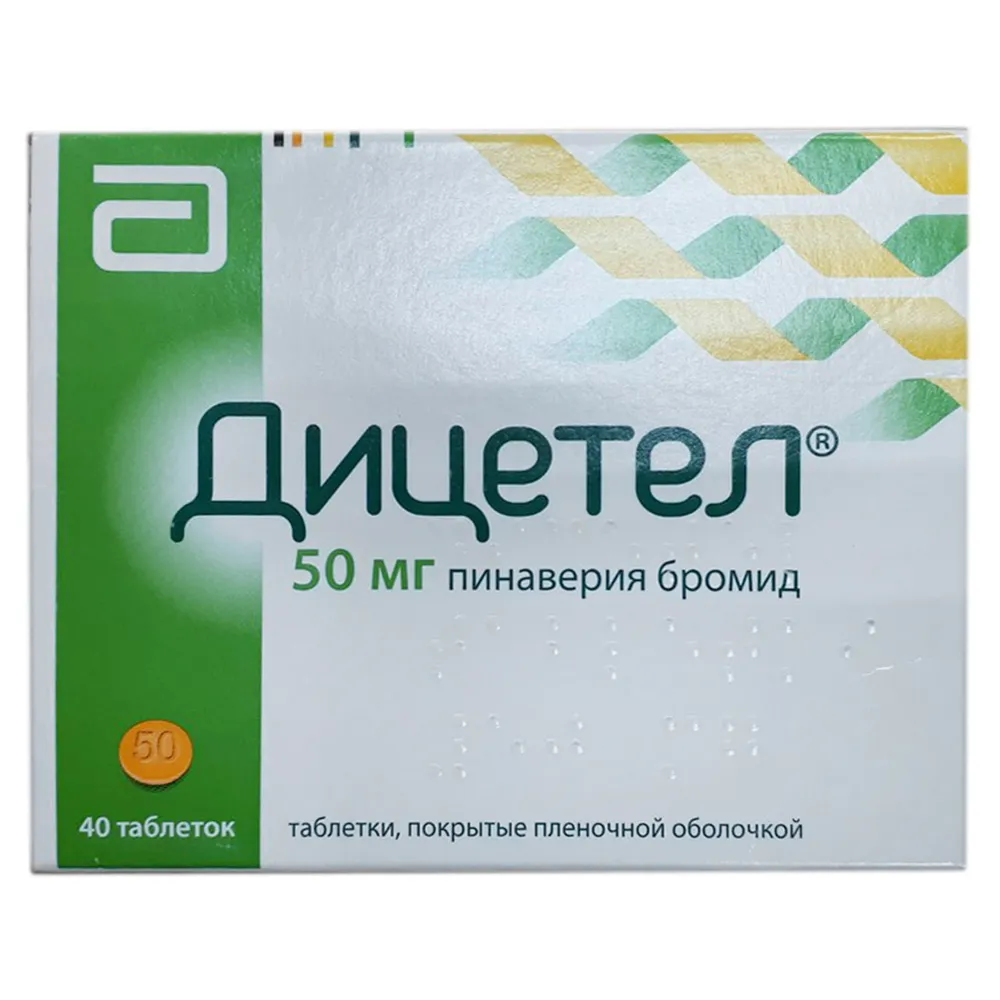
Table of Contents
- I N S T R U C T I O N for medical use of the medicinal product DICETEL® (DICETEL®)
- Composition:
- Pharmacological Properties
- Clinical characteristics.
- Special precautions for use
- Method of Administration and Dosage.
- Adverse Reactions
- Gastrointestinal disorders are mainly related to the underlying disease. Similar or lower incidence of abdominal pain, constipation, and dry mouth has been reported with the use of the drug compared to placebo.
I N S T R U C T I O N for medical use of the medicinal product DICETEL® (DICETEL®)
Composition:
Active substance: pinaverium bromide;
1 tablet contains 50 mg of pinaverium bromide;
Excipients: colloidal anhydrous silicon dioxide, microcrystalline cellulose, talc, magnesium stearate, pregelatinized starch, lactose monohydrate;
Coating: stearic acid, basic butylated methacrylate copolymer, sodium lauryl sulfate, hydroxypropylmethylcellulose, talc, yellow iron oxide (E 172), red iron oxide (E 172).
Pharmaceutical form. Film-coated tablets.
Main physico-chemical properties: yellowish-orange film-coated tablet with the imprint „50” on one side.
Pharmacotherapeutic group. Drugs used in functional gastrointestinal disorders. ATC code A03A X04.
Pharmacological Properties
Pharmacodynamics
Pinaverium bromide is a spasmolytic agent that acts selectively on the gastrointestinal tract. As a calcium antagonist, it inhibits calcium influx into smooth muscle cells of the intestinal wall. In animals, pinaverium directly or indirectly reduces the effects of stimulation of sensitive afferent nerve fibers. The drug has no significant anticholinergic effects and does not affect the cardiovascular system.
Pharmacokinetics
After oral administration, pinaverium bromide is rapidly absorbed, with maximum plasma concentrations reached within 1 hour. The drug is actively metabolized and eliminated via the liver. The elimination half-life is 1.5 hours. Absolute bioavailability of the oral formulation is very low (< 1%). The main route of elimination is via feces.
Plasma protein binding of pinaverium bromide is high (95–97%).
Clinical characteristics.
Indications.
- Symptomatic treatment of pain, transient intestinal disorders, and intestinal discomfort associated with functional intestinal disorders.
- Symptomatic treatment of pain due to dysfunction of the biliary passages.
- Preparation for barium-containing radiological examination of the intestine.
Contraindications.
Hypersensitivity to the active substance or to any of the excipients of the medicinal product.
Interaction with other medicinal products and other forms of interaction.
Clinical studies have confirmed the absence of any interaction between pinaverium bromide and digitalis preparations, oral antidiabetic agents, insulin, oral anticoagulants (e.g., acenocoumarol [vitamin K antagonist]) and heparin.
Concomitant use of anticholinergic drugs may enhance the spasmolytic effect. No influence on laboratory tests assessing drug levels has been observed.
Special precautions for use
Due to the risk of esophageal injury, it is essential to strictly follow the instructions for taking the medication. Particular attention to proper administration is required in patients with pre-existing esophageal disorders and/or diaphragmatic hiatal hernia.
This medicinal product contains lactose. Patients with rare hereditary disorders such as galactose intolerance, lactase deficiency, or glucose-galactose malabsorption should not take this product.
Use during pregnancy or breastfeeding
There are insufficient data on the use of pinaverium bromide in pregnant women. Animal studies on the effects on pregnancy, embryonic/fetal development, labor, or postnatal development are limited. The potential risk to humans is unknown. Dicetel® should not be used during pregnancy unless absolutely necessary.
Moreover, the presence of bromide in the formulation must be taken into account. The use of pinaverium bromide towards the end of pregnancy may affect the newborn's nervous system (hypotonia, sedative effect).
Information regarding the excretion of Dicetel® into human or animal breast milk is insufficient. Available physicochemical, pharmacodynamic, and toxicological data suggest that Dicetel® may be excreted in breast milk, and a risk to the breastfed infant cannot be ruled out. Dicetel® should not be used during breastfeeding.
Ability to affect reaction speed when driving or operating machinery
Studies on the influence of Dicetel® on the ability to drive or operate machinery have not been conducted.
Adverse drug reactions may occur, including somnolence (see section "Adverse reactions"). In such a condition, reaction ability may be reduced.
Method of Administration and Dosage.
Adults
- The recommended dose is 1 tablet three times daily or 2 tablets twice daily.
If necessary, this dose may be increased to 2 tablets three times daily.
- In preparation for barium X-ray examination of the intestine, the dose is 2 tablets twice daily for 3 days prior to the examination.
The tablets must be swallowed whole, without chewing or dissolving, with a glass of water, during meals, to avoid contact of pinaverium with the mucosa of the esophagus (risk of esophageal injury, see section "Side Effects").
Children.
Safety and efficacy of the drug in children have not been sufficiently established, and experience with its use is limited. Therefore, the medicinal product is not recommended for use in children.
Overdose.
Overdose of the drug may cause gastrointestinal reactions such as nausea, abdominal bloating, and diarrhea. No specific antidote is known; symptomatic treatment is recommended.
Adverse Reactions
Based on pooled data from 46 studies involving 3,755 patients who received pinaverium bromide, the following adverse reactions have been reported and are classified below by frequency and system organ class according to MedDRA. Frequency is defined as: very common (≥1/10), common (≥1/100 to <1/10), uncommon (≥1/1,000 to <1/100), rare (≥1/10,000 to <1/1,000), or very rare (<1/10,000).
Gastrointestinal disorders:
Common – abdominal pain*#, constipation#, dry mouth#, dyspepsia, nausea;
Uncommon – diarrhea, vomiting
General disorders and administration site conditions:
Uncommon – asthenia
Nervous system disorders:
Common – headache;
Uncommon – somnolence
* Combination of preferred terms: "abdominal pain", "lower abdominal pain", and "upper abdominal pain".
Gastrointestinal disorders are mainly related to the underlying disease. Similar or lower incidence of abdominal pain, constipation, and dry mouth has been reported with the use of the drug compared to placebo.
During post-marketing use, the following adverse reactions have been spontaneously reported. The exact frequency of these adverse reactions cannot be estimated from the available data (frequency unknown).
Gastrointestinal tract
Disorders such as abdominal pain, diarrhea, nausea, vomiting, and dysphagia have been observed. Esophageal injury may occur if the medication is taken without following the appropriate recommendations (see section "Dosage and administration***")***.
Skin and subcutaneous tissue
Skin reactions such as rash, pruritus, urticaria, and erythema have been observed.
Immune system
Hypersensitivity.
There have been spontaneous reports of systemic hypersensitivity reactions, including angioedema and anaphylactic shock, which may involve subcutaneous tissue and other organ systems.
Minor adverse events were recorded and described as mild to moderate. These were mainly minor gastrointestinal disturbances, which could be related to underlying conditions, such as constipation (0.4%), heartburn (0.3%), bloating (0.3%).
For other systems: headache (0.3%), somnolence (0.2%), dizziness (0.2%).
Shelf life. 3 years.
Storage conditions.
Store at a temperature not exceeding 30 °C. To protect from light, the blister should be kept in the cardboard box. Keep out of reach and sight of children!
Packaging.
20 tablets per blister, 1 or 2 blisters per cardboard box.
Prescription category.
Prescription only.
Manufacturer.
Mylan Laboratories SAS, France / Mylan Laboratories SAS, France.
Address.
Route de Belleville, Lieu dit Maillard, 01400, Chatillon-sur-Chalaronne, France / Route de Belleville, Lieu dit Maillard, 01400, Chatillon-sur-Chalaronne, France.