Dotavist
Ukraine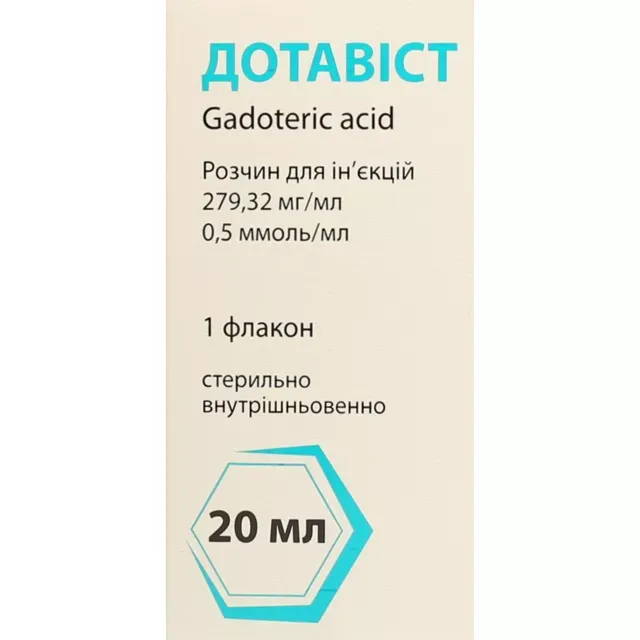
Table of Contents
INSTRUCTIONS FOR MEDICAL USE OF THE MEDICINAL PRODUCT DOTAVIST (DOTAVIST)
Composition:
Active substance: gadoteric acid;
1 ml of solution contains 279.32 mg (0.5 mmol) of gadoteric acid, equivalent to 376.92 mg of gadoterate meglumine;
Excipients: meglumine, water for injections.
Pharmaceutical form. Injection solution.
Main physicochemical properties: clear, colorless or slightly yellow solution, practically free from mechanical particles.
Pharmacotherapeutic group. Paramagnetic contrast agents. Gadoteric acid.
ATC code V08C A02.
Pharmacological properties.
Pharmacodynamics.
Gadoteric acid has paramagnetic properties that enhance contrast in magnetic resonance imaging (MRI). Gadoteric acid has no specific pharmacodynamic activity and is highly biologically inert.
Pharmacokinetics.
After intravenous injection, gadoteric acid distributes into the extracellular fluids of the body. Gadoteric acid does not bind to plasma albumin.
In patients with normal renal function, the plasma half-life is approximately 90 minutes. Gadoteric acid is excreted unchanged via glomerular filtration. In renal impairment, plasma clearance is reduced.
In animals, excretion of gadoteric acid into milk is low, and penetration across the placental barrier is slow.
Currently, there are no data available on the pharmacokinetics in elderly people, children, pregnant or breastfeeding women, or in patients with hepatic impairment.
Clinical characteristics.
Indications.
Used exclusively for diagnostic purposes when magnetic resonance imaging (MRI) without contrast enhancement is not feasible.
Adults
Contrast enhancement in MRI.
MRI of the brain and spinal cord: detection of brain and spinal tumors, surrounding tissues, intervertebral disc herniations, infectious diseases.
Whole-body MRI, including visualization of pathology of kidneys, heart, uterus, ovaries, thoracic and abdominal organs, and musculoskeletal abnormalities.
Angiography.
Children (0–18 years)
Contrast enhancement in MRI.
MRI of the brain and spinal cord: detection of brain and spinal tumors, surrounding tissues, intervertebral disc herniations, infectious diseases.
Whole-body MRI, including visualization of pathology of kidneys, heart, uterus, ovaries, thoracic and abdominal organs, and musculoskeletal abnormalities.
Contraindications.
Hypersensitivity to gadoterate acid, meglumine, or to any medicinal product containing gadolinium.
Interaction with other medicinal products and other forms of interaction.
No interaction with other medicinal products has been observed. Adequate studies on drug interactions have not been conducted.
Concomitant medicinal products to be considered. Beta-blockers, vasoactive substances, angiotensin-converting enzyme (ACE) inhibitors, and angiotensin II receptor antagonists may reduce the effectiveness of cardiovascular compensatory mechanisms in arterial pressure disturbances. The radiologist must be informed if the patient is taking any of these medications prior to administration of gadolinium-based agents, and resuscitation equipment should be prepared in advance.
Special precautions for use
Gadoteridic acid must not be administered intrathecally. Serious, life-threatening, and fatal reactions, predominantly neurological (e.g., coma, encephalopathy, seizures), have been reported following intrathecal administration. Gadoteridic acid must be administered strictly by intravenous injection. Extravasation may lead to local intolerance reactions requiring standard local treatment.
Standard precautions must be taken during MRI procedures: the presence of cardiac pacemakers, ferromagnetic vascular clips, infusion pumps, neurostimulators, cochlear implants, or suspicion of intracorporeal metallic foreign bodies, particularly in the eye, must be considered.
Hypersensitivity
- As with other gadolinium-containing contrast agents, hypersensitivity reactions, including life-threatening ones, may occur. Hypersensitivity reactions may be allergic (described as anaphylactic reactions if identified as serious) or non-allergic. Reactions may be immediate (within less than 60 minutes) or delayed (up to 7 days). Anaphylactic reactions occur immediately and may be fatal. Anaphylactic reactions are dose-independent, may occur even after the first dose of the agent, and are often unpredictable.
- Regardless of the administered dose, there is always a risk of developing hypersensitivity.
- Patients who have previously experienced a reaction during prior administration of a gadolinium-containing contrast agent have an increased risk of another reaction upon subsequent administration of the same agent or possibly other agents; therefore, these patients are at high risk of allergic reactions.
- Administration of gadoteridic acid may exacerbate symptoms of pre-existing asthma. In patients with asthma whose condition worsens following administration of the agent, the decision to use gadoteridic acid should be made only after careful risk-benefit assessment.
- It is known that patients receiving beta-blockers, especially those with concomitant bronchial asthma, may experience exacerbated hypersensitivity reactions to iodinated contrast agents. These patients may be refractory to standard treatment of hypersensitivity reactions with beta-agonists.
- Prior to injection of any contrast agent, the patient's allergy history (e.g., allergy to seafood, hay fever, urticaria), sensitivity to contrast agents, and presence of bronchial asthma should be assessed, as a higher frequency of adverse reactions to contrast agents has been reported in patients with these conditions. Premedication with antihistamines and/or glucocorticoids may also be considered.
- The examination must be performed under close medical supervision. In the event of a hypersensitivity reaction, administration of the contrast agent must be stopped immediately and specific therapy initiated as needed. Intravenous access must be maintained throughout the examination period. Appropriate medications (e.g., epinephrine and antihistamines), an endotracheal tube, and a respirator must be readily available to initiate emergency measures immediately.
Renal function impairment
All patients should be evaluated for renal dysfunction prior to administration of gadoteridic acid, with interpretation of laboratory test results.
Nephrogenic systemic fibrosis (NSF), associated with the use of certain gadolinium-containing contrast agents, has been reported in patients with acute or chronic severe renal impairment (GFR < 30 mL/min/1.73 m²). Patients undergoing liver transplantation are at particularly high risk due to the high incidence of acute renal failure in this group. Since there is a possibility that NSF may also occur following administration of gadoteridic acid, the agent should be used in patients with severe renal insufficiency and in patients before and after liver transplantation only after careful risk-benefit assessment and when diagnostic information is essential but not obtainable with non-contrast MRI.
After administration of gadoteridic acid, hemodialysis may be used to remove the agent from the body. There is no evidence supporting initiation of hemodialysis for the prevention or treatment of NSF in patients who have not yet undergone hemodialysis.
Elderly patients
Since renal clearance of gadoteridic acid may be reduced in elderly patients, particularly those aged 65 years and older, it is especially important to monitor these patients for the development of renal function impairment.
Children
Neonates and infants
Due to immature renal function in neonates up to 4 weeks of age and children up to 1 year of age, gadoteridic acid should be used in these patients only after careful evaluation of all risks.
Cardiovascular diseases
Gadoteridic acid should be used in patients with severe cardiovascular diseases only after careful risk-benefit assessment, as only limited data are currently available.
CNS disorders
As with other gadolinium-containing contrast agents, special precautions are necessary in patients with a low seizure threshold. Precautionary measures, such as close monitoring of the patient, should be taken. All equipment and medications necessary for seizure management must be prepared and readily available.
Use during pregnancy or breastfeeding
Pregnancy
Data on the use of gadolinium-based contrast agents, including gadoteridic acid, in pregnant women are limited. Gadolinium can cross the placenta. It is unknown whether the effect of gadolinium on the fetus is associated with adverse reactions. Animal studies do not indicate a direct or indirect harmful effect on reproductive function. Gadoteridic acid should not be used during pregnancy unless the clinical condition of the woman necessitates its use.
Period of breastfeeding
Gadolinium-containing contrast agents are excreted in breast milk in small amounts. Considering the small quantity of the agent excreted into milk and poor gastrointestinal absorption, no effect on the newborn is expected following clinical doses. The decision to continue or interrupt breastfeeding for 24 hours after administration of gadoteridic acid should be left to the discretion of the physician and the breastfeeding mother.
Ability to affect reaction rate when driving or operating machinery
No studies on the effect of the drug on the ability to drive or operate machinery have been conducted. Patients receiving the drug on an outpatient basis should be aware that nausea may occur suddenly while driving or operating machinery.
Method of Administration and Dosage
The lowest dose that provides adequate contrast enhancement for diagnostic purposes should be used.
The dose should be calculated based on the patient's body weight. This dose must not exceed the recommended dose per kilogram of body weight, as described in detail in this section.
Adults, including elderly patients
MRI of the brain and spinal cord. In most cases, the recommended dose is 0.1 mmol/kg, i.e. 0.2 ml/kg, which is sufficient to achieve diagnostically appropriate contrast enhancement.
If clinical suspicion of a lesion persists despite normal MRI findings, a subsequent injection of 0.2 mmol/kg, i.e. 0.4 ml/kg, within 30 minutes may improve tumor visualization and assist in treatment planning.
Whole-body MRI and angiography
A dose of 0.1 mmol/kg, i.e. 0.2 ml/kg, is recommended to achieve diagnostically appropriate contrast enhancement.
Angiography. In exceptional cases (e.g., inability to obtain adequate imaging of a large vascular region), administration of a second sequential injection of 0.1 mmol/kg, i.e. 0.2 ml/kg, may be justified. However, if two sequential doses of Dotarem are anticipated prior to angiography of specific regions (such as leg arteries or pulmonary arteries), administration of 0.05 mmol/kg, i.e. 0.1 ml/kg per dose, may be considered depending on the available image processing equipment.
Special populations
Renal impairment
In patients with mild or moderate renal impairment (GFR ≥ 30 ml/min/1.73 m²), the adult dose is used.
Dotarem should be administered to patients with severe renal impairment (GFR < 30 ml/min/1.73 m²), and to patients before and after liver transplantation, only after careful risk-benefit assessment and when diagnostic information is essential and cannot be obtained by non-contrast MRI. If administration of Dotarem is necessary, the dose must not exceed 0.1 mmol/kg body weight. More than one dose should not be administered during a single scanning session. Due to lack of data on repeat administration, injections of Dotarem should not be repeated if the interval between injections is less than 7 days.
Elderly patients (aged 65 years and older)
No dose adjustment is required. However, caution is advised when administering the drug to elderly patients.
Hepatic impairment
The adult dose is used in patients with hepatic impairment. However, caution is recommended, particularly in the perioperative period of liver transplantation.
Children (0–18 years)
MRI of the brain and spinal cord / Whole-body MRI
The recommended maximum dose of gadoterate acid is 0.1 mmol/kg body weight. More than one dose should not be administered during a single scanning session.
Due to immature renal function in neonates up to 4 weeks of age and children under 1 year of age, Dotarem should be used only after careful consideration of all factors, at a dose not exceeding 0.1 mmol/kg body weight. Due to lack of data on repeat administration, injections of Dotarem should not be repeated if the interval between injections is less than 7 days.
Angiography
Gadoterate acid is not recommended for angiography in children under 18 years of age due to insufficient data on efficacy and safety for this indication.
Method of administration
The product is intended for intravenous use only.
Intravenous administration of contrast agents should, if possible, be performed with the patient in a supine position. After administration, the patient should remain under observation for at least 30 minutes, as experience shows that most adverse reactions occur within this period.
From a microbiological standpoint, the product should be used immediately. If not used immediately, the time and conditions of storage prior to use are the responsibility of the user and, in general, should not exceed 24 hours at a temperature of 2 °C to 8 °C, except in cases where the container has been opened under controlled and validated aseptic conditions.
Paediatric population
Depending on the amount of Dotarem to be administered to a child, it is preferable to use vials of Dotarem with a volume adapted to that amount, in order to administer as accurate a volume as possible.
In neonates and infants, the required dose should be administered manually.
Children.
Due to immature renal function in neonates up to 4 weeks of age and children under 1 year of age, gadoterate acid should be used in these patients only after careful assessment of all risks.
Overdose.
Gadoterate acid may be removed by hemodialysis. However, there is no evidence that hemodialysis is effective in preventing nephrogenic systemic fibrosis (NSF).
Adverse reactions.
Adverse reactions associated with the use of gadoteric acid are usually mild or moderate in intensity and transient. The most commonly observed reactions are injection site reactions, nausea, and headache.
During clinical trials, the most frequently reported adverse reactions were nausea, headache, injection site reactions, chills, arterial hypotension, somnolence, dizziness, hot flushes, burning sensation, rash, asthenia, dysgeusia, and arterial hypertension, with an incidence classified as uncommon (≥1/1000 to <1/100).
In post-marketing studies, the most common adverse reactions following administration of gadoteric acid were nausea, vomiting, pruritus, and hypersensitivity reactions.
Among hypersensitivity reactions, skin reactions were the most frequently observed, which may be localized, widespread, or generalized.
These reactions most commonly occur immediately (during or within one hour after the start of injection), and sometimes with a delayed onset (from one hour to several days after injection), manifesting in such cases as skin changes.
Immediate-type hypersensitivity reactions include one or more effects appearing simultaneously or sequentially, and most commonly involve disorders of the skin, respiratory system, gastrointestinal tract, joints, and/or cardiovascular system.
Each symptom may be a warning sign of the onset of shock and very rarely leads to a fatal outcome.
There have been isolated cases of NSF reported following the use of gadoteric acid, most of which occurred in patients who had received other gadolinium-containing contrast agents concomitantly.
The table below lists adverse reactions by system organ class and frequency: very common (≥ 1/10), common (≥ 1/100 to <1/10), uncommon (≥ 1/1000 to <1/100), rare (≥ 1/10,000 to <1/1,000), very rare (<1/10,000), and frequency not known (cannot be estimated from available data). The data are derived from clinical studies.
| System organ class |
Frequency: adverse reaction. |
| Immune system disorders |
Uncommon: hypersensitivity. Very rare: anaphylactic reaction, anaphylactoid reaction. |
| Psychiatric disorders |
Rare: anxiety. Very rare: agitation. |
| Nervous system disorders |
Uncommon: headache, dysgeusia, dizziness, somnolence, paraesthesia (including burning sensation). Rare: pre-syncope. Very rare: coma, convulsions, syncope, tremor, parosmia. |
| Eye disorders |
Rare: eyelid oedema. Very rare: conjunctivitis, eye hyperaemia, blurred vision, increased lacrimation. |
| Cardiac disorders |
Rare: palpitations. Very rare: tachycardia, cardiac arrest, arrhythmia, bradycardia. |
| Vascular disorders |
Uncommon: arterial hypotension, arterial hypertension. Very rare: pallor, vasodilation. |
| Respiratory, thoracic and mediastinal disorders |
Rare: sneezing. Very rare: cough, dyspnoea, nasal congestion, respiratory arrest, bronchospasm, laryngospasm, pharyngeal oedema, dry throat, pulmonary oedema. |
| Gastrointestinal disorders |
Uncommon: nausea, abdominal pain. Rare: vomiting, diarrhoea, hypersalivation. |
| Skin and subcutaneous tissue disorders |
Uncommon: rash. Rare: urticaria, pruritus, hyperhidrosis. Very rare: erythema, angioneurotic oedema, eczema. Frequency not known: nephrogenic systemic fibrosis. |
| Musculoskeletal and connective tissue disorders |
Very rare: muscle spasms, muscle weakness, back pain. |
| General disorders and administration site conditions |
Uncommon: feeling of warmth, feeling of cold, asthenia, injection site reactions (extravasation, pain, discomfort, swelling, inflammation, cold). Rare: chest pain, chills. Very rare: malaise, chest discomfort, pyrexia, facial oedema, necrosis at injection site (following extravasation), superficial phlebitis. |
| Investigations |
Very rare: decreased oxygen saturation. |
The following adverse reactions have been reported with the use of other intravenous MRI contrast agents:
| System organ class |
Adverse reaction |
| Blood and lymphatic system |
Hemolysis |
| Psychiatric |
Confusion |
| Eye disorders |
Transient blindness, eye pain |
| Ear and labyrinth disorders |
Tinnitus, ear pain |
| Respiratory, thoracic and mediastinal disorders |
Asthma |
| Gastrointestinal disorders |
Dry mouth |
| Skin and subcutaneous tissue disorders |
Bullous dermatitis |
| Renal and urinary disorders |
Incontinence, acute tubular necrosis, acute renal failure |
| Investigations |
PR interval prolongation on ECG, increased blood iron levels, increased blood bilirubin levels, elevated serum ferritin levels, changes in liver function tests |
Adverse reactions in children
The safety of the drug in children was evaluated in clinical and post-marketing studies. Compared to adults, the safety profile of gadoteric acid did not show any specific characteristics in children. Most reactions are gastrointestinal symptoms or signs of hypersensitivity.
Suspected adverse reactions reporting
Reporting of suspected adverse reactions after drug registration is of great importance. It enables continuous monitoring of the benefit-risk balance of the medicinal product. Healthcare and pharmaceutical professionals, as well as patients or their legal representatives, should report all suspected adverse reactions and lack of therapeutic efficacy via the automated pharmacovigilance information system at the following link: https://aisf.dec.gov.ua/.
Shelf life
5 years.
Do not use the medicinal product after the expiry date stated on the packaging.
Storage conditions
No special storage conditions required.
Keep out of reach of children.
Packaging
5 ml, 10 ml, 15 ml, 20 ml, 60 ml, or 100 ml in vials. One vial per pack.
10 ml, 15 ml, or 20 ml in a pre-filled syringe. One pre-filled syringe in a blister. One or five blisters per pack.
10 ml, 15 ml, or 20 ml in a pre-filled syringe. One pre-filled syringe with a separately included needle in a container and/or finger rest in a blister. One or five blisters per pack.
10 ml, 15 ml, or 20 ml in a pre-filled syringe. One pre-filled syringe in a blister with a separately included needle in a container and/or finger rest in the pack. One or five blisters per pack.
Prescription status
Prescription only.
Manufacturer
JSC "Farmak".
Manufacturer's address and place of business
74, Kyrylivska Street, Kyiv, 04080, Ukraine.