Dolgit gel
Ukraine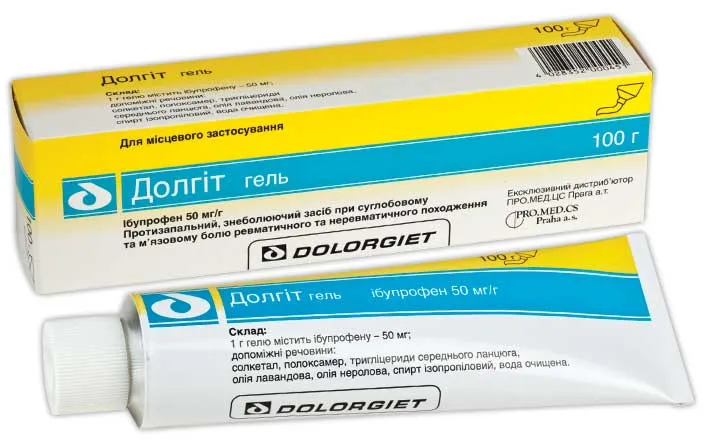
Table of Contents
INSTRUCTIONS FOR MEDICAL USE OF THE MEDICINAL PRODUCT DOLGIT® GEL (DOLGIT® GEL)
Composition:
Active substance: ibuprofen;
1 g of gel contains ibuprofen 50 mg;
Excipients: 2-propanol, solketals, poloxamer, medium-chain triglycerides, lavender oil, neroli oil, purified water.
Pharmaceutical form. Gel.
Main physicochemical properties: transparent, colorless or slightly cloudy gel with a characteristic odor.
Pharmacotherapeutic group. Topical agents for joint and muscular pain. ATC code M02A A13.
Pharmacological Properties
Pharmacodynamics
Dolgit® gel is a medicinal product for topical use in joint and muscle pain of rheumatic and non-rheumatic origin. It exerts a pronounced anti-inflammatory, analgesic, and moderate antipyretic effect, reduces swelling associated with inflammation caused by injuries or rheumatic diseases, and improves joint mobility. The pharmacological activity of the drug is due to its ability to inhibit the synthesis of prostaglandins.
When applied topically, ibuprofen is rapidly absorbed through the skin and penetrates into the site of inflammation. Penetration to the site of action may vary depending on the extent and type of lesion, as well as the application site and target area.
Therapeutic concentrations in joint tissues are maintained for several hours, while the active substance in blood serum constitutes only a negligible amount; therefore, systemic effects are practically absent.
Pharmacokinetics
Biological transformation of ibuprofen occurs in the liver. Pharmacologically inactive metabolites are excreted by the kidneys (90%) and also via bile. Ibuprofen is 99% bound to plasma proteins. The elimination half-life ranges from 1.8 to 3.5 hours.
Clinical characteristics.
Indications.
For local treatment of sports and other injuries such as muscle strain, ligament, tendon or joint sprains, contusions, degenerative joint diseases with pain syndrome (arthrosis), inflammatory rheumatic diseases of joints and spine, swelling or inflammation of soft tissues around joints (e.g., bursitis, tendinitis, tenosynovitis, ligament and joint capsule injuries), shoulder stiffness, low back pain, lumbago, myalgia.
Contraindications.
"Dolgit® gel" is contraindicated:
- in case of hypersensitivity to the active substance ibuprofen, to any of the excipients or to other analgesics and anti-rheumatic agents (nonsteroidal anti-inflammatory drugs);
- for application on open wounds, in inflammatory and infectious skin diseases such as eczema, as well as for application on mucous membranes;
- for use under occlusive dressings;
- during the third trimester of pregnancy.
Interaction with other medicinal products and other forms of interaction.
When applied topically according to recommendations, no interactions with other medicinal products have been observed.
Patients must inform their physician about concomitant treatment with other medicinal products, if applicable, or about recently conducted therapies.
Special precautions for use.
Patients with asthma, hay fever, nasal mucosal swelling (so-called nasal polyps), chronic obstructive respiratory diseases, or chronic respiratory infections (particularly with symptoms resembling hay fever), as well as patients with hypersensitivity to analgesics and anti-rheumatic drugs of various types, are at higher risk of developing asthma attacks (so-called analgesic intolerance/analgesic asthma), local skin and mucosal swelling (Quincke's edema), or urticaria. Administration of the drug to such patients should be performed under medical supervision.
The drug should be used with caution in patients with hypersensitivity (allergy) to other substances causing skin irritation, itching, or urticaria. If skin rash occurs, application of the gel should be discontinued immediately.
Severe skin adverse reactions have been reported with ibuprofen use, including exfoliative dermatitis, erythema multiforme, Stevens-Johnson syndrome, toxic epidermal necrolysis, drug reaction with eosinophilia and systemic symptoms (DRESS syndrome), and acute generalized exanthematous pustulosis, which may be life-threatening or lead to fatal outcomes (see section "Adverse reactions"). Most such reactions occurred within the first month of treatment.
If signs or symptoms indicating these reactions appear, ibuprofen use should be discontinued immediately, and alternative treatment options should be considered (if necessary).
Avoid contact of the drug with the eyes.
Care should be taken to ensure that children do not touch skin areas to which the drug has been applied.
If discomfort persists beyond 3 days of treatment, a physician should be consulted.
Due to the possible occurrence of increased photosensitivity, patients should avoid intense exposure to sunlight or UV radiation during treatment with this drug.
This medicinal product contains flavorings (lavender oil and neroli oil) with benzyl alcohol, benzyl benzoate, citral, citronellol, coumarin, eugenol, farnesol, geraniol, limonene/d-limonene, and linalool, which may cause allergic reactions.
Use during pregnancy or breastfeeding.
Pregnancy
There are no clinical data on the topical use of "Dolgit® gel" during pregnancy. Even though systemic exposure is lower compared to oral administration, it is unknown whether the systemic exposure to "Dolgit® gel" achieved after topical application may be harmful to the embryo/fetus. "Dolgit® gel" should not be used during the first and second trimesters of pregnancy unless clearly necessary. If used, the dose should be as low as possible and the duration of treatment as short as possible.
Systemic use of prostaglandin synthetase inhibitors, including "Dolgit® gel", during the third trimester of pregnancy may cause cardiopulmonary and renal toxicity in the fetus. Prolonged bleeding may occur in both mother and child towards the end of pregnancy, as well as delayed labor. Therefore, "Dolgit® gel" is contraindicated during the last trimester of pregnancy (see section "Contraindications").
Breastfeeding
Only a negligible amount of ibuprofen and its metabolites passes into breast milk. Currently, there are no data indicating negative effects on the newborn; therefore, short-term treatment does not require interruption of breastfeeding. However, the daily dose with three applications of a gel strip 4–10 cm in length must not be exceeded, and in case of prolonged treatment, breastfeeding should be interrupted.
Breastfeeding women should not apply this medicinal product to the breast area to avoid exposure of the infant to the drug.
Ability to affect reaction speed when driving vehicles or operating machinery.
The medicinal product does not affect the ability to drive vehicles or operate potentially hazardous machinery.
Method of Administration and Dosage
For external use only. Apply the medicinal product 3–4 times daily.
Depending on the size of the affected area, apply a thin layer of gel to the skin at the site of inflammation/pain in strips 4–10 cm long (corresponding to 2–5 g of gel, or 100–250 mg of ibuprofen), followed by gentle rubbing until completely absorbed. The maximum daily dose is 20 g of gel (corresponding to 1,000 mg of ibuprofen).
The duration of treatment should be determined by a physician. In most cases, treatment lasts 1–2 weeks. There are no data on the therapeutic benefit of using the medicinal product for longer periods.
Do not apply under an occlusive dressing.
Penetration of the active ingredient may be enhanced using iontophoresis (a special form of electrotherapy). In such cases, apply the product under the cathode (negative electrode), with a current intensity of 0.1–0.5 mA per 5 cm² of electrode surface area, and a procedure duration of up to 10 minutes.
After applying the gel to the skin, hands should be wiped with a paper towel and then washed, unless the hands are the treatment site. The paper towel should be disposed of with waste materials.
Before taking a shower or bath, the patient should wait until the active substance has been fully absorbed.
Children
Do not use in children under 14 years of age.
Overdose
If more gel is applied than recommended, remove the excess gel and wash the skin with water. In case of application of a very large amount or accidental ingestion of the gel, inform a physician immediately. A specific antidote is not known.
Side effects
Classification of side effects by frequency of occurrence: very common (≥ 1/10), common (≥ 1/100, < 1/10), uncommon (≥ 1/1,000, < 1/100), rare (≥ 1/10,000, < 1/1,000), very rare (< 1/10,000), frequency not known.
Immune system disorders
Uncommon: hypersensitivity reactions such as local allergic reactions (contact dermatitis).
Respiratory, thoracic and mediastinal disorders
Rare: bronchospastic reactions.
Skin and subcutaneous tissue disorders
Common: local reactions such as skin redness, itching, burning sensation, exanthema, including formation of pustules and vesicles.
Rare: severe skin adverse reactions (including erythema multiforme, exfoliative dermatitis, Stevens-Johnson syndrome, and toxic epidermal necrolysis).
Frequency not known: photosensitivity reactions; drug reaction with eosinophilia and systemic symptoms (DRESS syndrome); acute generalized exanthematous pustulosis.
When using "Dolgit® gel" on large areas of skin and for prolonged periods, adverse reactions affecting specific organs or the body as a whole, which are possible with systemic use of medicinal products containing ibuprofen, cannot be excluded.
Reporting of suspected side effects
Reporting suspected adverse reactions after drug authorization is of great importance. It allows continuous monitoring of the benefit-risk balance of the medicinal product. Medical and pharmaceutical professionals, as well as patients or their legal representatives, should report all suspected adverse reactions and lack of efficacy via the Automated Pharmacovigilance Information System at the following link: https://aisf.dec.gov.ua.
Shelf life. 30 months.
Storage conditions. Store in the original packaging at a temperature not exceeding 25 °C.
Keep out of reach of children.
Packaging. 20 g, 50 g, 100 g, 150 g in a tube; 1 tube per cardboard box.
Supply category. Over-the-counter.
Manufacturer.
Dolorgiet GmbH & Co. KG.
Manufacturer's address and place of business.
Otto-von-Guericke-Str. 1, 53757 Sankt Augustin, Germany.