Diutor
Ukraine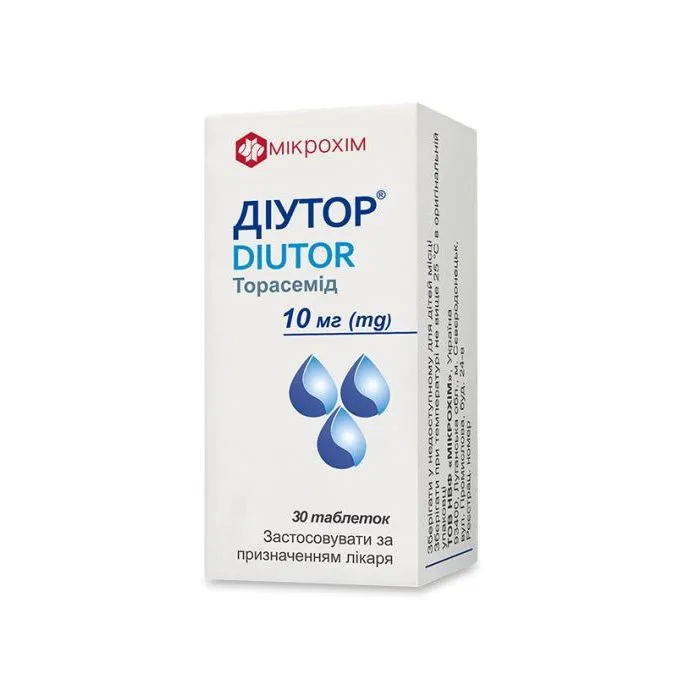
Table of Contents
INSTRUCTION FOR MEDICAL USE OF THE MEDICINAL PRODUCT Diutor® (Diutor)
Composition:
Active substance: torasemide;
1 tablet contains 5 mg or 10 mg of torasemide;
Excipients: lactose monohydrate; corn starch; colloidal anhydrous silicon dioxide; magnesium stearate.
Pharmaceutical form. Tablets.
Main physico-chemical properties: white to almost white, round, biconvex tablets.
Pharmacotherapeutic group.
Agents acting on the cardiovascular system. Diuretics. High-ceiling diuretics. Simple sulfonamides. Torasemide. ATC code C03CA04.
Pharmacological properties.
Pharmacodynamics.
Mechanism of action
Torasemide acts as a diuretic; its effect is associated with inhibition of renal reabsorption of sodium and chloride ions in the ascending limb of the loop of Henle.
Pharmacodynamic effects
In humans, the diuretic effect rapidly reaches its maximum within the first 2–3 hours after intravenous and oral administration, respectively, and remains consistent for approximately 12 hours. In healthy volunteers, within the dose range of 5–100 mg, a logarithmic dose-proportional increase in diuresis was observed (loop diuretic activity). Increased diuresis was observed even in cases where other diuretics, for example, distally acting thiazide-type diuretics, no longer produced the desired effect (e.g., in renal insufficiency). Due to this mechanism of action, torasemide leads to reduction of edema. In cases of heart failure, torasemide reduces symptoms of the disease and improves myocardial function by decreasing preload and afterload. After oral administration, the antihypertensive effect of torasemide develops gradually, beginning from the first week of treatment. The maximum antihypertensive effect is achieved no later than 12 weeks. Torasemide reduces blood pressure by decreasing total peripheral vascular resistance. This effect is explained by normalization of disturbed electrolyte balance, primarily due to reduction of elevated levels of free intracellular calcium ions in arterial smooth muscle cells, which has been observed in patients with arterial hypertension.
Presumably, this effect reduces increased vascular contractility and/or vascular responsiveness to endogenous vasoactive substances, such as catecholamines.
Pharmacokinetics.
Absorption and distribution
After oral administration, torasemide is rapidly and almost completely absorbed. Peak plasma concentration (Cmax) is reached within 1–2 hours. Bioavailability is approximately 80–90%. Under conditions of complete absorption, the maximum first-pass effect through the liver does not exceed 10–20%. According to data from two studies, food reduces the rate (dynamic component) of torasemide absorption (Cmax is reduced and tmax is prolonged), but does not affect total absorption. Plasma protein binding of torasemide exceeds 99%, while for its metabolites M1, M3, and M5, it is 86%, 95%, and 97%, respectively. The apparent volume of distribution (Vz) is 16 L.
Metabolism
In humans, torasemide is metabolized to form three metabolites—M1, M3, and M5. There is no evidence for the existence of other metabolites. Metabolites M1 and M5 are formed by oxidation of the methyl group on the phenolic ring to a carboxylic acid. Metabolite M3 is formed by hydroxylation of the phenolic ring. Metabolites M2 and M4, detected in animal studies, have not been found in humans.
Elimination
The terminal half-life (t1/2) of torasemide and its metabolites in healthy volunteers is 3–4 hours. Total clearance of torasemide is 40 mL/min, and renal clearance is approximately 10 mL/min. In healthy volunteers, approximately 80% of the administered dose is excreted in urine as torasemide and its metabolites in the following proportions: torasemide—approximately 24%, metabolite M1—approximately 12%, metabolite M3—approximately 3%, metabolite M5—approximately 41%. The main metabolite M5 has no diuretic activity. The combined contribution of the active metabolites M1 and M3 to the overall pharmacodynamic effect is approximately 10%. In renal insufficiency, total clearance and t1/2 of torasemide remain unchanged, while t1/2 of M3 and M5 is prolonged. However, the pharmacodynamic profile remains unchanged. The severity of renal insufficiency does not affect the duration of action. Torasemide and its metabolites are practically not removed by hemodialysis or hemofiltration. In patients with hepatic dysfunction or heart failure, t1/2 of torasemide and metabolite M5 is slightly prolonged. The ratio of unchanged torasemide to its metabolites excreted in urine is almost identical to that in healthy volunteers. Therefore, accumulation of torasemide and its metabolites does not occur.
Linearity
Torasemide and its metabolites exhibit dose-dependent linear kinetics. This means that Cmax and the area under the pharmacokinetic curve of torasemide increase proportionally with the administered dose.
Clinical characteristics.
Indications.
Dosing 5 mg:
- Essential hypertension;
- treatment and prevention of recurrence of edema and/or effusions caused by heart failure.
Dosing 10 mg:
- Treatment and prevention of recurrence of edema and/or effusions caused by heart failure.
Contraindications.
- Hypersensitivity to the active substance, sulfonamide drugs, or to any of the excipients of the medicinal product;
- Renal failure with anuria;
- Hepatic coma or precoma;
- Arterial hypotension;
- Hypovolemia;
- Hyponatremia;
- Hypokalemia;
- Arrhythmia;
- Significant impairment of urination, for example due to prostatic hyperplasia;
- Breastfeeding period.
Interaction with other medicinal products and other types of interactions.
Combinations not recommended
Torasemide, especially at high doses, may enhance the ototoxic and nephrotoxic effects of aminoglycoside antibiotics, such as kanamycin, gentamicin, tobramycin, and cytostatic agents—active platinum derivatives, as well as the nephrotoxic effect of cephalosporins. Concomitant use of torasemide and lithium preparations may increase lithium plasma concentration, potentially leading to enhanced lithium effects and adverse reactions.
Combinations of medicinal products whose use requires caution
Torasemide enhances the effect of other antihypertensive agents, particularly angiotensin-converting enzyme inhibitors, which may result in excessive reduction of arterial blood pressure during their concomitant use. When torasemide is used concomitantly with digitalis preparations, potassium deficiency caused by diuretic use may lead to increased and enhanced adverse effects of both medicinal products. Torasemide may reduce the effectiveness of antidiabetic agents. Probenecid and nonsteroidal anti-inflammatory drugs (e.g., indomethacin, acetylsalicylic acid) may inhibit the diuretic and antihypertensive effects of torasemide. When treating with high-dose salicylates, torasemide may increase their toxic effects on the central nervous system. Torasemide may enhance the effect of theophylline, as well as the muscle-relaxing effect of curare-like medicinal products. Laxatives, as well as mineralo- and glucocorticoids, may intensify potassium loss induced by torasemide. Torasemide may reduce the vasoconstrictive effect of catecholamines, such as epinephrine and norepinephrine. Concomitant use with cholestyramine may reduce the absorption of torasemide and, consequently, its expected efficacy.
Special precautions for use.
Torasemide should not be prescribed in the following cases:
- gout;
- cardiac arrhythmias, e.g. sinoatrial block, II and III degree atrioventricular block;
- pathological changes in acid-base metabolism;
- concomitant therapy with lithium, aminoglycosides, or cephalosporins;
- blood count abnormalities, e.g. thrombocytopenia or anemia in patients without renal insufficiency;
- renal dysfunction caused by nephrotoxic substances;
- in children and adolescents under 18 years of age.
Since increased blood glucose concentration may occur during treatment with torasemide, patients with latent or manifest diabetes mellitus should undergo regular monitoring of carbohydrate metabolism. Particular attention should be paid, especially at the beginning of treatment and when treating elderly patients, to the emergence of symptoms of hemoconcentration and symptoms of electrolyte loss. With prolonged use of torasemide, regular monitoring of electrolyte balance, particularly serum potassium levels, is required. Additionally, regular monitoring of blood levels of glucose, uric acid, creatinine, and lipids is necessary. Furthermore, regular monitoring of the complete blood count (erythrocytes, leukocytes, platelets) should be performed.
Consequences of improper use as doping
The use of the medicinal product DiuTor® may lead to a positive doping test result. It is impossible to predict the health effects when DiuTor® is used improperly, i.e. for doping purposes—in such a case, harm to health cannot be ruled out.
Excipients
DiuTor® contains lactose; therefore, patients with rare hereditary conditions such as galactose intolerance, lactase deficiency, or glucose-galactose malabsorption should not take this medicinal product.
Use during pregnancy or breastfeeding.
Pregnancy
Reliable data on the effects of torasemide in pregnant women are lacking. Information on reproductive toxicity of torasemide is available. Torasemide crosses the placental barrier. DiuTor® is not recommended during pregnancy, and in women of reproductive potential who are not using contraception. Due to the above, torasemide should be used during pregnancy only under life-threatening indications and at the lowest effective dose. Diuretics are not suitable for standard treatment regimens for arterial hypertension or edema in pregnant women, as they may reduce placental perfusion and cause toxic effects on fetal development. If torasemide is used to treat pregnant women with heart failure or renal failure, careful monitoring of electrolyte levels and hematocrit, as well as fetal development, is required.
Breastfeeding
It is currently unknown whether torasemide or its metabolites are excreted in human or animal breast milk. The risk to newborns/infants cannot be excluded. Therefore, the use of torasemide during breastfeeding is contraindicated (see section "Contraindications"). The decision to discontinue breastfeeding or to discontinue/stop treatment with DiuTor® should be made taking into account the benefits of breastfeeding for the child and the benefits of treatment for the woman.
Fertility
Studies on the effects of torasemide on fertility in humans have not been conducted. In animal experiments, no such effects of torasemide were observed.
Ability to affect reaction speed when driving or operating machinery.
Even when used correctly, torasemide may negatively affect reaction speed when driving or operating machinery. This is particularly relevant at the beginning of treatment, during dose escalation, when switching medications, during concomitant therapy, and when consuming alcohol. Therefore, special caution is required when driving or operating machinery during treatment with torasemide.
Method of administration and dosage
Essential hypertension
Treatment should be initiated with a daily dose of 2.5 mg torasemide (use another medicinal product containing torasemide in the corresponding dosage). Reduction of arterial pressure occurs gradually, already within the first week of treatment, and reaches its maximum effect no later than 12 weeks. If normalization of arterial pressure is not achieved after 12 weeks of treatment with a daily dose of 2.5 mg, the daily dose may be increased to 5 mg. The daily dose of Diutor® should not exceed 5 mg in the treatment of arterial hypertension, as further reduction in arterial pressure is not expected with higher doses.
Edema and effusions
Treatment should be initiated with a daily dose of 5 mg torasemide. This dose is usually considered a maintenance dose. If a daily dose of 5 mg is insufficient, a daily dose of 10 mg torasemide should be administered daily. Depending on the severity of the patient's condition, the daily dose may be increased up to 20 mg torasemide. Tablets should be taken on an empty stomach, without chewing, and swallowed with a small amount of liquid. The bioavailability of torasemide is not affected by food intake. Diutor® is generally administered for a prolonged period or until edema symptoms subside.
Special patient groups
Patients with hepatic impairment
Torasemide is contraindicated in patients with hepatic coma or precoma (see section "Contraindications"). Treatment in this patient group should be performed with caution, as increased plasma concentrations of torasemide may occur (see section "Pharmacokinetics").
Elderly patients
No specific dose adjustment is required. However, comparative studies of the drug's effect in younger and elderly patients have not been conducted.
Children
The safety and efficacy of Diutor® in children and adolescents under 18 years of age have not been established. Therefore, torasemide should not be used in this age group (see section "Special precautions for use").
Overdose
Symptoms
The typical clinical picture is unknown. Overdose may cause pronounced diuresis, including the risk of excessive loss of water and electrolytes, somnolence, confusion, symptomatic arterial hypotension, circulatory collapse, and gastrointestinal disturbances.
Treatment
No specific antidote is known. Symptoms of intoxication usually resolve with dose reduction or discontinuation of the drug and appropriate replacement of fluids and electrolytes (serum electrolyte levels should be monitored). Torasemide is not removed from blood by hemodialysis.
Treatment in case of hypovolemia: fluid volume replacement.
Treatment in case of hypokalemia: administration of potassium supplements.
Treatment of cardiovascular insufficiency: the patient should remain in a lying position; symptomatic therapy should be administered if necessary.
Anaphylactic shock (emergency measures): upon first signs of skin reactions (e.g., urticaria or skin redness), patient agitation, headache, excessive sweating, nausea, cyanosis, venous catheterization should be performed; the patient should be placed in a horizontal position with legs elevated, free airway ensured, and oxygen administered. If necessary, intensive therapy should be continued (including administration of epinephrine, glucocorticoids, and replacement of circulating blood volume).
Adverse reactions.
The following adverse reactions may be observed during torasemide treatment.
The frequency of adverse reactions is defined as follows: very common (≥ 1/10); common (≥ 1/100 to < 1/10); uncommon (≥ 1/1,000 to < 1/100); rare (≥ 1/10,000 to < 1/1,000); very rare (< 1/10,000); frequency not known (cannot be estimated from the available data).
Blood and lymphatic system disorders: very rare – haemoconcentration, thrombocytopenia, erythropenia and/or leucopenia (see section "Special warnings and precautions for use").
Immune system disorders: very rare – allergic reactions. After intravenous administration, acute, potentially life-threatening hypersensitivity reactions (anaphylactic shock) may occur, requiring immediate medical intervention.
Metabolism and nutrition disorders: common – exacerbation of metabolic alkalosis, hyperkalaemia, hypokalaemia with concomitant low-potassium diet, vomiting, diarrhoea, excessive use of laxatives, and in patients with chronic liver dysfunction. Depending on dosage and duration of treatment, disturbances in water and electrolyte balance may occur, such as hypovolaemia, hypokalaemia and/or hyponatraemia (see section "Special warnings and precautions for use").
Nervous system disorders: common – headache, dizziness (especially at the beginning of treatment); uncommon – paraesthesia; very rare – syncope, cerebral ischaemia, confusion.
Eye disorders: very rare – visual disturbances.
Ear and labyrinth disorders: very rare – tinnitus, hearing loss.
Cardiac disorders: very rare – myocardial ischaemia, arrhythmia, angina pectoris, acute myocardial infarction.
Vascular disorders: very rare – thromboembolic complications, arterial hypotension, as well as circulatory disorders in the heart and disturbances of central circulation.
Gastrointestinal disorders: common – gastrointestinal disturbances (e.g. loss of appetite, stomach pain, nausea, vomiting, diarrhoea, persistent constipation), especially at the beginning of treatment; uncommon – xerostomia; very rare – pancreatitis.
Hepatobiliary disorders: common – increased blood concentration of certain liver enzymes (gamma-glutamyl transpeptidase).
Skin and subcutaneous tissue disorders: very rare – allergic reactions (e.g. pruritus, rash, photosensitization), severe skin reactions.
Musculoskeletal and connective tissue disorders: common – muscle cramps (especially at the beginning of treatment).
Renal and urinary disorders: uncommon – with impaired urination (e.g. due to benign prostatic hyperplasia), increased urine production may be accompanied by urinary retention and bladder distension.
General disorders and administration site conditions: common – increased fatigue, general weakness (especially at the beginning of treatment).
Investigations: common – increased blood concentration of uric acid and lipids (triglycerides, cholesterol) (see section "Special warnings and precautions for use"); uncommon – increased blood urea and creatinine concentrations (see section "Special warnings and precautions for use").
Shelf life.
2 years.
Storage conditions.
Store at a temperature not exceeding 25 °C in the original packaging.
Keep out of reach of children.
Packaging.
10 tablets in blisters, 3 blisters with the package leaflet in a cardboard box, or 9 blisters with the package leaflet in a cardboard box.
Prescription category.
Prescription only.
Manufacturer.
MICROCHEM PHARMACEUTICALS LLC.
Manufacturer's address and place of business.
5 Budynstustriyi Street, Kyiv, 01013, Ukraine.
Marketing Authorisation Holder.
MICROCHEM PHARMACEUTICALS LLC.
Address of the Marketing Authorisation Holder.
5 Budynstustriyi Street, Kyiv, 01013, Ukraine.
You can report an adverse event associated with this medicinal product by calling +38 (050) 309-83-54 (24/7).