Diprostreptase distrept
Ukraine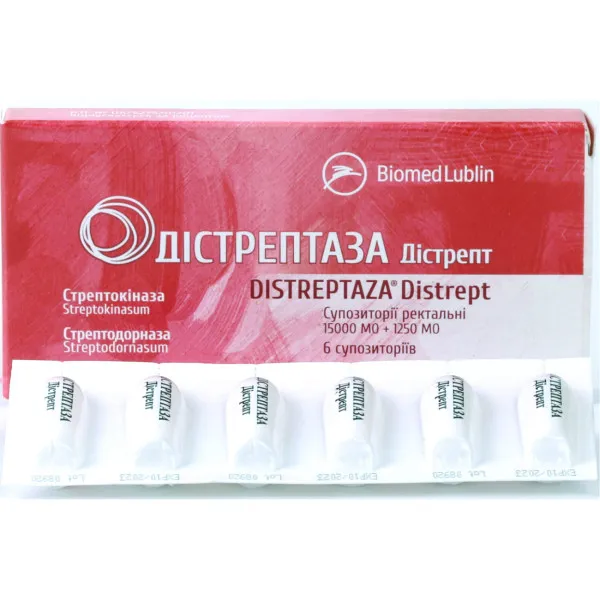
Table of Contents
INSTRUCTIONS for medical use of the medicinal product DISTREPTAZA® Distrept (DISTREPT)
Composition:
Active substances: 1 suppository contains streptokinase 15,000 IU, streptodornase 1250 IU;
Excipients: mineral oil, hard fat.
Pharmaceutical form. Rectal suppositories.
Main physicochemical characteristics: cone-shaped or "torpedo"-shaped with a pointed end; without mechanical damage, color ranging from white to creamy.
Pharmacotherapeutic group. Blood and blood-forming organs. Other hematological agents. Enzymes. Streptokinase, combinations. ATC code B06AA55.
Pharmacological properties.
Pharmacodynamics.
DISTREPTASE Distrept is a combined preparation containing two active substances – streptokinase and streptodornase. Streptokinase is an activator of the proenzyme plasminogen present in human blood; under the influence of streptokinase, plasminogen is converted into plasmin, which has the ability to dissolve blood clots.
Streptodornase is an enzyme capable of dissolving aggregates of nucleoproteins, dead cells, or pus, without affecting living cells and their physiological functions.
The preparation facilitates the penetration of antibiotics or chemotherapeutic agents to the site of inflammation.
Pharmacokinetics.
Not studied.
Clinical characteristics.
Indications.
- As an adjunctive treatment for inflammatory diseases of the pelvic organs (IDPO) — inflammatory diseases of the ovaries, fallopian tubes, and endometrium.
- Adhesive disease following surgeries on pelvic organs.
- Acute and chronic hemorrhoids.
- As an adjunctive treatment for perianal abscess and fistulas with pronounced inflammatory infiltration.
Contraindications.
The medicinal product should not be used:
- In case of hypersensitivity to the active or excipient substances contained in the medicinal product;
- If the patient has wounds covered with a fresh scab or surgical sutures in the area of application: the medicinal product must not come into contact with a fresh wound covered by a scab or with recently placed sutures, as this may lead to weakening of the sutures and subsequent wound bleeding;
- After bleeding for approximately 10 days, since it may provoke recurrent bleeding;
- With medicinal products containing calcium salts;
- In cases of purulent inflammation;
- In patients with reduced blood coagulation;
- With anticoagulants (agents that reduce blood coagulation) due to increased risk of local bleeding.
Interaction with other medicinal products and other forms of interactions.
Enhances penetration of antibiotics and chemotherapeutic agents into the inflammatory focus. Concomitant use with anticoagulants is contraindicated due to the possibility of bleeding at the site of application.
Special precautions for use.
Use only as directed by a physician. The preparation may cause local irritation. Hands should be thoroughly washed before and after administration of suppositories.
Use during pregnancy or breastfeeding.
Do not use.
Ability to affect reaction rate when driving or operating machinery.
No effect.
Method of Administration and Dosage.
Adults
Remove the suppository from the blister pack and insert deeply into the rectum.
The dosage depends on the course and severity of the inflammatory process.
In severe disease in adults:
- 1 suppository three times daily for the first 3 days;
- 1 suppository twice daily for the next 3 days;
- 1 suppository once daily for the following 3 days.
In moderate and mild disease in adults:
- 1 suppository twice daily for the first 3 days;
- 1 suppository once daily for the next 4 days,
or
- 1 suppository twice daily for 2 days.
Treatment course – on average, 8–18 suppositories.
Duration of treatment – on average, 7–10 days.
Elderly Patients
There is no information regarding the need to change the dosage in patients over 65 years of age.
Hepatic Impairment
The drug is administered as rectal suppositories and is not metabolized in the liver; therefore, there is no need to adjust the dosage in patients with hepatic insufficiency.
Renal Impairment
There is no information on the need to modify dosage in patients with renal insufficiency.
Children
Do not use.
Overdose.
Symptoms of overdose are unknown. An overdose may enhance the manifestations of adverse reactions. Treatment is symptomatic.
Side effects.
Rarely (from ≥ 1/10,000 to < 1/1,000), allergic reactions, increased body temperature, and tendency to bleeding may occur. Possible local changes at the site of administration, including irritation, pain, and swelling.
Shelf life. 3 years.
Storage conditions.
Store at a temperature of 2 to 8 °C. Do not freeze. Keep out of the reach of children.
Packaging. 6 suppositories in a blister; 1 blister per cardboard box.
Prescription status. Prescription only.
Manufacturer: Synthavers S.A.
Manufacturer's address and place of business:
10 Uniwersytecka Street, 20-029 Lublin, Poland.