Dioxisol®-darnitsa
Ukraine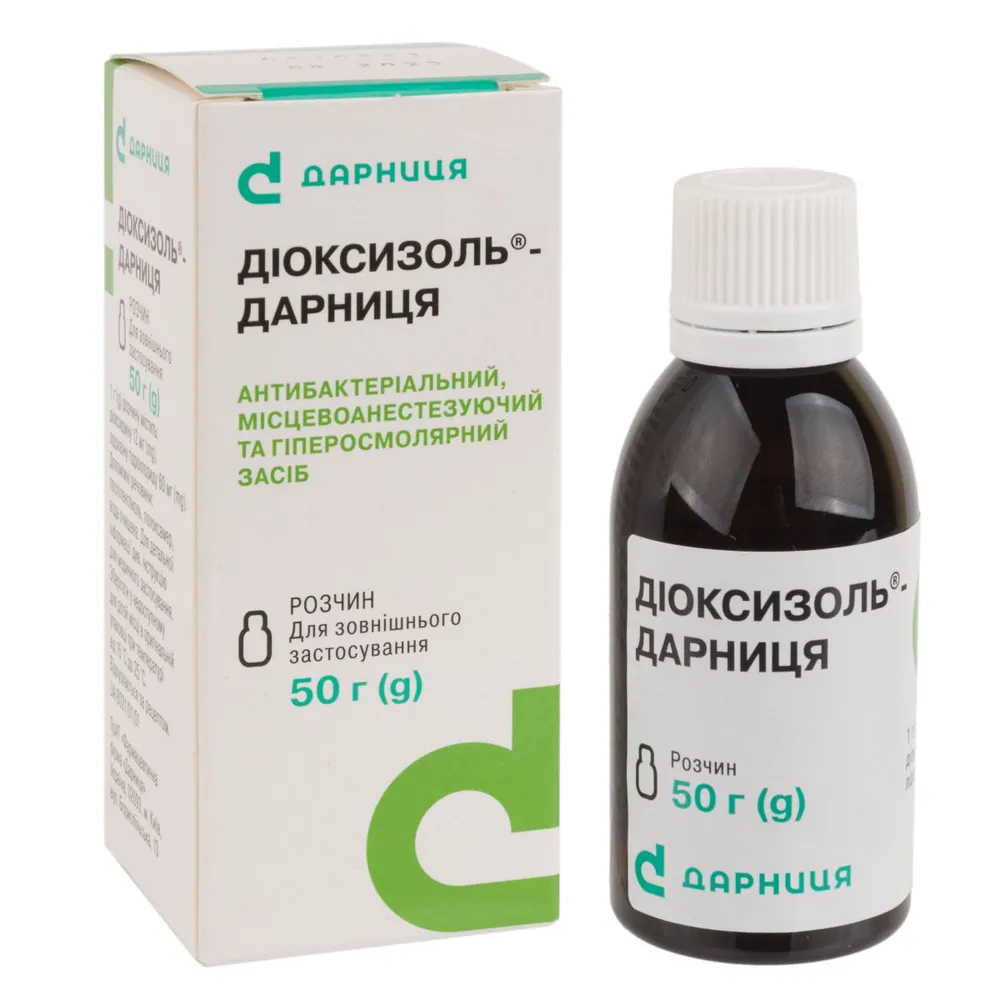
Table of Contents
INSTRUCTIONS FOR MEDICAL USE OF THE MEDICINAL PRODUCT DIOXIZOL-DARNITSA® (DIOXIZOL-DARNITSA)
Composition:
Active substances: dioxydine, lidocaine hydrochloride;
1 g of solution contains: dioxydine 12 mg, lidocaine hydrochloride 60 mg;
Excipients: propylene glycol, poloxamer, purified water.
Pharmaceutical form. Solution.
Main physico-chemical characteristics: clear, viscous, light-yellow liquid with a weak specific odor.
Pharmacotherapeutic group. Antibacterial agents. ATC code J01XX.
Pharmacological Properties
Pharmacodynamics
Dioxyzol®-Darnytsia is a combined medicinal product for topical use, with active ingredients being dioxydin and lidocaine. The solution has a strong local anesthetic and moderate hyperosmolar effect, suppresses wound and perifocal inflammation, and stimulates tissue repair processes and phagocyte activity in the wound.
Dioxydin exerts pronounced antibacterial activity against gram-negative and gram-positive, aerobic and anaerobic, spore-forming and non-spore-forming microflora (including Pseudomonas aeruginosa, staphylococci, streptococci, clostridia, peptococci, etc.) both as monocultures and microbial associations, including hospital strains of bacteria with polyresistance to other antibacterial agents. The basis of its antibacterial action lies in its ability to damage bacterial DNA. As a result of this effect, synthesis of bacterial nucleases is slowed, ultrastructure of bacterial cells is disrupted, thickening of the cell wall occurs, and membrane integrity is impaired. The cytostatic effect of the drug is due to its action on genomic regions responsible for synthesis of exoenzymes that determine virulence, which explains the drug’s ability to prevent the development of microbial resistance.
Lidocaine produces a local anesthetic effect by blocking voltage-dependent Na+ channels, thereby preventing generation and conduction of impulses in sensory nerve endings and along nerve fibers. When applied topically, it causes vasodilation and does not produce local irritation. The effect develops within 1–5 minutes after application to the skin.
Pharmacokinetics
Dioxydin is practically not absorbed upon topical application and does not produce local irritation. It is not metabolized in the body and does not accumulate. It is excreted by the kidneys.
The rate of lidocaine absorption and the amount of active substance entering the systemic circulation depend on the dose, type, size, and condition of the surface to which it is applied (skin or mucous membrane), as well as on the duration of exposure.
Lidocaine is well absorbed when applied to mucous membranes or damaged skin, but poorly absorbed through intact healthy skin. Time to reach maximum plasma concentration is up to 1 hour. 40–80% of lidocaine binds to plasma proteins. It crosses the blood-brain and placental barriers and enters breast milk. Lidocaine is metabolized in the liver. The elimination half-life of lidocaine is 1.6 hours. It is excreted by the kidneys and via bile: 90–95% as metabolites, up to 10% unchanged.
Clinical characteristics.
Indications.
- Infected soft tissue wounds of various localization and origin (amputation stumps of limbs, wounds after surgical treatment of purulent foci, pressure ulcers, trophic ulcers, purulent postoperative wounds and fistulas, periproctitis, abscesses and phlegmons of the maxillofacial region, etc.);
- Burns of II–IV degrees;
- Acute and chronic osteomyelitis;
- Wound preparation for autodermoplasty;
- Prevention of purulent-inflammatory processes in surgery and burn care during various plastic procedures.
Contraindications.
- Hypersensitivity to the active substances or to other components of the medicinal product;
- Arterial hypotension, bradycardia, atrioventricular block of II–III degree, cardiogenic shock, hypovolemia;
- Adrenal cortex insufficiency (including in medical history);
- Pregnancy and breastfeeding;
- Pediatric age.
Interaction with other medicinal products and other forms of interactions.
Interaction of the medicinal product Dioxysole®-Darnytsia with other medicinal products has not been described. However, it is not recommended to use the solution simultaneously with other locally applied medicinal products (ointments, creams, etc.).
Special precautions.
The medicinal product should be used only under medical supervision.
Use with caution in patients with impaired liver function.
Use with caution in renal insufficiency; in chronic renal failure, the dose should be reduced.
Dioxidine should be prescribed only for severe forms of infectious diseases or when other antibacterial medicinal products, including second to fourth generation cephalosporins, fluoroquinolones, and carbapenems, are ineffective.
If adverse reactions or pigmented spots occur, reduce the dose, administer antihistamine medicinal products, and, if necessary, discontinue the medicinal product.
The medicinal product should be primarily used in the first phase of the wound process, as well as in the second phase for granulating wounds with areas of necrosis and inflammation.
Dioxidine has demonstrated teratogenic and embryotoxic effects (therefore, it is contraindicated during pregnancy); dioxidine also exerts mutagenic effects.
Uncontrolled use of dioxidine and medicinal forms containing it is prohibited.
The medicinal product contains propylene glycol, which may cause skin irritation.
Use during pregnancy or breastfeeding.
The medicinal product is contraindicated during pregnancy or breastfeeding.
Ability to affect reaction speed when driving or operating machinery.
During use of the medicinal product, patients should refrain from driving or operating machinery.
Method of Administration and Dosage.
Dioxyzol®-Darnytsia is intended for topical use and for instillation into fistulas, wound cavities, and pockets in adults.
Topical application.
The medicinal product should be used immediately after surgical wound and burn management, as well as during the subsequent treatment process. Prior to application, the wound surface must be cleaned from exudate and necrotic tissues. Sterile dressing materials (gauze dressings or tampons) should be thoroughly saturated with the solution and applied to superficial burns or inserted into deep wounds, followed by covering with sterile gauze pads secured with bandage or adhesive tape. Dressings should be changed every 7–14 days when treating burns, and once daily when treating wounds.
For instillation into fistulas, wound cavities, and pockets.
The medicinal product should be administered through a drainage tube, catheter, or using a syringe (without a needle) 1–2 times daily, followed by application of a sterile gauze dressing.
Dosage and duration of treatment depend on the size of the affected area, severity of the disease, and patient tolerance, and are determined by a physician. The daily dose of the solution should not exceed 100 mL when used topically, and 50–60 mL when administered into cavities. The treatment course should not exceed 15 days.
If necessary, the treatment course may be repeated after 1–1.5 months.
Children. The medicinal product must not be used in children.
Overdose.
In case of overdose, adverse effects of the drug may be intensified, including the development of acute adrenal cortical insufficiency.
Treatment: discontinuation of the drug, symptomatic therapy.
Adverse reactions.
Immune system disorders:
When the drug is administered intracavitarily or in case of overdosage, systemic adverse effects associated with the presence of dioxydinum in the drug may occur: headache, dyspeptic disorders, chills, fever, seizures, hypersensitivity reactions, photosensitization, angioneurotic edema, very rarely malignant hyperthermia.
Systemic adverse reactions associated with the use of lidocaine as a local anesthetic are very rare. They may be caused by administration of excessively high doses (more than 15 g) of lidocaine, rapid absorption of the drug, hypersensitivity, idiosyncrasy, or reduced tolerance to lidocaine in some patients. Systemic adverse effects may manifest as central nervous system excitation or depression, cardiovascular depression associated with arterial hypotension, bradycardia and anaphylaxis, seizures, tremor.
Skin and subcutaneous tissue disorders:
hypersensitivity reactions, including pruritus, skin hyperemia, rash, urticaria, periwound dermatitis, edema, pain and burning sensation at the application site, which resolve spontaneously within a few minutes and do not require discontinuation of the drug.
Shelf life. 2 years.
Storage conditions.
Store in the original packaging, out of reach of children, at a temperature between 15 °C and 25 °C.
Packaging.
50 g or 100 g in bottles or jars; 1 bottle or jar per carton;
200 g, 500 g or 1000 g in bottles or jars.
Prescription status. Prescription only.
Manufacturer. JSC "Pharmaceutical Company "Darnytsia".
Manufacturer's name and address of place of business.
13, Borispilska Street, Kyiv, 02093, Ukraine.