Decaris
Ukraine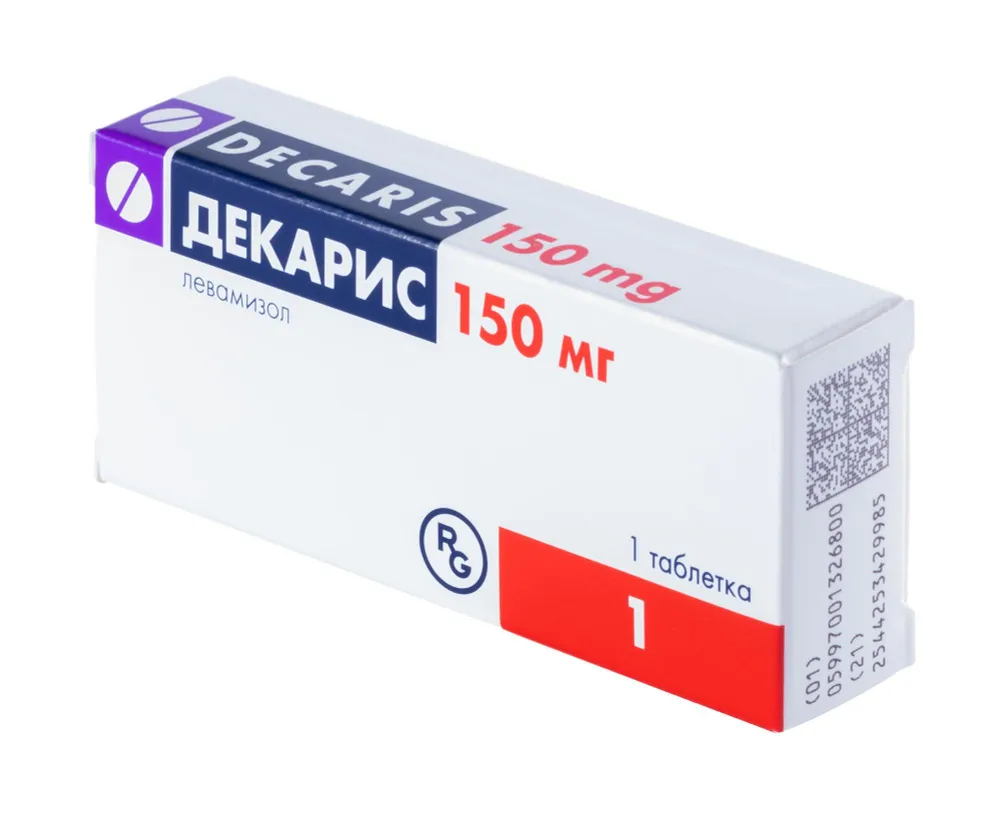
Table of Contents
INSTRUCTIONS FOR MEDICAL USE OF THE MEDICINAL PRODUCT DECARIS (DECARIS)
Composition:
Active substance: levamisole;
1 tablet of 50 mg contains levamisole 50 mg (in the form of 59 mg of levamisole hydrochloride);
Excipients: maize starch, sodium saccharin, povidone, talc, apricot flavor, magnesium stearate, tartrazine (E 110);
1 tablet of 150 mg contains levamisole 150 mg (in the form of 177 mg of levamisole hydrochloride);
Excipients: maize starch, lactose monohydrate, sucrose, povidone, talc, magnesium stearate.
Pharmaceutical form. Tablets.
Main physicochemical properties:
tablets of 50 mg – round, flat, pale orange in color, with a slight apricot odor, with a score line and grooves dividing the tablet into four parts on one side. The tablet's cross-section is pale orange. Tablet diameter – approximately 7 mm;
tablets of 150 mg – round, flat, nearly white, with a score line and engraved "DECARIS •150•" on one side, the other side blank. Tablet diameter – approximately 9 mm.
Pharmacotherapeutic group. Anthelmintics. Agents used in nematode infections. Imidazothiazole derivatives. ATC code P02C E01.
Pharmacological properties.
Pharmacodynamics.
Mechanism of action
The active ingredient of Decaris tablets, levamisole, is a fast-acting anthelmintic agent.
Levamisole causes depolarizing neuromuscular paralysis in ganglion-like structures of nematodes. Thus, paralyzed nematodes are eliminated from the body due to normal intestinal peristalsis within 24 hours after administration of the drug. Although levamisole primarily affects the neuromuscular system of nematodes, it is quite possible that in some helminths, inhibition of the fumarate reductase system also contributes to the anthelmintic efficacy of levamisole.
Pharmacokinetics.
Absorption, distribution, metabolism and elimination
A single 50 mg dose of levamisole is rapidly absorbed from the gastrointestinal tract. The maximum plasma concentration of levamisole, 0.13 μg/mL, is reached on average within 1.5–2 hours after drug administration.
The elimination half-life is 3–6 hours. Levamisole is metabolized in the liver into several metabolites, which are excreted primarily by the kidneys (approximately 70% within 3 days) and to a lesser extent in feces (5%).
Less than 5% of the administered dose is excreted unchanged in urine and less than 0.2% in feces. The main urinary metabolite is p-hydroxylevamisole and its glucuronide conjugate (12% of the dose).
Clinical characteristics.
Indications. Ascariasis, necatoriasis, ancylostomiasis.
Contraindications. Hypersensitivity to levamisole or to any excipient contained in the medicinal product.
Interaction with other medicinal products and other forms of interaction.
Alcohol
Disulfiram-like symptoms have been observed when Decaris is taken concomitantly with alcoholic beverages. Concomitant use of alcohol and the medicinal product Decaris is not permitted.
Anticoagulants
Decaris should be used with caution in combination with drugs affecting hematopoiesis.
When Decaris is used concomitantly with coumarin-like anticoagulants, prothrombin time may increase; therefore, the dose of the oral anticoagulant should be adjusted accordingly.
Other anthelmintic agents
Concomitant administration of Decaris with albendazole significantly reduced the area under the curve (AUC) of albendazole sulfoxide. The safety and efficacy of levamisole have not been established when used concomitantly with albendazole.
Concomitant administration of Decaris with ivermectin significantly increased the area under the curve (AUC) of ivermectin. The safety and efficacy of levamisole have not been established when used concomitantly with ivermectin.
Phenytoin
Decaris increases blood levels of phenytoin; therefore, phenytoin plasma concentrations should be monitored when both agents are used concomitantly.
Special precautions for use
Hematological disorders
There is some evidence that repeated exposure to levamisole may be associated with allergic reactions, including hematological disorders such as leukopenia. Therefore, the recommended dose of the drug must not be exceeded. Caution is required when using Decaris in combination with medicinal products that may adversely affect hematopoiesis.
Off-label use
Levamisole has been reported to be associated with leukopenia, neutropenia/agranulocytosis when used at doses significantly higher than recommended and over prolonged periods. In addition, leukocytoclastic vasculitis has been reported with off-label use of levamisole.
Alcohol
Alcoholic beverages must not be consumed during treatment and within 24 hours after taking the drug.
Excipients
Decaris 50 mg tablets contain Sunset Yellow FCF (E 110), which may cause allergic reactions. This medicinal product contains less than 1 mmol of sodium (23 mg) per tablet, i.e. essentially "sodium-free".
Decaris 150 mg tablets contain lactose monohydrate and sucrose. Patients with rare hereditary disorders of galactose intolerance, lactose intolerance, fructose intolerance, glucose-galactose malabsorption syndrome, or sucrase-isomaltase deficiency should not take Decaris 150 mg tablets.
Use during pregnancy or breastfeeding
Pregnancy
Teratogenic effects were not observed in animal studies; however, levamisole has embryotoxic potential if administered to pregnant subjects at toxic doses.
Well-controlled clinical studies in pregnant women have not been conducted. Therefore, Decaris should be administered during pregnancy only if the expected benefit outweighs the potential risk of using the drug.
Breastfeeding period
It is not known whether levamisole passes into human breast milk; however, it is known to be excreted in cow's milk. To prevent potential adverse effects on the nursing infant, a decision should be made whether to discontinue breastfeeding or to discontinue the drug, taking into account the importance of the drug therapy for the mother.
Fertility
Reproductive studies in animals have not shown any effect on fertility.
Ability to influence the reaction rate when driving or operating machinery
Levamisole has not been shown to affect the ability to drive or operate machinery. However, encephalopathy has been reported as a very rare adverse reaction during levamisole treatment.
Method of administration and dosage.
Adults. Decaris is administered as a single dose of 150 mg (1 tablet).
Children. The drug is administered as 50 mg tablets as a single dose of 2.5 mg/kg body weight:
| Child's age |
Body weight |
Dosage of the drug |
| 3−6 years |
10−20 kg |
25–50 mg (1/2–1 tablet), single dose |
| 7−10 years |
20−30 kg |
50−75 mg (1–1.5 tablets), single dose |
| 11−18 years |
30−60 kg |
75–100 mg (1.5–3 tablets), single dose |
A 50 mg tablet may be divided in half.
Route of administration
For oral use.
The drug should be taken with a small amount of water after a light meal, in the evening. There is no need to use laxatives or follow a special diet.
If necessary, treatment may be repeated after a 7–14 day interval.
Children. The 150 mg tablets must not be administered to children! The 50 mg tablets may be used in children aged 3 years and older only as prescribed and under medical supervision.
Overdose.
Symptoms and signs
Signs of intoxication following ingestion of a large dose of levamisole (over 600 mg) include nausea, vomiting, lethargy, spasms, diarrhea, headache, dizziness, and confusion. At doses higher than recommended, seizures, leukopenia, and agranulocytosis/neutropenia have been reported.
Treatment. Monitoring of vital signs and symptomatic therapy are required.
In the presence of symptoms of anticholinesterase activity, atropine may be considered.
Adverse reactions.
Clinical trial data
The safety of levamisole was evaluated in 6799 individuals. Table 1 lists the adverse reactions observed during 13 clinical studies of levamisole used for the treatment of parasitic infections caused by Ancylostoma duodenale, Ascaris lumbricoides, or Necator americanus. Among these studies:
- 6 studies included levamisole only;
- 4 studies were placebo- and active-controlled (pamoate pyrantel, piperazine, thiabendazole, and mebendazole);
- 2 studies were active substance-controlled (piperazine);
- 1 study was placebo-controlled.
In all studies, patients received a single dose of levamisole.
The frequency of adverse reactions is defined according to the following categories: very common (≥ 1/10), common (≥ 1/100 and < 1/10), uncommon (≥ 1/1000 and < 1/100); rare (≥ 1/10,000 and < 1/1000); very rare (< 1/10,000), including isolated reports; frequency not known (cannot be estimated based on available data).
Table 1. Adverse reactions reported during 13 clinical studies of levamisole
| System organ class |
Adverse reaction frequency (N = 6799) |
Adverse reactions |
| Gastrointestinal disorders |
common frequency not known frequency not known frequency not known |
abdominal pain diarrhea nausea vomiting |
| Skin and subcutaneous tissue disorders |
frequency not known |
rash |
The adverse reactions reported during the post-marketing surveillance period with levamisole use are described in Table 2.
Table 2. Adverse reactions identified during post-marketing surveillance with levamisole use
| System organ class |
Frequency of adverse reactions |
Adverse reactions |
| Nervous system disorders |
Uncommon |
Headache |
| Frequency unknown |
Encephalopathy |
|
| Frequency unknown |
Dysgeusia |
|
| Frequency unknown |
Parosmia |
|
| Skin and subcutaneous tissue disorders |
Uncommon |
Pruritus |
| General disorders and administration site conditions |
Rare |
Pyrexia |
Reporting of suspected adverse reactions
Reporting of adverse reactions following registration of a medicinal product is of great importance. It enables continuous monitoring of the benefit-risk balance of the medicinal product. Medical and pharmaceutical professionals, as well as patients or their legal representatives, should report all suspected adverse reactions and lack of therapeutic efficacy through the automated pharmacovigilance information system at the following link: https://aisf.dec.gov.ua.
Shelf life. 5 years. Do not use after the expiry date stated on the packaging.
Storage conditions. Store at a temperature not exceeding 25°C. Keep the medicinal product out of the reach of children.
Packaging. Decaris, 50 mg – 2 tablets in a blister; 1 blister in a cardboard box;
Decaris, 150 mg – 1 tablet in a blister; 1 blister in a cardboard box.
Availability category. Over-the-counter.
Manufacturers. Gedeon Richter Romania S.A.; JSC "Gedeon Richter".
Manufacturers' addresses and locations of their operations.
99-105 Calea Bucovinei, Tirgu-Mures, Mures County, 540306, Romania (complete production cycle of finished product, packaging, batch control);
H-1103 Budapest, Demre utca 19-21, Hungary (batch release, issuance of quality certificates).
Marketing Authorization Holder. JSC "Gedeon Richter".
Address of the Marketing Authorization Holder. H-1103 Budapest, Demre utca 19-21, Hungary.