Dalmacin
Ukraine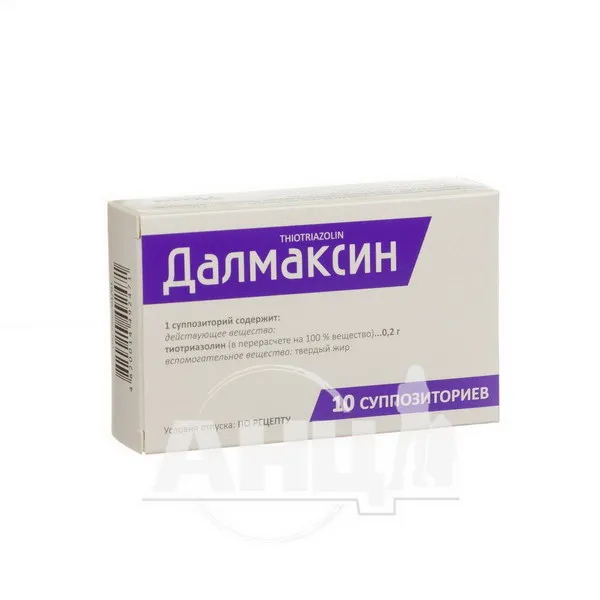
Table of Contents
INSTRUCTION FOR MEDICAL USE OF THE MEDICINAL PRODUCT DALMAXIN (DALMAXIN)
Composition:
Active substance: thiotriazolin (morpholinium-5-methyl-1,2,4-triazoline-5-thioacetate);
1 suppository contains thiotriazoline (calculated as 100% substance) 200 mg (0.2 g);
Excipients: hard fat.
Pharmaceutical form. Suppositories.
Main physico-chemical characteristics: white or white with a creamy shade, bullet-shaped suppositories. A surface film on the suppositories is permissible.
Pharmacotherapeutic group. Hepatoprotective agents. ATC code A05B A.
Pharmacological Properties
Pharmacodynamics
The pharmacological effect of the drug is due to its anti-ischemic, membrane-stabilizing, and antioxidant actions. Thiotriazolin prevents hepatocyte destruction, reduces the degree of fatty infiltration and the spread of centrilobular necrosis in the liver, promotes reparative regeneration of hepatocytes, and normalizes protein, carbohydrate, lipid, and pigment metabolism within them. It increases the rate of bile synthesis and excretion and normalizes its chemical composition. Thiotriazolin exerts a hepatoprotective effect in hepatitis and cirrhosis of various etiologies, which determines the use of this drug in complex therapy.
When administered rectally or vaginally, thiotriazolin acts locally upon contact with the mucous membranes of the rectum and female urogenital organs, demonstrating anti-inflammatory activity and accelerating the healing of wounds and ulcers of the urogenital tract mucosa. Upon absorption and manifestation of a systemic effect, it exerts a similar action on the mucous membrane of the gastrointestinal tract.
The drug accelerates wound healing in the skin, mucous membranes of the urogenital system, and gastrointestinal tract.
Pharmacokinetics
After rectal administration, the bioavailability of the drug is 60%. The drug accumulates in significant concentrations in the tissues of the liver, spleen, rectum, and kidneys, and in minor amounts—in the lungs and small intestine. In addition to local effects, it is rapidly absorbed through the mucous membranes, with maximum plasma concentration reached within 1.5 hours. The half-life of thiotriazolin is 2.9 hours. The drug is predominantly excreted by the kidneys.
Clinical characteristics.
Indications.
Inflammatory-erosive lesions of the rectal and sigmoid mucosa, fissures and erosions in the area of the anal opening and rectum.
Inflammatory-erosive lesions of the vagina and cervix, viral and atrophic colpitis. Also used to accelerate epithelialization in cases of impaired mucosal integrity following diathermy and cryotherapy, as well as after surgical interventions.
Liver diseases, particularly chronic persistent hepatitis, chronic active hepatitis, liver cirrhosis, viral and toxic hepatitis (as part of complex therapy).
Contraindications.
Hypersensitivity to the components of the drug. Renal insufficiency.
Interaction with other medicinal products and other forms of interaction.
Not studied.
Special precautions for use.
Before using the suppository, it is necessary to:
- detach one suppository in its primary packaging from the blister pack along the perforation line;
- then pull the edges of the film in opposite directions, tearing it apart, and remove the suppository from its primary packaging.
The suppository should be administered in the lying position.
Use during pregnancy or breastfeeding.
Due to limited experience with the use of the drug in pregnant and breastfeeding women, the drug is not recommended for these patient groups. If use of this drug is necessary, the benefit-risk ratio should be carefully considered.
Ability to influence reaction speed when driving or operating machinery.
There are no data regarding the effect of the drug on the ability to drive or operate machinery. However, if adverse effects such as dizziness, general weakness, or other central nervous system disturbances occur, it is recommended to refrain from such activities.
Dosage and Administration.
Adults.
For acute and chronic hepatitis, liver cirrhosis: administer rectally, 1 suppository twice daily (in the morning and evening) for 2–4 weeks.
For inflammatory conditions of the rectum and sigmoid colon: administer rectally, 1 suppository twice daily (in the morning and evening) for 1–2 weeks.
For inflammatory-erosive lesions of the vagina and cervix: administer vaginally, 1 suppository daily (preferably in the evening) for 1–2 weeks, or 1 suppository twice daily (in the morning and evening) for 7–10 days.
Children. The drug should not be used for treatment of children.
Overdose.
In case of overdose, increased concentrations of sodium and potassium in urine are possible. After reducing the dose, adverse effects resolve spontaneously without specific treatment.
Side effects.
Allergic reactions: itching, skin hyperemia, fever, rashes (urticarial, papular, petechial, macular), urticaria, angioneurotic edema, anaphylactic shock.
Respiratory system disorders: dyspnea, asthma.
Central nervous system disorders: dizziness, general weakness, tinnitus.
Gastrointestinal tract disorders: nausea, vomiting, dry mouth, abdominal distension.
Cardiovascular disorders: arterial hypertension, chest pain, sinus rhythm disturbances, tachycardia.
Reactions at the site of administration: itching, hyperemia, rashes.
Shelf life.
3 years.
Storage conditions.
Store at a temperature not exceeding 25 °C.
Keep out of reach of children.
Packaging.
5 suppositories per blister pack; 1 or 2 blister packs per carton.
Prescription status.
Prescription only.
Manufacturer.
Private Joint-Stock Company "Lekhim-Kharkiv".
Manufacturer's address.
36 Severina Pototskogo Street, Kharkiv, Kharkiv region, 61115, Ukraine.