Buspirone sandos®
Ukraine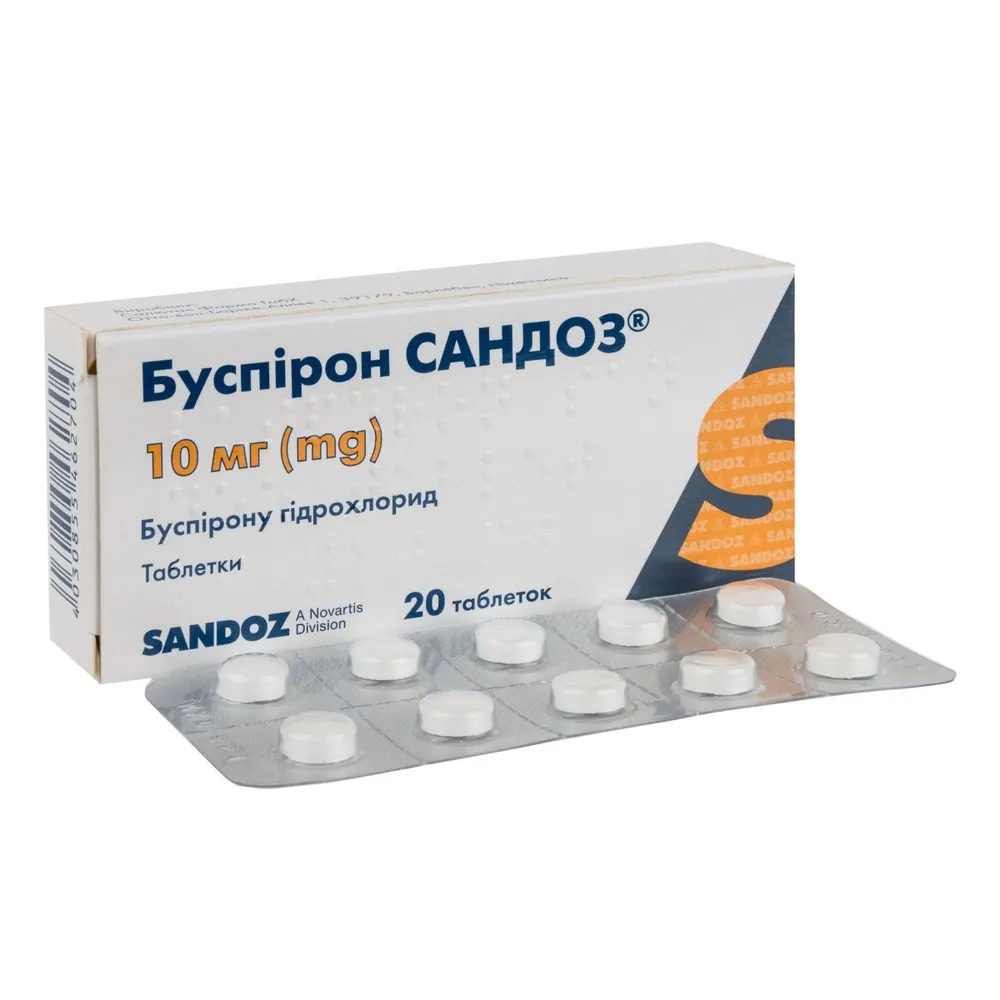
Table of Contents
INSTRUCTIONS FOR MEDICAL USE OF THE MEDICINAL PRODUCT BUPSPIRON SANDOZÒ (Buspiron SANDOZÒ)
Composition:
Active substance: buspiron;
One tablet contains 5 mg or 10 mg of buspirone hydrochloride;
Excipients: lactose monohydrate, corn starch, calcium hydrogen phosphate dihydrate, colloidal anhydrous silicon dioxide, sodium starch glycolate (type A), microcrystalline cellulose, magnesium stearate.
Pharmaceutical form. Tablets.
Main physicochemical properties:
5 mg and 10 mg tablets: white, round tablets with a "snap tab" break line.
Pharmacotherapeutic group.
Agents acting on the nervous system. Anxiolytics. ATC code N05B E01.
Pharmacological properties.
Pharmacodynamics.
Buspirone is an anxiolytic agent used for the treatment of anxiety disorders of various origins, particularly neuroses accompanied by feelings of anxiety, restlessness, tension, and irritability. The mechanism of action of buspirone has not been fully elucidated; however, it is known to differ from that of benzodiazepines and other anxiolytic agents. Buspirone exhibits high affinity for presynaptic 5-HT1A receptors and acts as a partial agonist at postsynaptic 5-HT1A receptors in the central nervous system (CNS). In a series of preclinical studies using experimental models, buspirone demonstrated properties typical of both anxiolytics and antidepressants. Buspirone does not exhibit significant activity at benzodiazepine receptors and does not affect GABA binding. Unlike benzodiazepines, buspirone lacks anticonvulsant and muscle relaxant effects, does not cause dependence, and withdrawal symptoms do not develop after discontinuation of treatment. The effect of buspirone develops gradually. The therapeutic effect begins to manifest between 7 and 14 days of therapy, and maximum efficacy is achieved only after approximately 4 weeks of treatment initiation.
Pharmacokinetics.
After administration, the drug is rapidly and almost completely absorbed from the gastrointestinal tract. Steady-state plasma concentrations may be reached approximately 2 days after initiation of regular dosing.
Buspirone undergoes extensive first-pass metabolism in the liver. Systemic bioavailability is 4%. Peak plasma concentration is achieved within 60–90 minutes after drug intake. Approximately 95% of buspirone is protein-bound in plasma. The elimination half-life from plasma is 2–3 hours. Pharmacokinetic parameters of the drug do not change with continuous administration (no accumulation occurs).
The main pharmacologically active metabolite of buspirone is 1-[2-pyrimidinyl]piperazine (1-PP).
Its anxiolytic activity is 4–5 times lower than that of the parent compound, but its plasma concentration is higher and its elimination half-life is approximately twice as long as that of buspirone.
Approximately 29–63% of buspirone and its metabolites are excreted in urine within 24 hours, and 18–38% are eliminated in feces. Elimination of buspirone and its metabolites is somewhat reduced in patients with impaired renal or hepatic function.
Concomitant food intake slows the absorption of buspirone from the gastrointestinal tract.
Buspirone penetrates into breast milk. Data regarding placental passage of buspirone are lacking.
Elevated plasma levels of buspirone and increased AUC values, as well as prolonged elimination half-life, may occur in patients with hepatic impairment. Due to biliary excretion of unchanged compound, a secondary peak may appear in plasma levels of buspirone. Patients with hepatic cirrhosis should receive lower individual doses or the same doses but less frequently.
Renal insufficiency may reduce buspirone clearance by up to 50%. Buspirone should be administered with caution and at reduced doses in patients with renal impairment. Pharmacokinetics of buspirone is not altered in elderly patients.
Clinical characteristics.
Indications.
Symptomatic treatment of anxiety disorders with predominant symptoms such as anxiety, inner restlessness, and tension.
Contraindications.
Hypersensitivity to buspirone or to any of the excipients. Acute congestive glaucoma, severe liver disease, myasthenia gravis, severe hepatic insufficiency (prothrombin time > 18 seconds); severe renal insufficiency (creatinine clearance < 20 mL/min/1.72 m²), epilepsy, acute alcohol intoxication, sedatives, analgesics, and neuroleptics.
Concomitant use of monoamine oxidase inhibitors (MAOIs) and within 14 days after discontinuation of an irreversible MAOI or within 1 day after discontinuation of a reversible MAOI.
Interaction with other medicinal products and other forms of interaction.
Due to insufficient clinical data, concomitant use of buspirone with antihypertensive agents, neuroleptics, antidepressants, antidiabetic agents, anticoagulants, oral contraceptives, and cardiac glycosides is possible only under strict medical supervision. Buspirone must not be used concurrently with benzodiazepines or other sedative agents.
Combination with MAO inhibitors is not recommended due to the risk of hypertensive crisis.
Since buspirone is primarily metabolized by cytochrome P450, potent inhibitors of this enzyme may increase the bioavailability of buspirone.
Nefazodone
Concomitant administration of buspirone (2.5 or 5 mg twice daily) and nefazodone (250 mg twice daily) resulted in a 20-fold increase in the maximum plasma concentration (Cmax) of buspirone and a 50-fold increase in the area under the concentration-time curve (AUC), as well as a statistically significant reduction (approximately 50%) in the plasma concentration of the buspirone metabolite, 1-pyrimidinylpiperazine. When buspirone was administered at a dose of 5 mg twice daily, a slight increase in AUC for nefazodone (23%), its metabolite hydroxynefazodone (HO-NEF) (17%), and mCPP (9%) was observed. A slight increase in Cmax for nefazodone (8%) and its metabolite HO-NEF (11%) was also observed.
The adverse reaction profile in patients receiving buspirone at 2.5 mg twice daily and nefazodone at 250 mg twice daily did not differ from that observed in patients receiving either drug alone. Adverse reactions in patients receiving buspirone at 5 mg twice daily and nefazodone at 250 mg twice daily included pre-syncope, asthenia, dizziness, and somnolence. A reduction in the dose of buspirone is recommended when used concomitantly with nefazodone.
Erythromycin
Concomitant administration of buspirone (single 10 mg dose) and erythromycin (1.5 g once daily for 4 days) resulted in a 5-fold increase in Cmax and a 6-fold increase in AUC of buspirone. If concomitant use of buspirone and erythromycin is necessary, a low dose of buspirone (e.g., 2.5 mg twice daily) is recommended.
Itraconazole
Concomitant administration of buspirone (single 10 mg dose) and itraconazole (200 mg once daily for 4 days) resulted in a 13-fold increase in Cmax and a 19-fold increase in AUC of buspirone. If concomitant use of buspirone and itraconazole is necessary, a low dose of buspirone (e.g., 2.5 mg once daily) is recommended.
Diltiazem
Concomitant administration of buspirone (single 10 mg dose) and diltiazem (60 mg three times daily) resulted in a 5.3-fold increase in Cmax and a 4-fold increase in AUC of buspirone. Enhanced effect and increased toxicity of buspirone are possible when used concomitantly with diltiazem.
Verapamil
Concomitant administration of buspirone and verapamil resulted in a 3.4-fold increase in both Cmax and AUC of buspirone. Increased effect and toxicity of buspirone are possible when used concomitantly with verapamil.
Cimetidine
Concomitant administration of buspirone and cimetidine resulted in a 40% increase in Cmax of buspirone and a doubling of tmax, but AUC remained practically unchanged.
When buspirone is used concomitantly with the above-mentioned agents, the therapeutic effect and toxicity of buspirone may increase; therefore, a reduced dose of buspirone (e.g., 2.5 mg twice daily) is recommended. Subsequent dose adjustments should be based on the individual clinical response to treatment.
Baclofen, lofexidine, nabilone, and antihistamines may potentiate any sedative effect.
Rifampicin
Concomitant administration of buspirone (single 30 mg dose) and rifampicin (600 mg once daily for 5 days) resulted in an 83.9% decrease in Cmax and an 89.6% decrease in AUC of buspirone.
Cytochrome CYР3A4 inhibitors and inducers
Ketoconazole or ritonavir inhibit the metabolism of buspirone and increase its plasma levels. If buspirone is used concomitantly with a CYР3A4 inhibitor, its dose should be reduced. Inducers of CYР3A4, such as dexamethasone, phenytoin, phenobarbital, or carbamazepine, may increase the rate of buspirone metabolism. In such cases, the dose of buspirone may need to be increased to maintain its anxiolytic efficacy.
Serotonin reuptake inhibitors
No dangerous interactions have been reported with the concomitant use of buspirone and antidepressants that are selective serotonin reuptake inhibitors. However, isolated reports exist of seizures occurring with long-term concomitant use of these agents with buspirone.
Haloperidol
Concomitant administration of buspirone and haloperidol resulted in increased serum concentrations of haloperidol.
Trazodone
There have been reports of a threefold increase in ALT activity in some patients receiving trazodone concomitantly with buspirone. However, this elevation in liver transaminases has not been confirmed in clinical studies.
Diazepam
Concomitant use of diazepam and buspirone leads to a slight increase in plasma levels of diazepam and may result in adverse effects such as dizziness, headache, and nausea.
Alcoholic beverages should be avoided during treatment with buspirone.
Fluvoxamine
Short-term therapy with buspirone concomitantly with fluvoxamine resulted in a doubling of plasma buspirone levels compared to buspirone monotherapy.
Digoxin
Approximately 95% of buspirone is protein-bound in human plasma. In vitro, buspirone does not displace highly protein-bound drugs (e.g., warfarin) from plasma protein binding sites in serum. However, in vitro, buspirone may displace weakly protein-bound drugs (e.g., digoxin) from their binding sites. The clinical significance of this property is unknown.
Increased prothrombin time has been reported after adding buspirone to a treatment regimen that includes warfarin.
Patients undergoing treatment should avoid consuming large amounts of grapefruit juice (double dose of 200 mL for 2 days), as this may lead to increased plasma levels of buspirone and an increased frequency or severity of adverse effects.
Special precautions for use.
Hepatic impairment.
Buspirone undergoes extensive metabolism in the liver. In a pharmacokinetic study, administration of a single 30 mg dose of buspirone to patients with liver cirrhosis resulted in increased plasma levels of buspirone, increased AUC values, and prolonged elimination half-life of buspirone. Due to biliary excretion of the drug, a secondary peak in plasma buspirone concentration may occur. The drug is contraindicated in patients with severe hepatic impairment. In patients with liver cirrhosis, the drug should be administered at lower doses or at the same doses but with extended dosing intervals.
Renal impairment.
In moderate or severe renal impairment, buspirone clearance may be reduced by 50%. The drug is contraindicated in patients with severe renal impairment (creatinine clearance < 20 mL/min/1.72 m²). The drug should be administered with caution in patients with renal dysfunction (see "Dosage and administration").
Elderly patients.
Dosage adjustment is not generally required; however, caution should be exercised when administering the drug (e.g., due to possible decreased renal and/or hepatic function and increased sensitivity to adverse effects of the drug). Patients should be started on the lowest effective dose, and close monitoring is recommended if dose escalation is necessary.
Patients should be advised not to consume grapefruit or drink grapefruit juice in significant amounts during treatment, as these products may increase plasma levels of buspirone and lead to an increased frequency or severity of adverse effects.
Switching from benzodiazepines to buspirone.
Buspirone does not alleviate benzodiazepine withdrawal symptoms. If a patient is to be switched to buspirone therapy after prolonged benzodiazepine treatment, buspirone should only be initiated after completion of a gradual benzodiazepine dose reduction regimen.
Buspirone does not cause drug dependence; however, its use in patients with known or suspected susceptibility to substance dependence requires careful medical supervision.
Since the anxiolytic effect of the drug becomes apparent after 7–14 days of treatment and the full therapeutic effect develops approximately after 4 weeks, patients with pronounced anxiety require careful medical monitoring during the initial phase of therapy.
Alcoholic beverages should be avoided throughout the course of buspirone treatment.
Buspirone is not indicated for the treatment of withdrawal symptoms caused by benzodiazepines or other sedative/hypnotic agents. Therefore, these agents should be gradually discontinued before initiating buspirone therapy. This is particularly important for patients taking medications that depress the central nervous system. Buspirone should not be used as monotherapy in the treatment of depression, as it may mask clinical symptoms of depression.
Clinical and experimental studies have not revealed any signs that buspirone causes risk of dependence or addiction; however, the prescription of the drug should always be justified.
Concomitant use of buspirone with monoamine oxidase inhibitors (MAOIs) may be hazardous. Cases of increased blood pressure have been reported with concurrent use of these drugs.
Buspirone should be used with caution in patients with acute angle-closure glaucoma, myasthenia gravis, or a history of substance dependence.
Buspirone is contraindicated in patients with a history of epilepsy seizures.
Buspirone Sandoz® contains lactose and therefore should not be administered to patients with rare hereditary forms of galactose intolerance, lactase deficiency, or glucose-galactose malabsorption syndrome.
Long-term toxicity.
Since the mechanism of action is not fully understood, long-term toxic effects on the CNS or other organ systems cannot be predicted.
Use during pregnancy or breastfeeding.
There are no adequate data on the use of buspirone during pregnancy; therefore, the drug should be prescribed only if the expected benefit to the pregnant woman outweighs the potential risk to the fetus. Buspirone passes into breast milk; therefore, breastfeeding should be discontinued during treatment.
Ability to affect reaction speed when driving or operating machinery.
During treatment, patients should refrain from driving or operating machinery, as adverse reactions affecting the central nervous system and mental performance may occur (see section "Adverse reactions").
Method of Administration and Dosage.
The dosage is determined individually by a physician for each patient depending on the condition being treated.
At the beginning of therapy, administer 5 mg of buspirone hydrochloride three times daily. To achieve the maximum therapeutic effect, the daily dose should be gradually increased to 20–30 mg of buspirone, divided into several individual doses.
The maximum single dose should not exceed 30 mg.
The maximum daily dose should not exceed 60 mg.
Food increases the bioavailability of buspirone. Tablets should always be taken at the same time of day, without chewing, swallowed with a small amount of liquid, either after meals or independently of food intake.
If it is necessary to split the tablet in half, place it on a firm surface with the score line facing upwards and gently press down with the thumb.
If buspirone is used concomitantly with a strong CYP3A4 inhibitor, its initial dose should be reduced and only gradually increased after medical evaluation of the patient (see section "Interaction with Other Medicinal Products and Other Forms of Interaction").
Grapefruit juice increases buspirone plasma levels. Patients are advised not to consume large quantities of grapefruit juice during treatment.
Special Patient Groups.
Renal Impairment
In mild to moderate renal impairment (creatinine clearance 20–49 mL/min/1.72 m²), single-dose administration of buspirone results in increased plasma levels without prolongation of the elimination half-life. For these patients, buspirone should be used cautiously and at lower doses, administered twice daily. Response to treatment and patient symptoms should be carefully monitored before increasing the dose. In patients with anuric syndrome, single-dose administration leads to increased blood levels of the metabolite 1-pyrimidinyl/piperazine (1-PP); dialysis has shown no effect on plasma levels of either buspirone or 1-PP. Buspirone should not be administered to patients with creatinine clearance below 20 mL/min/1.72 m², especially those with anuric syndrome, due to the potential for increased levels of buspirone and its metabolites.
Hepatic Impairment
Administration of drugs such as buspirone in patients with impaired liver function demonstrates reduced first-pass metabolism through the liver. In patients with liver cirrhosis, single-dose administration of buspirone leads to increased plasma levels of the unchanged drug and prolonged elimination half-life. For these patients, buspirone should be used cautiously and only after individual dose titration to minimize the risk of serious adverse reactions that may occur with high doses. Dose escalation should be considered only after careful patient evaluation and no sooner than 4–5 days after administration of the previous dose.
Elderly Patients
Available data do not indicate a need for dosage adjustment based on age or gender.
Duration of Treatment.
Anxiolytics should not be used for prolonged periods without medical supervision. Therefore, the duration of treatment with buspirone 5 mg and/or 10 mg should not exceed 4 months. Dosage is determined individually by a physician for each patient depending on the condition being treated. If prolonged use of the drug is required (up to 6 months), careful medical monitoring is necessary.
Psychological and social support measures should be considered in parallel with buspirone therapy.
Children.
Buspirone should not be administered to children due to lack of data on safety and efficacy in this patient group.
Overdose.
Symptoms: nausea, vomiting, dizziness, increased fatigue, drowsiness, loss of consciousness, miosis (pupil constriction), and gastrointestinal disturbances. More severe complications have not been observed, even with daily doses up to 2400 mg.
Treatment: gastric lavage, monitoring of respiration, pulse, and blood pressure. Symptomatic therapy. There is no specific antidote. Buspirone is not removed by hemodialysis. Based on clinical experience, overdose with high doses (single oral dose of 375 mg) does not necessarily result in severe symptoms.
Adverse Reactions
Adverse effects usually occur at the beginning of treatment and typically diminish with continued use. In some cases, dose reduction may be necessary. The most commonly observed adverse reactions were those affecting the nervous system, such as dizziness, insomnia, nervousness, drowsiness, and semiconsciousness, as well as those affecting the gastrointestinal tract, such as nausea, and other undesirable effects, for example, headache and increased fatigue.
Less frequently observed were anger and hostility, confusion, blurred vision, diarrhea, muscle and bone pain, numbness, paresthesia, impaired motor coordination, tremor, skin rash, dry mouth, weakness, asthenia, increased sweating, and clammy skin.
Frequency of adverse reactions: very common (≥ 1/10), common (≥ 1/100, < 1/10), uncommon (≥ 1/1000, < 1/100), rare (≥ 1/10000, < 1/1000), very rare (< 1/10000), frequency not known (cannot be estimated from available data).
Infections and infestations:
Frequency not known — influenza-like illness.
Cardiovascular system:
Common — non-specific chest pain, tachycardia/palpitations; uncommon — transient loss of consciousness, arterial hypotension and/or hypertension; rare — cerebrovascular disorders, heart failure, myocardial infarction, cardiomyopathy, bradycardia, cerebrovascular events.
Blood and lymphatic system disorders:
Rare — blood parameter changes (eosinophilia, leukopenia, thrombocytopenia).
Psychiatric disorders:
Common — nightmares, insomnia, nervousness, decreased attention, emotional excitement, irritability, hostility, confusion, depression; uncommon — depersonalization, discomfort, pathological hypersensitivity to normal sounds, euphoria, hyperkinesis, restlessness, loss of interest, impaired associative perception, hallucinations, suicidal thoughts, dysphoria, fear; rare — sudden mood swings, claustrophobia, stupor, slurred speech, psychosis, transient memory problems, serotonin syndrome, affective lability.
Nervous system disorders:
Very common — dizziness, headache, drowsiness; common — paresthesia (tingling, pain sensation), blurred vision, coordination disturbances, tremor; uncommon — numbness, epileptic seizures, dysgeusia, dysosmia, prolonged reaction time; rare — involuntary movements, bradyphrenia, extrapyramidal symptoms including early and late dyskinesia, tone disturbances, parkinsonism, akathisia, dystonia, syncope, amnesia, ataxia, serotonin syndrome, cogwheel rigidity, restless legs syndrome, agitation.
Eye disorders:
Common — blurred vision; uncommon — redness and itching in the eye area, conjunctivitis; rare — photophobia, sensation of pressure in the eyes, eye pain, narrowed visual field, increased intraocular pressure.
Ear and labyrinth disorders:
Common — tinnitus; rare — inner ear disorders.
Respiratory system:
Common — sore throat, nasal congestion, pharyngolaryngeal pain; uncommon — hyperventilation, dyspnea, chest tightness, hyperventilation, sensation of suffocation; rare — epistaxis, burning sensation of the tongue.
Gastrointestinal disorders:
Common — nausea, xerostomia, epigastric pain, diarrhea, constipation, vomiting; uncommon — flatulence, loss of appetite, increased appetite, hypersalivation, irritable bowel syndrome, rectal bleeding.
Renal and urinary disorders:
Uncommon — frequent urination, urinary retention, dysuria; rare — enuresis, nocturia.
Skin and subcutaneous tissue disorders:
Common — cold sweat, rash; uncommon — swelling, urticaria, hyperemia, bruising, alopecia, dry skin, eczema, facial swelling, bullous eruptions, skin fragility, pruritus; rare — allergic reactions, ecchymosis, acne, nail thinning.
Musculoskeletal and connective tissue disorders:
Common — musculoskeletal pain; uncommon — muscle spasms and rigidity, myalgia, arthralgia; rare — myasthenia.
Endocrine disorders:
Rare — galactorrhea, gynecomastia, thyroid dysfunction.
Metabolism and nutrition disorders:
Uncommon — anorexia, increased appetite; frequency not known — weight gain, weight loss.
General disorders and administration site conditions:
Common — asthenia; uncommon — fever, tinnitus, malaise, increased fatigue, disturbances in smell and taste, increased sweating, hot flashes, cold hyperesthesia; rare — tendency to alcohol abuse, coagulation disorders, voice loss, hiccups, glossalgia.
Hepatobiliary disorders:
Uncommon — increased liver enzymes.
Reproductive system and breast disorders:
Uncommon — menstrual cycle disturbances, decreased or increased libido; rare — amenorrhea, inflammation of urogenital organs, reduced ejaculation, impotence.
Laboratory investigations:
Elevated serum transaminase levels.
Shelf life.
2 years.
Storage conditions.
No special storage conditions required.
Keep out of reach of children.
Packaging.
For 5 mg dosage: 10 or 20 tablets in a blister; 1 (20 × 1) or 2 (10 × 2) blisters in a cardboard box.
For 10 mg dosage: 10 tablets in a blister; 2 (10 × 2) blisters in a cardboard box.
Prescription category.
Prescription only.
Manufacturer.
Salutas Pharma GmbH.
Manufacturer's address and place of business.
Otto-von-Guericke-Allee, 1, 39179 Barleben, Germany.