Bronhostop® pastilles
Ukraine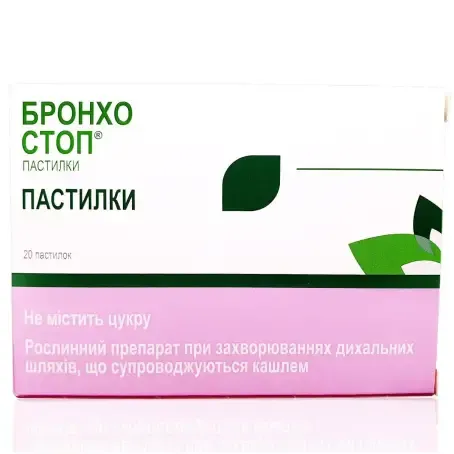
Table of Contents
INSTRUCTIONS FOR MEDICAL USE OF THE MEDICINAL PRODUCT BONCHOSTOP® LOZENGES
Composition:
Active ingredient: dry extract of thyme herb (Thymi herba);
1 lozenge contains dry extract of thyme herb (Thymi herba) (7–13:1) (extractant: water) 59.5 mg;
Excipients: gum arabic (E 414); fructose; sorbitol 70% non-crystallizing liquid (E 420); maltodextrin; anhydrous citric acid (E 330); sodium saccharin (E 954); aronia flavor [containing propylene glycol (E 1520)]; berry flavor [containing propylene glycol (E 1520), benzyl alcohol (E 1519)]; mineral oil; purified water.
Pharmaceutical form. Lozenges.
Main physicochemical properties: hexagonal-shaped lozenges, brown in color, with a fruity taste.
Pharmacotherapeutic group.
Combined preparations used in cough and colds.
ATC code R05C A.
Pharmacological Properties.
Pharmacodynamics.
BROCHOSTOP® LOZENGES is used as an expectorant in cough associated with the common cold, primarily for long-term therapy. The essential oils and flavonoids from thyme herb exert broncholytic, secretolytic, and antibacterial effects, thus promoting rapid liquefaction of accumulated mucus in the respiratory tract, reducing cough, and easing respiration, as well as acting against the infectious agent.
The natural base (gum) ensures slow release of the active substance, resulting in gradual cessation of secretion from the mucous membranes. This reduces mucosal irritation, stimulates salivation, and thereby moistens the mucous membrane, additionally relieving irritation caused by coughing and suppressing cough. It rapidly and persistently protects the receptors of the respiratory mucosa from irritation.
Pharmacokinetics.
Flavonoids from thyme herb (apigenin, luteolin) are metabolized by intestinal microflora and are well absorbed. They are excreted from the body mainly in urine, either unchanged or as metabolites.
Clinical characteristics.
Indications.
Symptomatic treatment of inflammatory diseases of the respiratory tract accompanied by cough and difficulty in expectorating thick mucus, relief of dry cough, and soothing of irritation of the oral and pharyngeal mucosa.
Contraindications.
- Hypersensitivity to the components of the medicinal product or to other plants of the Lamiaceae family, as well as sensitivity to celery and birch pollen (cross-reactivity possible);
- contraindicated in children with a history of acute stenosing laryngotracheitis;
- asthma;
- severe liver or kidney disease.
Interaction with other medicinal products and other forms of interaction.
Interaction studies have not been conducted.
Special precautions for use
If symptoms worsen during treatment with the medicinal product and/or dyspnea, fever, or purulent sputum occur, a physician should be consulted. If symptoms persist for 5 days, a physician should be consulted.
Each tablet of this medicinal product contains 523 mg of sorbitol and 300 mg of fructose.
Sorbitol is a source of fructose. If a patient has been diagnosed with intolerance to certain sugars or hereditary fructose intolerance—a rare genetic disorder in which the body is unable to metabolize fructose—a physician should be consulted before taking this medicinal product.
One tablet corresponds to approximately 0.1 carbohydrate exchange unit. This should be taken into account by patients with diabetes mellitus.
Due to the risk of accidentally swallowing the whole tablet, use in children under 6 years of age is not recommended.
BROCHOSTOP® TABLETS contain propylene glycol (E 1520)
One tablet contains 5.53 mg of propylene glycol.
BROCHOSTOP® TABLETS contain benzyl alcohol (E 1519)
One tablet contains 0.0018 mg of benzyl alcohol. Benzyl alcohol (E 1519) may cause allergic reactions.
BROCHOSTOP® TABLETS contain sodium
One tablet contains less than 1 mmol of sodium (23 mg), i.e., the medicinal product can be considered essentially "sodium-free".
Use during pregnancy or breastfeeding
Due to insufficient data, use of the medicinal product during pregnancy and breastfeeding is not recommended.
Ability to influence reaction rate when driving or operating machinery
Not established.
Dosage and Administration.
For oral use (hold in the mouth until completely dissolved).
For adults and children aged 12 years and older: 1–2 pastilles every 3–4 hours (4–6 times daily).
For children aged 6 to 12 years: 1 pastille three times daily.
The treatment duration should not exceed 5 days. Any further use must be determined by a physician.
Children.
For use in children aged 6 years and older.
Overdose.
There is no information available regarding cases of overdose.
In case of accidental overdose, discontinue use of the medicinal product and seek medical advice.
Side effects.
Hypersensitivity reactions have been observed during the use of preparations containing thyme, including cases of anaphylactic shock and Quincke's edema. Possible dyspnea, rash, urticaria, gastrointestinal disorders (including spasms, nausea, vomiting, diarrhea).
If any adverse reactions occur, discontinue treatment and consult a physician.
Shelf life.
3 years.
Storage conditions.
Store in the original packaging at a temperature not exceeding 25 °C.
Keep out of reach of children.
Packaging.
10 pastilles in a blister pack, 2 blisters per cardboard box.
Availability.
Over-the-counter (without prescription).
Manufacturer.
Quisda Pharma GmbH.
Manufacturer's address.
Effingerstrasse 21, 1160 Vienna, Austria.