Bronhomucin
Ukraine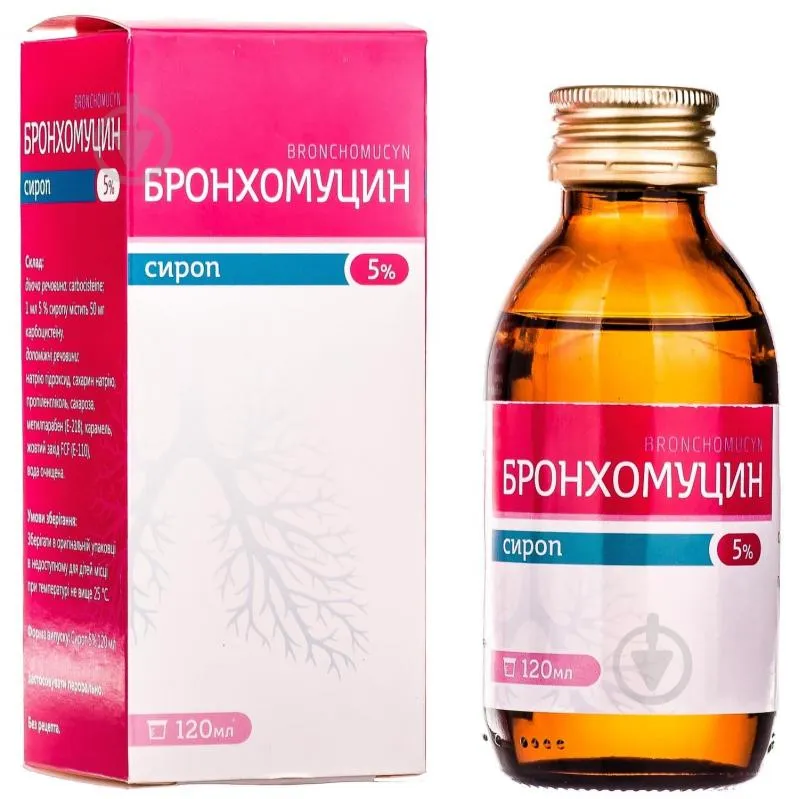
Table of Contents
INSTRUCTION FOR MEDICAL USE OF THE MEDICINAL PRODUCT Bronchomucyn (Bronchomucyn)
Composition:
Active substance: carbocisteine;
Bronchomucyn 2%: 1 ml of syrup contains 20 mg of carbocisteine;
Bronchomucyn 5%: 1 ml of syrup contains 50 mg of carbocisteine;
Excipients: sodium hydroxide, sodium saccharin, propylene glycol, sucrose, methylparaben (E 218), caramel, yellow azo dye FCF (E 110), purified water.
Pharmaceutical form. Syrup.
Main physicochemical properties: light yellow syrup with a caramel flavor.
Pharmacotherapeutic group.
Preparations used for cough and colds. Mucolytic agents. Carbocisteine. ATC code R05CB03.
Pharmacological properties.
Pharmacodynamics.
Carbocysteine affects the gel phase of respiratory tract mucus: by breaking disulfide bridges of glycoproteins, it causes liquefaction of excessively viscous bronchial secretions, thus facilitating expectoration.
The mucoregulatory effect of carbocysteine is associated with activation of sialyltransferase—an enzyme of goblet cells in the bronchial mucosa. Carbocysteine normalizes the quantitative ratio of acidic and neutral sialomucins in bronchial secretions, restoring their viscosity and elasticity. It activates ciliated epithelium function and improves mucociliary clearance. It promotes regeneration of the respiratory tract mucosa, normalizes its structure, reduces goblet cell hyperplasia, and consequently decreases mucus production. It restores secretion of immunologically active IgA (specific protection) and increases the number of sulfhydryl groups in mucus components (non-specific protection). It exerts anti-inflammatory effects due to kinin-inhibiting activity of sialomucins, thereby reducing edema and bronchoobstruction.
Pharmacokinetics.
After oral administration, carbocysteine is rapidly absorbed. Peak plasma concentration of the active substance is reached within 2 hours. Bioavailability is low—less than 10% of the administered dose (due to intensive metabolism in the gastrointestinal tract and first-pass effect in the liver).
Carbocysteine and its metabolites are mainly excreted in urine. Elimination half-life is approximately 2 hours.
Clinical characteristics.
Indications.
Treatment of symptoms related to impaired bronchial secretion and expectoration, particularly in acute bronchopulmonary diseases such as acute bronchitis; during exacerbations of chronic respiratory diseases.
Contraindications.
Brонhomycin 2 %:
- children under 2 years of age;
Brонhomycin 2 % and 5 %:
- hypersensitivity to the active substance or to any of the excipients of the medicinal product;
- peptic ulcer of the stomach or duodenum in the acute phase;
- first trimester of pregnancy due to insufficient data on teratogenic and embryotoxic effects.
Interaction with other medicinal products and other forms of interaction.
During treatment with carbocysteine, cough suppressants and agents that inhibit bronchial secretion should not be used. Enhances the effectiveness of glucocorticoid therapy (mutually) and antibacterial therapy.
Special precautions for use
Do not use carbocysteine with medicinal products that suppress cough and/or reduce secretions (atropine-like drugs).
The use of mucolytic agents may lead to impaired bronchial clearance in children under 2 years of age due to limited ability to clear bronchial secretions, related to age-related anatomical and physiological characteristics. Mucolytic agents should not be used in children under 2 years of age.
Treatment should be re-evaluated if there is no therapeutic effect or if symptoms worsen.
In cases of productive cough with purulent sputum, high fever, or chronic bronchial or lung disease, the clinical situation should be re-assessed.
The product should be used with caution in patients with a history of gastric or duodenal ulcer.
The product contains sucrose; therefore, patients with hereditary fructose intolerance, glucose-galactose malabsorption syndrome, or sucrase-isomaltase deficiency should avoid this product.
Patients on a low-carbohydrate diet or diabetic patients should be aware that 5 ml of 2% syrup contains 1.75 g of sucrose, and 15 ml of 5% syrup contains 5.25 g of sucrose.
This medicinal product contains sodium: 5 ml of 2% syrup contains 0.59 mmol (or 13.6 mg) of sodium, and 15 ml of 5% syrup contains 3.81 mmol (or 88.26 mg) of sodium. This should be taken into account by patients on a sodium-controlled diet.
The medicinal product contains methylparaben and the colouring agent Sunset Yellow FCF (E 110), which may cause allergic reactions (delayed-type).
Use during pregnancy or breastfeeding
Animal studies have not shown any teratogenic effects. The absence of teratogenic effects in animals suggests that developmental abnormalities are unlikely in humans. To date, there have been no reports of teratogenic effects during the post-marketing period. There are no data on the passage of carbocysteine into breast milk.
The product is contraindicated during the first trimester of pregnancy.
During the second and third trimesters of pregnancy and during breastfeeding, the product should be used only after careful assessment of the benefit-risk ratio for mother and fetus (child), as determined by the physician.
Effect on ability to drive or operate machinery
Has no effect.
Method of administration and dosage.
For oral use.
Bronchomucin 2% is recommended for treatment of children under 15 years of age.
Bronchomucin 5% is recommended for treatment of adults and children aged 15 years and older.
| Age |
Form of release |
Dosage |
| Children aged 2 to 5 years |
Bronchomucil 2% |
5 ml of syrup (1 teaspoon) twice daily |
| Children aged 5 to 15 years |
Bronchomucil 2% |
5 ml of syrup (1 teaspoon) three times daily |
| Adults and children aged 15 years and older |
Bronchomucil 5% |
15 ml of syrup (1 tablespoon) three times daily |
The maximum single dose for children is 100 mg of carbocysteine.
The duration of treatment should not exceed 8–10 days.
The duration of carbocysteine administration in children should be as short as possible – no more than 5 days.
Children.
Treatment of children should be carried out under medical supervision.
Bronchomucin 2% is used for the treatment of children aged 2 to 15 years.
Bronchomucin 5% is used for the treatment of children aged 15 years and older.
Overdose.
Symptoms: stomach pain, nausea, diarrhea.
Treatment: symptomatic therapy.
Side effects.
Risk of developing impaired bronchial patency in children under 2 years of age (see sections "Contraindications" and "Special precautions").
Very rarely, gastrointestinal disturbances (stomach pain, nausea, vomiting, diarrhea) may occur. In such cases, dose reduction is recommended.
Allergic skin reactions such as urticaria, angioneurotic edema, pruritus, and erythematous skin rashes (possibly delayed in time) are possible.
There have been several reported cases of rashes caused by administration of the medicinal product.
Shelf life. 3 years.
Do not use the medicinal product after the expiry date stated on the packaging.
Storage conditions.
Store in the original packaging, in a place inaccessible to children, at a temperature not exceeding 25 °C.
Packaging.
120 ml of syrup in a glass bottle, in a cardboard box.
Prescription status. Over-the-counter.
Manufacturer.
LLC "Arpimed".
Manufacturer's address and place of business.
19, 2nd microdistrict, city of Abovyan, Kotayk region, Republic of Armenia.