Bronchobos
Ukraine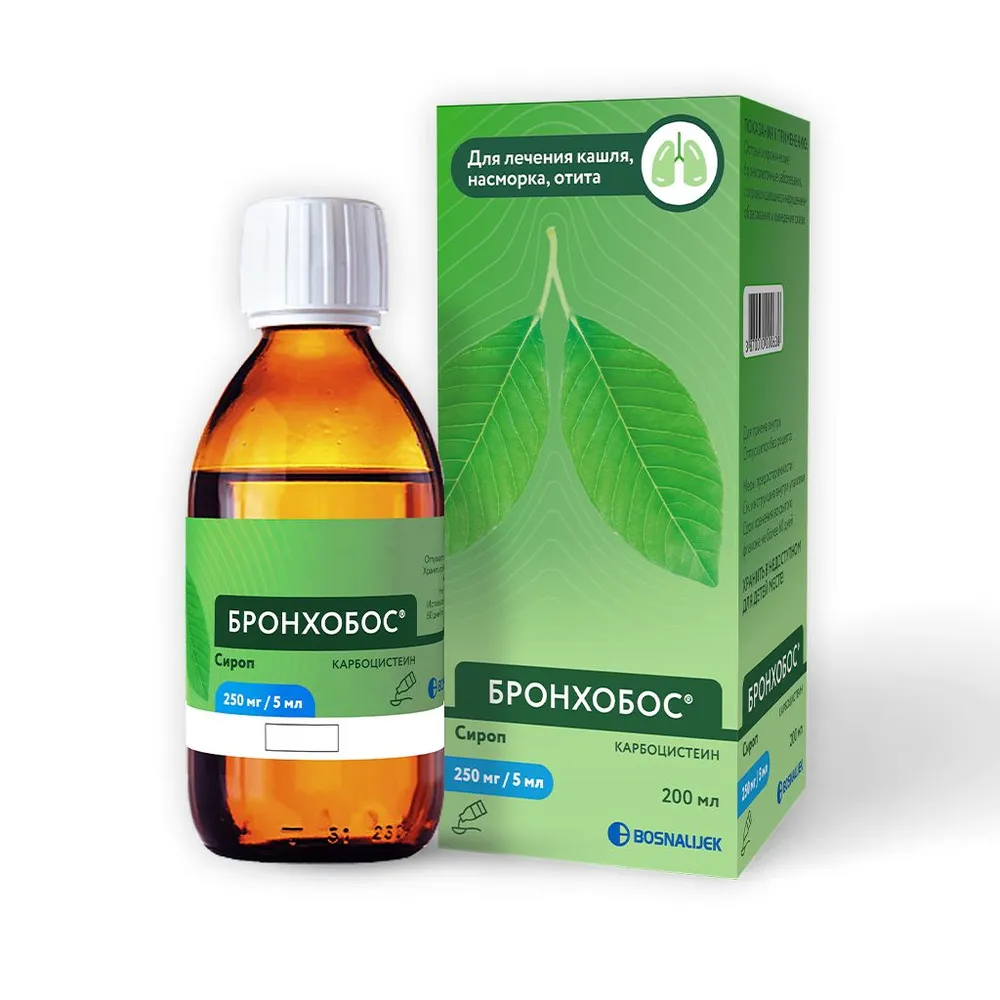
Table of Contents
INSTRUCTIONS FOR MEDICAL USE OF THE MEDICINAL PRODUCT BROMCHOBOS® (BRONCHOBOS®)
Composition:
Active substance: carbocisteine;
5 ml of syrup contains carbocisteine 125 mg or 250 mg;
Excipients: glycerol 85 %, ethanol 96 %, sodium hydroxide, sodium carmellose, methylparahydroxybenzoate (E 218), citric acid monohydrate, sodium saccharin, propylparahydroxybenzoate (E 216), raspberry flavor, azorubine (E 122), purified water.
Pharmaceutical form. Syrup.
Main physicochemical properties: clear, slightly viscous raspberry-colored liquid with a raspberry odor.
Pharmacotherapeutic group.
Medicinal products used for cough and common cold. Mucolytic agents. Carbocisteine. ATC code R05CB03.
Pharmacological properties.
Pharmacodynamics.
Carbocysteine (S-carboxymethyl L-cysteine), as demonstrated in studies in both healthy animals and those with bronchitis, affects the quality and quantity of glycoproteins secreted in the respiratory tract. An increased ratio of acidic to neutral glycoproteins in mucus and transformation of serous cells into mucus cells represent the initial response to irritation, followed by hypersecretion. In animals exposed to irritants, administration of carbocysteine resulted in maintenance of normal glycoprotein secretion; post-exposure administration accelerated normalization of the animals' condition. Clinical studies have demonstrated that carbocysteine reduces hyperplasia of goblet cells. Therefore, the use of carbocysteine is appropriate in the treatment of diseases characterized by abnormal mucus production.
Pharmacokinetics.
Carbocysteine is rapidly absorbed from the gastrointestinal tract. In a steady-state study (7 days) in which carbocysteine 375 mg capsules were administered at a dose of 2 capsules three times daily to healthy volunteers, the following pharmacokinetic parameters were observed:
| Plasma parameters |
Mean value |
Range |
| T Max (Hr) |
2.0 |
1.0–3.0 |
| T ½ (Hr) |
1.87 |
1.4–2.5 |
| KEL (Hr-1) |
0.387 |
0.28–0.50 |
| AUC0–7.5 (mcg.Hr.ml-1) |
39.26 |
26.0–62.4 |
| Values of obtained pharmacokinetic parameters |
||
| ٭CLS (L.Hr-1) |
20.2 |
- |
| CLS (ml.min-1) |
331 |
- |
| VD (L) |
105.2 |
- |
| VD (L.Kg-1) |
1.75 |
- |
| *Calculated based on the dose administered on day 7 of the study |
||
Clinical characteristics.
Indications.
Adjunctive therapy of respiratory diseases characterized by excessive production of viscous mucus, including chronic obstructive pulmonary disease.
Contraindications.
Hypersensitivity to the active substance or to any of the excipients.
Peptic ulcer of the stomach and duodenum during the period of exacerbation.
Interaction with other medicinal products and other forms of interaction.
Not established.
Special precautions for use
Caution is recommended when treating elderly patients, patients with a history of gastric or duodenal ulcer, or patients receiving medicinal products capable of causing gastrointestinal bleeding. In the event of gastrointestinal bleeding, administration of the drug should be discontinued.
BROMHOBOS®, syrup contains 96% ethanol. When 2.5 mL of syrup is administered, up to 62.5 mg of alcohol enters the body; when 15 mL of syrup is administered, up to 375 mg of alcohol enters the body. This may be harmful for patients suffering from alcoholism. This should also be taken into account when treating women during pregnancy or breastfeeding, children, and patients with liver disease or epilepsy.
BROMHOBOS®, syrup contains methyl parahydroxybenzoate (E 218) and propyl parahydroxybenzoate (E 216), which may cause allergic reactions (delayed hypersensitivity reactions are possible).
BROMHOBOS®, syrup contains azorubine (E 122), which may cause allergic reactions.
Use during pregnancy or breastfeeding
There are no data on the use of carbocysteine in pregnant women. It is not possible to draw conclusions regarding the safety of carbocysteine use during pregnancy. The use of carbocysteine for the treatment of women during pregnancy is not recommended, especially during the first trimester of pregnancy.
There are no data on the passage of carbocysteine into breast milk, its effect on milk production, or its effect on the breastfed infant. It is not possible to draw conclusions regarding the safety of carbocysteine use during breastfeeding. The use of carbocysteine for the treatment of women during breastfeeding is not recommended.
Ability to influence reaction speed when driving or operating machinery
BROMHOBOS®, syrup has no effect or has a negligible effect on the ability to drive or operate machinery.
Method of Administration and Dosage
For oral use.
For measuring the syrup, use a 5 ml dosing spoon with 2.5 ml graduations.
1 dosing spoon of BRONHOBOS®, syrup 125 mg/5 ml contains 125 mg of carbocisteine;
1 dosing spoon of BRONHOBOS®, syrup 250 mg/5 ml contains 250 mg of carbocisteine.
BRONHOBOS®, syrup 125 mg/5 ml
Children aged 2–5 years: 2.5 ml (1 dosing spoon filled to the 2.5 ml mark) 4 times daily.
Children aged 5–12 years: 5 ml (1 dosing spoon filled to the 5 ml mark) 3 times daily.
The duration of carbocisteine treatment in children should be as short as possible and not exceed 5 days.
BRONHOBOS®, syrup 250 mg/5 ml
Adults, including elderly patients: initial dose of 2250 mg carbocisteine per day, divided into several doses, subsequently reduced to 1500 mg per day, divided into several doses, after achieving satisfactory response.
That is, initial single dose of 15 ml (3 dosing spoons), then 10 ml (2 dosing spoons)
3 times daily.
The duration of treatment should not exceed 8–10 days.
Children.
The medicinal product is contraindicated for children under 2 years of age.
For treatment of children aged 2 to 12 years, use BRONHOBOS®, syrup 125 mg/5 ml. For children aged 12 years and older, BRONHOBOS®, syrup 250 mg/5 ml is recommended.
Overdose.
The most likely symptoms of overdose are gastrointestinal disturbances. Treatment: gastric lavage followed by medical supervision.
Adverse reactions.
Immune system disorders: There have been reports of anaphylactic reactions, allergic skin rash, and fixed drug eruption.
Gastrointestinal disorders: Diarrhea, nausea, epigastric discomfort, and gastrointestinal bleeding have been reported during the use of carbocysteine. Frequency unknown: vomiting, gastrointestinal bleeding.
Skin and subcutaneous tissue disorders: Skin rash and allergic skin eruptions have been reported. Isolated cases of bullous dermatitis have also been reported, including Stevens-Johnson syndrome and erythema multiforme.
Information on suspected adverse reactions.
Reporting of suspected adverse reactions after authorization of the medicinal product is important. It allows continuous monitoring of the benefit-risk balance of the medicinal product. Healthcare professionals, patients, and their legal representatives are encouraged to report any suspected adverse reactions and lack of efficacy of the medicinal product via the Automated Pharmacovigilance Information System at the following link: https://aisf.dec.gov.ua, and to the Bosnalijek d.d. representative office at the email address: [email protected].
Shelf life.
3 years.
Shelf life after first opening of the bottle: 60 days.
Storage conditions.
Store at temperatures not exceeding 30 °C. Do not freeze.
Keep out of reach and sight of children.
Packaging.
200 ml of syrup in a dark glass bottle with a child-resistant cap, 1 bottle and a measuring spoon in a cardboard box.
Prescription status.
Over-the-counter (without prescription).
Manufacturer.
Bosnalijek d.d.
Manufacturer's address and place of business.
Yukicheva 53, 71000 Sarajevo, Bosnia and Herzegovina.
Marketing Authorization Holder.
Bosnalijek d.d.
Address of the Marketing Authorization Holder.
Yukicheva 53, 71000 Sarajevo, Bosnia and Herzegovina.