Brakson
Ukraine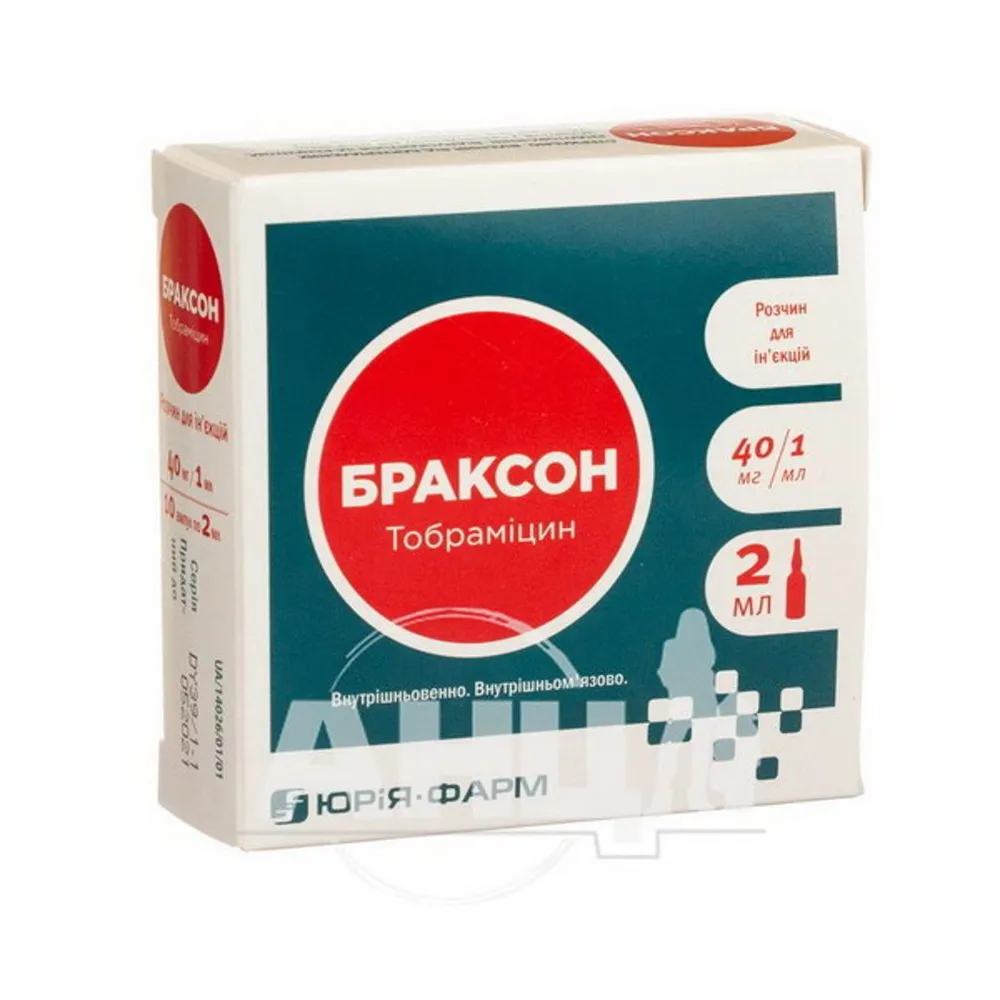
Instructions for Use
INSTRUCTIONS for medical use of the medicinal product BRAKSON (BRAKSON)
Composition:
Active substance: tobramycin;
1 ml of solution contains tobramycin (as sulfate) 40 mg;
Excipients: disodium edetate, anhydrous sodium sulfite, water for injections.
Pharmaceutical form. Injection solution.
Main physicochemical properties: clear colorless or yellowish liquid.
Pharmacotherapeutic group. Antibacterial agents. Other aminoglycosides.
ATC code J01G B01.
Pharmacological Properties
Pharmacodynamics
An aminoglycoside antibiotic with broad-spectrum activity. It acts bacteriostatically by binding to the 30S ribosomal subunit and disrupting protein synthesis. At higher concentrations, it impairs cytoplasmic membrane function, leading to cell death.
Highly active against Gram-negative microorganisms (Pseudomonas aeruginosa, Acinetobacter spp., Escherichia coli, Klebsiella spp., Serratia spp., Providencia spp., Enterobacter spp., Proteus spp., Salmonella spp., Shigella spp.), as well as some Gram-positive microorganisms: Staphylococcus spp. (including strains resistant to penicillins and cephalosporins), and certain strains of Streptococcus spp.
Aminoglycosides in combination with penicillins or certain cephalosporins are effective in treating infections caused by Pseudomonas aeruginosa or Enterococcus faecalis.
Pharmacokinetics
After intramuscular administration, the drug rapidly distributes into tissues and organs. It crosses the placental barrier. Cmax in blood serum is reached within 40–90 minutes after administration; following intramuscular injection at a dose of 1 mg/kg body weight, Cmax in plasma ranges from 3 to 7 mg/L. Therapeutic concentrations persist for up to 8 hours. The half-life (T1/2) is approximately 2 hours in patients with normal renal function. 80–84% of the administered dose is excreted unchanged by the kidneys, and 10–20% via the gastrointestinal tract. T1/2 in neonates ranges from 5 to 8 hours, in older children from 2.5 to 4 hours. Terminal T1/2 exceeds 100 hours (due to slow release from intracellular depots).
In patients with renal impairment, T1/2 varies depending on the degree of impairment, reaching up to 100 hours. In patients with cystic fibrosis, T1/2 is 1–2 hours. In burn patients and those with hyperthermia, T1/2 may be shorter than average due to increased clearance. During hemodialysis, 25–70% of the administered dose is removed.
Clinical Characteristics.
Indications.
Severe infections caused by microorganisms sensitive to the drug:
- infections of the central nervous system, including meningitis, septicemia, and neonatal sepsis;
- infections of the abdominal cavity, including peritonitis;
- complicated and recurrent urinary tract infections, such as pyelonephritis and cystitis;
- lower respiratory tract infections, including pneumonia, bronchopneumonia, acute bronchitis, and lung abscess;
- skin, bone, and soft tissue infections, including burns.
Severe staphylococcal infections, in cases where penicillin and other agents with lower toxicity risk are contraindicated for the patient, and when, in the physician’s opinion, treatment with tobramycin is appropriate and supported by bacterial sensitivity testing results.
Contraindications.
Hypersensitivity to tobramycin or to other aminoglycoside antibiotics.
Auditory nerve neuritis, severe chronic renal failure.
Interaction with other medicinal products and other forms of interaction.
Concomitant and/or sequential use of tobramycin with the following medicinal products: other aminoglycosides (e.g., amikacin, streptomycin, neomycin, kanamycin, gentamicin, and paromomycin), amphotericin B, cephaloridine, viomycin, polymyxin B, colistin, cisplatin, and vancomycin increases the risk of neurotoxicity and/or ototoxicity and nephrotoxicity, and requires careful monitoring. Other factors that may increase the risk of neuro- and nephrotoxicity include advanced age and dehydration.
Diuretics
Tobramycin should not be administered concurrently with potent diuretics. Some of these agents may independently cause ototoxicity, and when intravenous diuretics are used concomitantly with aminoglycosides, ototoxicity and nephrotoxicity of the latter are enhanced due to changes in antibiotic concentrations in plasma and tissues.
Antibacterial agents
Beta-lactam antibiotics reduce efficacy. When tobramycin is used concomitantly with other antibacterial agents such as cephalosporins, particularly cephalothin, the risk of nephrotoxicity increases.
Nonsteroidal anti-inflammatory agents
Intravenous administration of indomethacin reduces tobramycin renal clearance, increases its blood concentration, and prolongs its half-life (T1/2), which may necessitate dosage regimen adjustment.
Cisplatin and cyclosporine
There is an increased risk of nephrotoxicity and possibly ototoxicity when tobramycin is used with cisplatin, as well as an increased risk of nephrotoxicity when used with cyclosporine.
Oral anticoagulants
Tobramycin potentiates the effects of warfarin and phenindione.
Neuromuscular blockers
Tobramycin enhances the effects of non-depolarizing neuromuscular blockers. Concomitant use of these drugs may lead to respiratory muscle paralysis.
Cholinergic agents
Tobramycin reduces the efficacy of anticholinesterase agents, specifically neostigmine and pyridostigmine.
Agents for general anesthesia
Methoxyflurane increases the risk of adverse reactions.
Others
Medicinal products for inhalational general anesthesia (halogenated hydrocarbons), narcotic analgesics, massive blood transfusions with citrate-containing anticoagulants, and medicinal products that block neuromuscular transmission enhance neuromuscular blockade.
Special precautions for use.
Use with caution in patients with renal insufficiency, botulism, myasthenia gravis, Parkinsonism, dehydration, or hearing impairments.
During treatment, it is necessary to monitor kidney and liver function, vestibular apparatus, and hearing (at least once a week), as well as serum tobramycin concentrations, which should not exceed 8 mcg/mL.
If audiometric tests yield unsatisfactory results, the dose should be reduced or treatment discontinued.
The risk of ototoxicity and nephrotoxicity significantly increases when plasma concentrations remain above 12 mcg/mL for prolonged periods.
Patients with mitochondrial DNA mutations, particularly the substitution of nucleotide 1555 A by G in the 12S rRNA gene, may have an increased risk of ototoxicity, even if aminoglycoside levels in serum remain within recommended ranges. In cases of familial history of aminoglycoside-induced deafness or known mitochondrial DNA mutations in the 12S rRNA gene, alternative treatment options should be considered.
The likelihood of nephrotoxicity is higher in patients with impaired renal function, as well as when the drug is administered in high doses or over prolonged periods (in such patients, renal function should be monitored daily).
Aminoglycosides are excreted in small amounts in breast milk. Since they are poorly absorbed from the gastrointestinal tract, complications in nursing infants have not been reported.
Superinfections may develop during therapy.
In the absence of positive clinical progress, the possibility of resistant microorganisms should be considered. In such cases, treatment should be discontinued and appropriate alternative therapy initiated.
Dosage adjustment may be required when the volume of distribution increases (e.g., in burns, peritonitis, or extraperitoneal infections) to achieve effective drug concentrations. In critically ill patients and young patients with high cardiac output and glomerular filtration rate, the infusion rate should be increased.
The medicinal product contains sodium sulfite, which may rarely cause hypersensitivity reactions and bronchospasm.
This medicinal product contains less than 1 mmol (23 mg) of sodium per dose, i.e., it is practically sodium-free.
Use during pregnancy or breastfeeding.
Aminoglycosides cross the placenta and may cause fetal harm when administered during pregnancy. There have been several reports of irreversible, total, bilateral congenital deafness in children whose mothers received streptomycin during pregnancy. Serious adverse effects in mothers, fetuses, or newborns have not been reported with other aminoglycosides, but tobramycin should be administered to pregnant women only when potential benefit clearly outweighs potential risk.
If tobramycin is used during pregnancy or if a patient becomes pregnant while receiving tobramycin, she should be informed of the potential hazard to the fetus.
Tobramycin is excreted in breast milk. If treatment is necessary, breastfeeding should be discontinued.
Ability to affect the speed of reactions while driving or operating machinery.
The drug is administered in a hospital setting.
Administration and Dosage.
The drug should be administered intramuscularly (i.m.) or by intravenous infusion (i.v.). For i.m. administration, inject the appropriate dose directly from the ampoule.
For i.v. administration, dilute the solution in 100–200 mL of 0.9% sodium chloride solution or 5% glucose solution and administer over 20–60 minutes.
Single dose for adults and children from 1 year of age – 1 mg/kg; daily dose – 3 mg/kg; maximum daily dose – 5 mg/kg.
Children aged 1 week to 1 year: 6–7.5 mg/kg/day, divided into 3–4 equal doses (2–2.5 mg/kg every 8 hours or 1.5–1.89 mg/kg every 6 hours).
Premature infants or newborns under 1 week of age: up to 4 mg/kg/day, divided into 2 equal doses every 12 hours. The usual duration of treatment is 7–10 days. In severe or complicated infections, a longer course of therapy may be required (with monitoring of kidney function, hearing, and vestibular apparatus, as neurotoxicity is most likely when treatment exceeds 10 days).
In chronic renal insufficiency, as well as in elderly patients, the dose should be reduced and the dosing intervals extended. Dose calculation is as follows: the interval between doses in hours equals serum creatinine concentration multiplied by 8; doses remain the same as in patients with normal renal function; the initial single dose is equivalent to that given to patients with normal renal function and amounts to 1 mg/kg.
Children.
Can be used from the first days of life.
Tobramycin should be used with caution in premature infants and newborns due to immature renal function, which prolongs the elimination half-life (T1/2).
Overdose.
Symptoms: toxic reactions (hearing loss, ataxia, dizziness, urinary disturbances, thirst, decreased appetite, nausea, vomiting, tinnitus or sensation of ear fullness, nephrotoxicity – increased urea concentration, hypercreatininemia, proteinuria, oliguria), respiratory muscle paralysis.
Treatment: in patients with normal renal function, administer fluid infusion and forced diuresis; in patients with impaired renal function – hemodialysis or peritoneal dialysis. In case of neuromuscular blockade – anticholinesterase agents and calcium salts; in case of respiratory arrest – artificial ventilation of the lungs and other symptomatic and supportive therapy.
Adverse reactions.
Gastrointestinal system: nausea, vomiting, diarrhea, liver function disorders (increased activity of liver transaminases, lactate dehydrogenase, hyperbilirubinemia).
Hematopoietic system: anemia, leukopenia, granulocytopenia, thrombocytopenia, leukocytosis.
Nervous system: headache, neurotoxic effects (nervous tics, paresthesias, epileptic seizures); neuromuscular blockade (difficulty breathing, drowsiness, weakness).
Sensory organs: ototoxicity (partial or complete bilateral deafness, tinnitus, ringing or feeling of fullness in the ears), vestibular and labyrinthine disorders (coordination disturbances, dizziness, nausea, vomiting, loss of balance).
Urinary system: nephrotoxicity (oliguria, cylindruria, proteinuria, significant increase or decrease in frequency of urination, polyuria; signs of renal failure – increased concentrations of creatinine and blood urea nitrogen, thirst, decreased appetite, nausea, vomiting).
Allergic reactions: skin itching, skin hyperemia, rash, fever, angioneurotic edema, eosinophilia.
Laboratory findings: hypocalcemia, hyponatremia, hypomagnesemia.
Shelf life. 2 years.
Storage conditions.
Store at a temperature not exceeding 30 °C. Keep out of reach of children.
Incompatibility.
Incompatibility or loss of activity has been observed when tobramycin sulfate is used concomitantly with certain cephalosporins and penicillin, as well as sodium heparin.
Tobramycin for injection should not be mixed with other drugs prior to administration.
Packaging.
1 ml or 2 ml in an ampoule; 5 ampoules in a contour cell pack; 2 contour cell packs in a cardboard box.
Prescription status. Prescription only.
Manufacturer.
LLC "Yuria-Pharm".
Manufacturer's address and location of business activity.
108, Kozbirska St., Cherkasy, Cherkasy region, 18030, Ukraine. Tel.: (044) 281-01-01.
Frequently Asked Questions
What is Brakson prescribed for?
The drug is used to treat severe infections caused by microorganisms sensitive to it. These may include infections of the central nervous system (e.g., meningitis), sepsis, abdominal cavity infections (peritonitis), urinary tract infections (pyelonephritis, cystitis), respiratory tract infections (pneumonia, bronchitis), as well as diseases of the skin, bones, soft tissues, and burns.
How should Brakson be taken correctly?
The drug is administered intramuscularly or via intravenous infusion. For intravenous administration, the solution is diluted in 100–200 ml of saline or 5% glucose and administered over 20–60 minutes. The dosage is selected by a physician depending on the age, weight, and condition of the patient.
What side effects can Brakson cause?
Possible side effects include nausea, vomiting, diarrhea, and impaired liver or kidney function. Regarding the nervous system, headache, dizziness, coordination impairment, tinnitus, or even hearing loss may occur. Allergic reactions (rash, itching) and changes in blood parameters are also possible.
Who should not use this drug?
Contraindications include hypersensitivity to tobramycin or other aminoglycoside antibiotics, as well as the presence of auditory nerve neuritis or severe chronic renal failure.
Can this drug be combined with other medicines?
Special caution is required. Combining it with other aminoglycosides, diuretics, certain antibiotics (e.g., cephalosporins), non-steroidal anti-inflammatory drugs, and cisplatin increases the risk of kidney and hearing damage. The drug may also enhance the effects of anticoagulants (warfarin) and muscle relaxants.
Can the drug be taken during pregnancy or breastfeeding?
In pregnant women, the drug is prescribed only when the potential benefit significantly outweighs the risk to the fetus, as it may cause harm to the child. During treatment, it is recommended to discontinue breastfeeding, as the substance passes into breast milk.
This page has been machine-translated and may contain inaccuracies. The original data is available in the manufacturing country's language.
Last data check: July 21, 2026 · Data source: Державний реєстр лікарських засобів України