Biotin-kv
Ukraine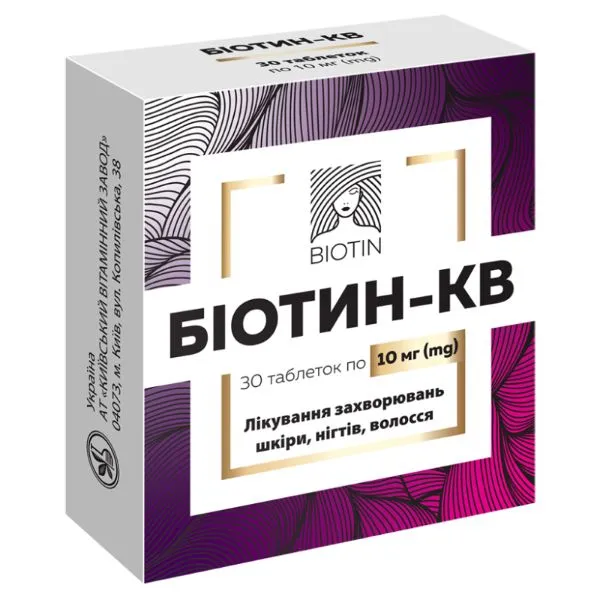
Table of Contents
INSTRUCTIONS FOR MEDICAL USE OF THE MEDICINAL PRODUCT BIOTIN-KV (BIOTIN-KV)
Composition:
Active substance: biotin;
1 tablet contains 5 mg or 10 mg of biotin;
Excipients: lactose monohydrate; microcrystalline cellulose; povidone; crospovidone; magnesium stearate.
Pharmaceutical form. Tablets.
Main physico-chemical properties:
5 mg tablets: round, biconvex tablets, white or almost white in color;
10 mg tablets: round, biconvex tablets with a score line, white or almost white in color.
Pharmacotherapeutic group. Vitamins. Other vitamin preparations. Biotin.
ATC code A11H A05.
Pharmacological properties.
Pharmacodynamics.
Biotin is an essential substance for cell development and growth. As a coenzyme, it plays an important role in gluconeogenesis, lipogenesis, propionate biotransformation, fatty acid synthesis, and leucine catabolism. Biotin deficiency may occur with unbalanced nutrition, prolonged diets, and consumption of raw egg white; additionally, increased biotin requirements are associated with multiple carboxylase deficiencies due to genetic defects. Deficiency manifests with skin and its appendages disorders, and may lead to specific neuropsychiatric symptoms and gastrointestinal disturbances during parenteral nutrition, malabsorption syndrome, after resection of the small intestine, and in patients undergoing hemodialysis.
Biotin (vitamin H, vitamin B7) is a water-soluble vitamin of the B group. In the body, biotin plays an essential role in carbohydrate, fat, and protein metabolism and is vital for normal cell growth and development. Once absorbed, biotin acts as a coenzyme for carboxylases, exerts insulin-like effects, and participates in gluconeogenesis (due to its role in glucokinase synthesis), thereby contributing to blood glucose stabilization and improved nervous system function. Biotin acts as a synergist with other B-complex vitamins, folic acid, pantothenic acid, and cyanocobalamin. There is evidence of biotin’s involvement in purine nucleotide synthesis. Biotin also serves as a source of sulfur involved in protein synthesis—specifically collagen—and thus positively influences the structure of skin and its appendages (hair, nails).
Pharmacokinetics.
Absorption of free biotin begins in the upper part of the small intestine. Here, the biotin molecule passes through the intestinal wall unchanged. Absorption occurs primarily by diffusion.
The degree of biotin binding to plasma proteins is approximately 80%.
The concentration of free or only weakly bound biotin in blood typically ranges from 200 to 1200 mcg/L. Biotin is excreted in urine (6 to 50 mcg per day) and feces. Excretion occurs in unchanged form (about 50%) and as biologically inactive metabolites. The elimination half-life depends on the administered dose and is nearly 26 hours after an oral dose of 100 mcg per kilogram of body weight. In patients with biotinidase deficiency, the half-life after administration of the same dose is reduced to 10–14 hours.
Biotin enters the human body through food and is also synthesized by intestinal microflora. Dietary biotin is mostly protein-bound and occurs as biocytin (in animal-derived foods), which after hydrolysis in the small intestine is rapidly reabsorbed. In plants, biotin is partially present in free form.
Clinical characteristics.
Indications.
For the treatment of conditions caused by biotin deficiency: skin, nail, and hair disorders.
For the treatment of genetically determined enzymopathies associated with biotin (multiple carboxylase deficiency).
Contraindications.
Hypersensitivity to biotin or to any other components of the medicinal product.
Interaction with other medicinal products and other forms of interaction.
When biotin is used concomitantly with anticonvulsant drugs, a decreased plasma concentration of biotin may occur due to increased urinary excretion.
Valproic acid reduces biotinidase activity, impairing mitochondrial functions in the liver.
Pantothenic acid, when administered in high doses, competes with biotin; therefore, simultaneous use should be avoided.
Special precautions for use
Raw egg white contains the protein avidin, which interacts with biotin; therefore, simultaneous intake should be avoided.
Consuming large amounts of raw eggs over 2–3 weeks may cause biotin deficiency.
Effect on clinical laboratory tests
Depending on the assay, test results may be falsely high or falsely low due to administration of medicinal products containing biotin. The likelihood of interference is higher in children and patients with impaired renal function, and increases with higher biotin doses.
When interpreting laboratory test results, potential biotin interference must be considered, especially if results are inconsistent with the clinical picture (e.g., thyroid function tests mimicking Graves' disease in asymptomatic patients taking biotin, or falsely negative troponin test results in patients with myocardial infarction who are taking biotin). When biotin interference is suspected, alternative tests not susceptible to biotin interference should be used.
When ordering laboratory tests for patients taking biotin, consultation with laboratory personnel is recommended.
The medicinal product contains lactose; therefore, if you have been diagnosed with intolerance to certain sugars, consult your physician before taking this product.
Use during pregnancy or breastfeeding
There is no experience with the use of this medicinal product during pregnancy or breastfeeding.
Ability to influence reaction rate while driving or operating machinery
No effect.
Dosage and Administration.
Take tablets with food, without chewing, and with sufficient amount of liquid.
For treatment of biotin deficiency (nail, hair, and skin disorders): the recommended dose for adults is 1 tablet of 5 mg per day.
For treatment of genetically determined biotin-associated enzymopathies (multiple carboxylase deficiencies): 1–2 tablets are prescribed (daily dose – up to 20 mg of biotin).
Duration of treatment depends on the nature and course of the disease.
Children.
Data on use in children are lacking.
Overdose.
There are currently no reports of biotin overdose.
Adverse reactions.
Allergic reactions are possible from the immune system, including urticaria, chest pain, shortness of breath, and skin rashes.
If any adverse reactions occur, it is recommended to discontinue treatment and consult a physician.
Shelf life. 2 years.
Storage conditions.
Store in the original packaging at a temperature not exceeding 25 °C.
Keep out of reach of children.
Packaging.
10 tablets in a blister; 3 blisters per pack.
Availability category. Over-the-counter.
Manufacturer. JSC "KYIV VITAMIN PLANT".
Manufacturer's address and location of business activity.
38 Kopilivska St., Kyiv, 04073, Ukraine.
Website: www.vitamin.com.ua