Benzylbenzoate grindex
Ukraine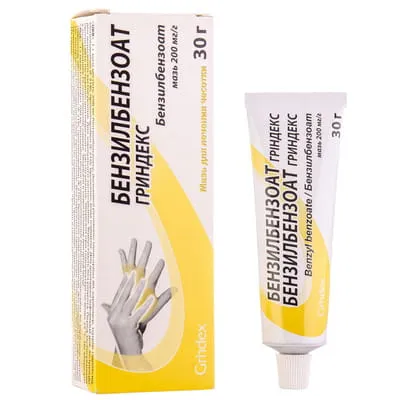
Table of Contents
INSTRUCTIONS FOR MEDICAL USE OF THE MEDICINAL PRODUCT BENZYL BENZOATE GRINDEKS (BENZYLBENZOATE GRINDEKS)
Composition:
Active substance: benzyl benzoate;
1 g of the ointment contains 200 mg of benzyl benzoate;
Excipients: polysorbate 80, carbomer, sodium hydroxide, methylparaben (E 218), propylparaben (E 216), bronopol, purified water.
Medicinal form: Ointment.
Main physicochemical properties: white or almost white ointment with a specific odor.
Pharmacotherapeutic group: Agents used for ectoparasitoses, including scabies mites. ATC code: P03AX01.
Pharmacological properties.
Pharmacodynamics.
Benzyl benzoate is the benzyl ester of benzoic acid. It acts selectively, penetrates through the chitinous cover of scabies mites Acarus scabiei, and accumulates within their bodies at toxic concentrations, causing death of adult mites. It has no effect on scabies mite eggs. It also has a weak anesthetic effect.
Pharmacokinetics.
When applied topically, benzyl benzoate penetrates into the upper layers of the epidermis and is not systemically absorbed.
Clinical characteristics.
Indications.
Scabies.
Contraindications.
Hypersensitivity to the components of the ointment.
Interaction with other medicinal products and other forms of interactions.
Interaction studies have not been conducted.
Special precautions for use.
The ointment is intended for external use only. To avoid irritation, the ointment must not come into contact with the eyes, mucous membranes, or damaged skin.
To determine hypersensitivity to the drug, it is recommended to initially apply a small amount of the ointment to the skin.
The ointment contains methylparaben (E 218), propylparaben (E 216), and bronopol as excipients. Methylparaben (E 218) and propylparaben (E 216) may cause allergic reactions (possibly of the delayed type); bronopol may cause local skin reactions (e.g., contact dermatitis).
Use during pregnancy or breastfeeding.
Do not use during pregnancy. Breastfeeding should be discontinued for the duration of treatment.
Ability to affect reaction speed when driving or operating machinery. No effect.
Method of Administration and Dosage
For external use only.
Immediately before use in children aged 3 to 5 years, the ointment should be diluted with warm boiled water (30–35 °C) in a 1:1 ratio and mixed thoroughly to form a homogeneous emulsion. Treatment is generally performed without prior warm bathing, twice with a 12-hour interval. In children aged 5 years and older, and in adults, the undiluted ointment is used.
Treatment of scabies: Apply 10–15 g of ointment in a single application to previously cleansed skin. The ointment should cover all skin areas except the face and hairy regions of the scalp.
Initially, apply the ointment to the palms and hands, then proceed to all other body parts in a top-to-bottom sequence. The feet, soles, and interdigital spaces are treated last. In areas with delicate skin (inguinal region, genitals, mammary glands), as well as in cases of eczema, dermatitis, or pyoderma, the ointment should be applied carefully without rubbing.
After application, hands should not be washed for 3 hours. In some cases, after the applied ointment has dried (usually within 1 hour), a second layer of the preparation may be recommended. After completing treatment, patients should put on clean underclothing and change bed linens. After 24–48 hours, take a shower and again change underclothing and bed linens.
The ointment should be applied to the skin 4 times over a 2-week period, with intervals of 3–4 days between applications. The average amount of ointment used per treatment course is 60–90 g.
Children: The ointment is not recommended for children under 3 years of age.
Overdose
Symptoms: Accidental ingestion of the ointment or application of a very large amount may lead to central nervous system stimulation (seizures) and urinary retention.
Treatment: Symptomatic therapy. The skin should be washed thoroughly. In case of ingestion, gastric lavage and activated charcoal should be administered. Anticonvulsant agents should be used if necessary.
Side effects.
Classification of side effect frequency: very common (≥ 1/10); common (≥ 1/100 to < 1/10); uncommon (≥ 1/1000 to < 1/100); rare (≥ 1/10000 to < 1/1000); very rare (< 1/10000), including single cases; not known (cannot be estimated from available data).
Skin and subcutaneous tissue disorders
Not known: contact dermatitis; allergic skin reactions: skin irritation, sensation of painful burning. Skin sensitivity is particularly increased if the skin surface is damaged, or if the ointment comes into contact with genital mucosa.
When rubbing the ointment into the skin, a sensation of tingling may occur, which disappears within a few minutes. If the tingling sensation persists, the skin should be washed.
Shelf life. 2.5 years.
Do not use after the expiry date stated on the packaging.
Storage conditions.
Store at a temperature not exceeding 25 °C. Do not store in refrigerator or freezer.
Keep out of reach of children.
Packaging.
30 g in an aluminum tube; 1 tube per cardboard box.
Supply classification.
Over-the-counter (without prescription).
Manufacturer.
JSC Tallinn Pharmaceutical Plant.
Manufacturer's location and address of place of business.
Tondi TN 33, Kristiine district, Tallinn, Harju County, 11316, Estonia.
Marketing Authorisation Holder.
JSC "Grindex".
Address of the Marketing Authorisation Holder.
Krustpils str. 53, Riga, LV-1057, Latvia.