Benzyl benzoate
Ukraine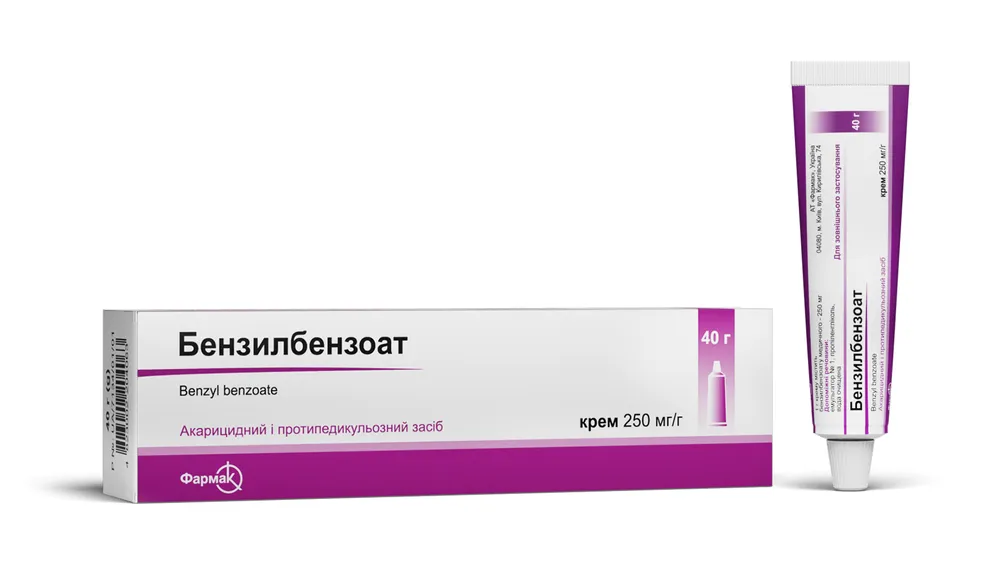
Table of Contents
INSTRUCTIONS FOR MEDICAL USE OF THE MEDICINAL PRODUCT BENZYL BENZOATE (BENZYL BENZOATE)
Composition:
Active substance: benzyl benzoate;
1 g of cream contains medical benzyl benzoate – 250 mg;
Excipients: cetostearyl alcohol (type A) emulsifying, propylene glycol, purified water.
Pharmaceutical form. Cream.
Main physicochemical properties: white cream with a weak specific odor.
Pharmacotherapeutic group. Agents acting on ectoparasites, including scabies mites. ATC code P03AX01.
Pharmacological properties.
Pharmacodynamics.
Benzyl benzoate cream exerts acaricidal activity against various species of mites, including scabies mites (Sarcoptes scabiei) and mites of the genus Demodex, and demonstrates anti-pediculosis activity. It has a toxic effect on all species of lice (lice die within 2–5 hours, mites within 7–32 minutes). It penetrates through the chitinous integument and accumulates in the mite's body at toxic concentrations. Causes death of larvae and adult forms of scabies mites; has no effect on eggs.
Pharmacokinetics.
When applied topically, benzyl benzoate practically does not enter the systemic circulation.
Clinical characteristics.
Indications.
Treatment of scabies and pediculosis.
Contraindications.
Hypersensitivity to benzyl benzoate or to any other component of the drug. Skin injuries, including purulent skin diseases.
Interaction with other medicinal products and other forms of interaction.
No pharmacological interactions of Benzyl benzoate cream with other drugs have been identified. However, as with all antiparasitic agents, concomitant use with other topical medicinal products is not recommended. Local or systemic use of corticosteroids may lead to the disappearance or reduction of certain symptoms (such as itching, erythema) while the infestation persists; therefore, during treatment with Benzyl benzoate cream, the use of such agents should be avoided.
Special precautions for use.
Before starting treatment, it is advisable for the patient to take a hot shower to mechanically remove mites from the skin surface and to soften the superficial layer of the epidermis (to facilitate drug penetration). Hands must be re-treated after each washing. It is essential to treat underwear, bed linen, outer clothing, and headwear.
Avoid contact of the cream with eyes and mucous membranes. In case of accidental exposure:
- Eyes: rinse thoroughly with water or 1 % sodium bicarbonate solution; treat symptomatically;
- Mouth: rinse mouth with water or warm 2 % sodium bicarbonate solution;
- Stomach: in case of accidental ingestion, seek immediate medical advice.
After completion of the treatment course, medical follow-up is required for 2 weeks (and longer if complications occur).
Patients affected within the same focus, as well as contact persons, should be treated simultaneously.
Complications in the form of eczema should be treated concurrently with scabies and continued after elimination of scabies.
Use during pregnancy or breastfeeding.
There are no data available on the use of Benzyl benzoate cream during pregnancy; therefore, the use of this drug is not recommended in this patient population.
The drug should not be applied immediately before breastfeeding.
Ability to influence reaction rate while driving or operating machinery.
The drug does not affect the ability to drive vehicles or operate complex machinery.
Method of Administration and Dosage
Apply Benzylbenzoate cream topically.
Apply 10–15 g of cream per application. When treating scabies, patients should take a hot shower with soap prior to applying the medication to remove scales and crusts, thoroughly rinse off the soap, and dry the skin with a towel. First, apply the cream to the palms and hands, then proceed to all other parts of the body sequentially from top to bottom (the cream should not be applied to the face or mucous membranes). Finally, apply the cream to the feet, soles, and interdigital spaces. Exercise caution when applying the cream to areas with delicate skin (inguinal area, genitalia, mammary glands), as well as in cases of eczema or dermatitis; do not rub in.
Hands should not be washed for 3 hours after application. In some cases, after the applied cream has dried (usually within 1 hour), a second layer of the medication may be applied. After completing the treatment, patients should put on clean undergarments and clothing, and change bed linens. After 24–48 hours, patients should take a shower and again change undergarments and bed linens.
Apply the cream to the skin 4 times over a 2-week period, with intervals of 3–4 days between applications. The average total amount of cream required for a full course of treatment is 60–90 g.
For the treatment of scabies in children aged 3 to 5 years, Benzylbenzoate cream must be diluted immediately before use with warm boiled water (30–35 °C) in a 1:1 ratio and mixed thoroughly to form a uniform emulsion. Treatment is usually performed without prior warm bathing, twice with a 12-hour interval.
For the treatment of Norwegian scabies, skin surfaces must first be debrided of crusts using keratolytic agents prior to applying Benzylbenzoate cream. The duration of treatment is determined based on the dynamics of skin clearance, resolution of inflammation, and cessation of itching.
For the treatment of pediculosis, apply the medication to the hair and scalp, gently rubbing it into the skin; cover the head with a scarf. After 30 minutes, wash off the medication with running water and rinse the hair with warm 5% vinegar solution. After completing this procedure, wash the hair with soap or shampoo and comb thoroughly with a fine-toothed comb to remove nits. In cases of pubic pediculosis, rub the cream into the skin of the pubic area, abdomen, inguinal folds, and inner surfaces of the thighs. Assess treatment efficacy after 24 hours and repeat the procedure if necessary.
Children
Do not use the medication in children under 3 years of age.
Overdose
Overdose may lead to an intensification of adverse effects, such as contact dermatitis.
In case of accidental ingestion or application of a very large amount of cream, possible symptoms include: increased adverse effects of the medication, contact dermatitis, sudden loss of consciousness, central nervous system stimulation (seizures), and urinary retention.
Treatment is symptomatic.
The skin must be cleaned from the cream. In case of accidental ingestion, gastric lavage is required, and treatment is symptomatic. If necessary, administer anticonvulsant agents.
If any adverse reaction occurs at the site of application, the medication must be washed off with water and soap.
Side effects.
When applying the product, a sensation of stinging or burning may occur, which usually disappears with continued use of the cream. In individuals with sensitive skin, local skin reactions are possible, including burning or itching sensations, redness or dryness of the treated skin area, as well as allergic reactions, such as skin rash and swelling. If the aforementioned adverse effects do not resolve spontaneously, use of the product should be discontinued. Skin sensitivity is particularly increased on damaged areas and on genital skin. Contact dermatitis may occasionally occur.
The product contains propylene glycol, which may cause skin irritation.
Shelf life.
3 years.
Do not use the product after the expiry date stated on the packaging.
Storage conditions.
Keep out of reach of children at a temperature not exceeding 25 °C.
Packaging. 40 g or 80 g in a tube. 1 tube per carton.
Availability. Over-the-counter (without prescription).
Manufacturer: JSC "Farmak".
Manufacturer's address and place of business.
74, Kyrylivska Street, Kyiv, 04080, Ukraine.