Belosalik
Ukraine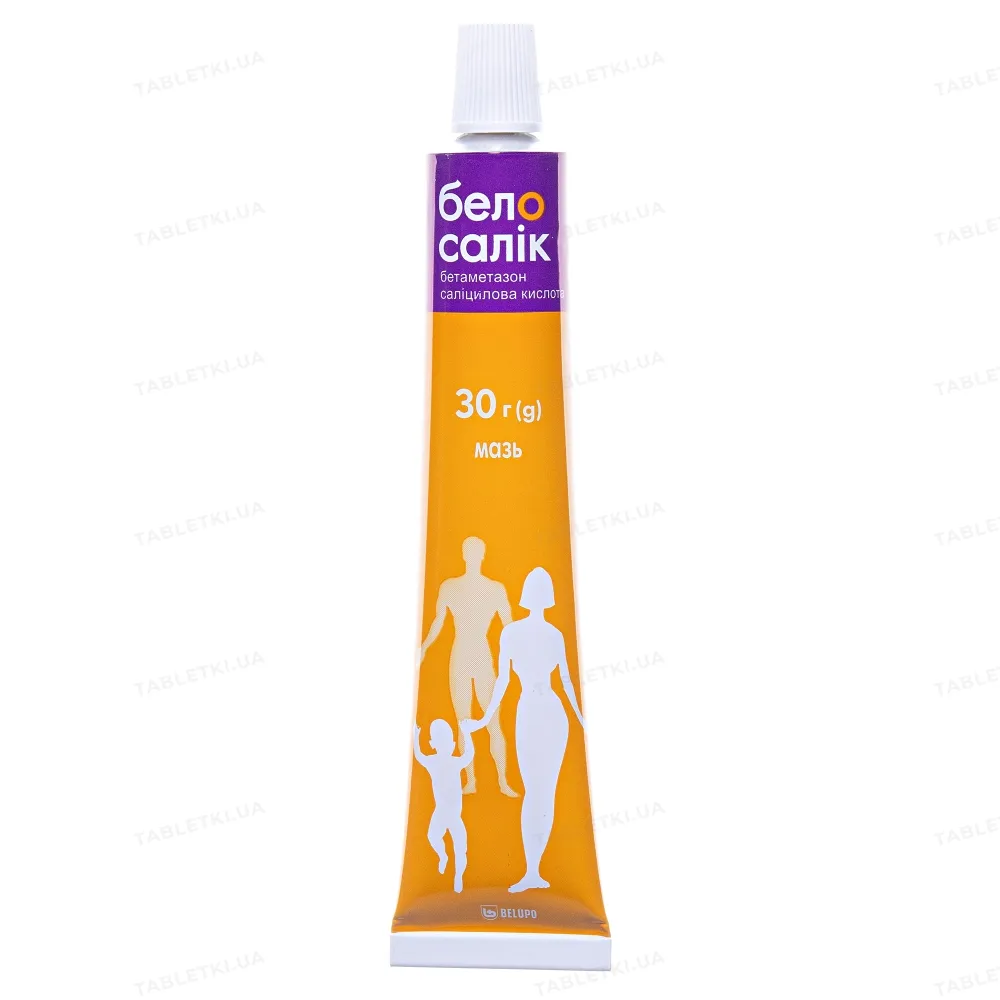
Table of Contents
INSTRUCTION FOR MEDICAL USE OF THE MEDICINAL PRODUCT BELOSALIC (BELOSALIC®)
Composition:
Active substances: betamethasone, salicylic acid;
1 g of ointment contains 0.5 mg of betamethasone in the form of dipropionate, 30 mg of salicylic acid;
Excipients: mineral oil, white soft paraffin.
Pharmaceutical form. Ointment.
Main physicochemical properties: white, semi-transparent, homogeneous ointment.
Pharmacotherapeutic group.
Corticosteroids for dermatological use. Corticosteroids in combination with other agents. ATC code: D07XC01.
Pharmacological Properties.
Pharmacodynamics.
Betamethasone dipropionate is a synthetic fluorinated corticosteroid exerting anti-inflammatory, antipruritic, and vasoconstrictive effects. When applied locally, salicylic acid exerts a keratolytic effect.
Pharmacokinetics.
Systemic absorption of betamethasone dipropionate is possible primarily after prolonged treatment over a large skin surface area.
Clinical characteristics.
Indications.
For local treatment of dermatoses sensitive to corticosteroids, such as chronic, erythematous, or hyperkeratotic psoriasis, and other erythematous-squamous dermatoses, including seborrheic dermatitis (eczema), dry eczema in the desquamative phase, lichenification.
Contraindications.
Hypersensitivity to betamethasone, salicylic acid, or to any of the excipients of the drug. Also contraindicated: rosacea, acne, generalized plaque psoriasis, perianal and genital pruritus, diaper dermatitis, perioral dermatitis, rosacea, cutaneous manifestations of syphilis, cutaneous tuberculosis, other bacterial and fungal skin infections without appropriate antibacterial and antifungal therapy, molluscum contagiosum, dermatomycoses, skin reactions following vaccination, varicose veins, viral infections (e.g., herpes simplex, herpes zoster, varicella). Should not be used under occlusive dressings.
Interaction with other medicinal products and other forms of interaction.
There are no known cases of interaction with other medicinal products.
Topical application of salicylic acid should not be combined with oral administration of drugs containing acetylsalicylic acid and other nonsteroidal anti-inflammatory agents. Do not use concurrently with benzoyl peroxide and topical retinoids.
Salicylic acid may increase skin permeability for other topically applied medicinal products, thereby enhancing their systemic absorption. In addition, salicylic acid may potentiate the adverse effects of methotrexate and the hypoglycemic effect of oral antidiabetic drugs of the sulfonylurea derivatives.
If using any other medicinal products, it is essential to inform the physician.
Special precautions for use.
The drug is not intended for ophthalmological use. Contact of the drug with the eyes, mucous membranes, wounds, and ulcers should be avoided.
When applied to the facial skin, treatment duration should be limited to 5 days.
If skin irritation or hypersensitivity occurs during use, treatment should be discontinued. In the presence of infection, appropriate therapy should be prescribed.
After resolution of scaling or hyperkeratosis, treatment should continue with corticosteroids only.
Any adverse effects associated with systemic corticosteroids, including suppression of adrenal cortex function, may also occur with topical application of glucocorticosteroids, especially in children.
Systemic absorption of glucocorticosteroids or salicylic acid following topical application may be increased when treatment is applied over large body surface areas or under occlusive dressings. Appropriate precautions should be observed in such cases, particularly when treating children.
Prolonged therapy with this drug should be avoided in all patients, regardless of age.
If excessive dryness or increased skin irritation develops, the drug should be discontinued.
Hypothalamic-pituitary-adrenal (HPA) axis function usually recovers after discontinuation of the drug. In some cases, withdrawal symptoms may develop, requiring supplementation with systemic corticosteroids.
After resolution of scaling or hyperkeratosis, treatment should continue with corticosteroids only.
The use of the drug under occlusive dressings is not recommended.
In the presence of infection, appropriate antifungal or antibacterial agents should be administered. If the desired effect is not rapidly achieved, corticosteroid use should be discontinued until signs of infection resolve.
Appropriate precautions should be taken to prevent increased absorption area when applying the drug to damaged skin, atrophic skin, large body surface areas, under occlusive dressings, or in children (due to higher body surface area-to-body weight ratio). When applied to large body surface areas, absorption of salicylic acid should also be considered.
Visual disturbances.
Visual disturbances may occur with both systemic and topical corticosteroids (including intranasal, inhaled, and intraocular administration). If symptoms such as blurred vision or other visual disturbances occur, the patient should undergo ophthalmological examination to evaluate possible causes, including cataract, glaucoma, or rare conditions such as central serous chorioretinopathy, which has been reported after both systemic and topical corticosteroid use.
Topical corticosteroids may induce psoriasis for various reasons, including rebound of symptoms followed by development of tolerance, risk of pustular psoriasis, and local systemic toxicity due to impaired skin barrier function. Patients with hepatic dysfunction are most susceptible to systemic effects. Close monitoring of such patients is required.
Topical corticosteroids may alter the clinical presentation.
Relapse may occur upon discontinuation of treatment. Infection may worsen, and wound healing may be delayed.
The drug should not be applied to mucous membranes or areas around the eyes due to the keratolytic action of salicylic acid.
Application of the drug to areas with atrophic skin is contraindicated.
Use during pregnancy or breastfeeding.
Pregnancy.
As the safety of topical corticosteroids in pregnant women has not been established, the drug should not be used during the first trimester of pregnancy. Use of corticosteroids in later stages of pregnancy is possible only if the expected benefit to the mother clearly outweighs the potential risk to the fetus. Drugs of this class are contraindicated during pregnancy at high doses or for prolonged periods.
Breastfeeding period.
It is currently unknown whether corticosteroids, following topical application and subsequent systemic absorption, are excreted in breast milk. Therefore, when deciding whether to discontinue breastfeeding or discontinue use of the drug, the necessity of drug administration should be taken into account.
Ability to affect reaction speed when driving or operating machinery.
Generally, the drug does not affect reaction speed when driving or operating machinery.
Method of Administration and Dosage.
Belosalik, ointment, is for topical use only, applied twice daily by spreading a thin layer over the affected area and gently rubbing in. The duration of treatment is usually limited to three weeks. The frequency and duration of use differing from that recommended may be determined by the physician, depending on the severity of the disease. In mild cases, once-daily application may be sufficient. The maximum daily dose should be gradually reduced to the lowest possible dose that still allows control of symptoms.
Children.
There are no clinical data on the use of the drug in children; therefore, its use in this age group is not recommended.
Since in children the surface area to body weight ratio is greater than in adults, more intensive absorption of the drug may occur. Therefore, children are more susceptible to suppression of the hypothalamic-pituitary-adrenal (HPA) axis due to corticosteroid effects and development of exogenous corticosteroid effects.
In children receiving topical corticosteroids, adrenal suppression, Cushing's syndrome, growth retardation, inadequate weight gain, and increased intracranial pressure have been observed.
Signs of adrenal cortex suppression include low plasma cortisol levels and lack of response to adrenal stimulation test with adrenocorticotropic hormone (ACTH) preparations. Increased intracranial pressure may manifest as bulging of the fontanelle, headache, and bilateral optic disc swelling.
Since corticosteroids may affect growth hormone production in children, body weight and growth should be monitored.
Overdose.
Prolonged or excessive use of topical glucocorticosteroids may lead to suppression of pituitary-adrenal function, resulting in secondary adrenal insufficiency and symptoms of hypercorticism, including Cushing's disease. Excessive or prolonged use of topical products containing salicylic acid may cause symptoms of salicylism.
When large doses of the drug are used, keratolytic effects and allergic reactions may be intensified.
Treatment. Appropriate symptomatic therapy should be administered. Symptoms of acute hypercorticism are usually reversible. If necessary, correction of electrolyte balance should be performed. In cases of chronic toxic effects, gradual withdrawal of corticosteroids is recommended.
Treatment of salicylism is symptomatic. Measures to accelerate elimination of salicylates from the body should be applied. In case of excessive growth of resistant microorganisms, treatment with the drug should be discontinued and appropriate therapy initiated. Orally administer sodium bicarbonate to alkalinize urine and enhance diuresis.
Side effects
The frequency is defined according to the following conventional classification: very common (≥1/10), common (≥1/100, <1/10), uncommon (≥1/1,000, <1/100), rare (≥1/10,000, <1/1,000), very rare (<1/10,000), frequency not known (cannot be estimated from the available data).
Within each group, adverse reactions are listed in order of decreasing severity.
Infections and infestations
Common: secondary infection
Skin and subcutaneous tissue disorders
Common: burning sensation, pruritus, irritation, dryness of the skin, folliculitis, hypertrichosis, acneiform eruptions, telangiectasia, hypopigmentation, perioral dermatitis, allergic contact dermatitis, maceration of the skin, skin atrophy, striae, and miliaria.
Endocrine system disorders
Rare: adrenal insufficiency (adrenal cortex suppression)
Eye disorders
Uncommon: visual disturbances, blurred vision
When applying topical corticosteroids, the following adverse reactions may occur: skin tingling, skin induration, skin cracking, sensation of warmth, fine desquamation, focal desquamation, erythema.
When the product is applied over a large surface area or under occlusive dressing, especially for prolonged periods, systemic effects should be considered.
The following adverse reactions may occur more frequently when occlusive dressings are used: maceration of the skin, secondary infections, skin atrophy, striae, and miliaria.
Hypersensitivity reactions may occur in individuals with known hypersensitivity to any component of the product.
Cases of blurred vision have been reported with corticosteroid use (see also section "Special precautions").
Striae and vascular dilation, mainly on the face, may result from prolonged continuous application of the product.
Any adverse effects associated with systemic use of glucocorticoids, including adrenal cortex suppression, may also occur with topical use.
When salicylic acid is applied topically, the following skin changes may occur: dryness, desquamation, irritation, contact dermatitis, allergic reactions (urticaria, pruritus), which may necessitate discontinuation of the product.
With prolonged use, systemic absorption of the product may occur, leading to salicylate-related adverse effects: tinnitus, dizziness, epigastric pain, nausea, vomiting, acidosis, and hyperventilation.
Reporting of suspected adverse reactions
Reporting suspected adverse reactions after product authorization is important. It allows continued monitoring of the benefit-risk balance of the medicinal product. Healthcare professionals should report any suspected adverse reactions via the national reporting system.
Shelf life. 4 years.
Storage conditions.
Store at temperatures not exceeding 25 °C. Do not freeze.
Keep out of reach and sight of children.
Packaging.
30 g in a tube; 1 tube per cardboard box.
Prescription status. Prescription only.
Manufacturer.
Belupo, lijekovi i kozmetika, d.d.
Manufacturer's address and location of operations.
Danice 5 Street, 48000 Koprivnica, Croatia