Bactialis
Ukraine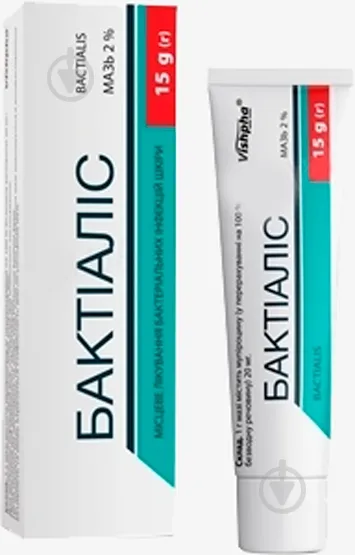
Table of Contents
INSTRUCTIONS FOR MEDICAL USE OF THE MEDICINAL PRODUCT BACTIALIS (BACTIALIS)
Composition:
Active substance: mupirocin;
1 g of ointment contains mupirocin (calculated as 100 % anhydrous substance) 20 mg;
Excipients: macrogol 4000, macrogol 400.
Pharmaceutical form. Ointment.
Main physicochemical properties: white or almost white ointment.
Pharmacotherapeutic group. Dermatological agents. Antibiotics and chemotherapeutic agents for dermatological use. Antibiotics for topical use. Other antibiotics for topical use. ATC code D06AX09.
Pharmacological properties.
Pharmacodynamics.
Bactialis is an antibacterial agent for topical use, active against organisms causing most skin infections, including Staphylococcus aureus, even methicillin-resistant strains, as well as other staphylococci and streptococci. It is also active against Gram-negative organisms such as Escherichia coli and Haemophilus influenzae.
Bactialis is a potent inhibitor of bacterial protein and RNA synthesis by suppressing isoleucyl-transfer-RNA-synthetase.
Pharmacokinetics.
After topical application of Bactialis ointment, mupirocin is minimally systemically absorbed, and the small amount that is absorbed is rapidly metabolized to the microbiologically inactive metabolite monic acid. Penetration of mupirocin into deeper epidermal and dermal layers of the skin increases in damaged skin areas and under occlusive dressings.
Clinical characteristics.
Indications.
Topical treatment of bacterial skin infections, such as impetigo, folliculitis, and furunculosis.
Contraindications.
Hypersensitivity to mupirocin or to any other component of the medicinal product.
This dosage form is not intended for ophthalmic or intranasal use.
Interaction with other medicinal products and other forms of interaction.
No reports available.
Special precautions for use.
If isolated hypersensitivity reactions or severe local irritation occur during the application of the ointment, treatment should be discontinued, the affected skin area should be washed with water to remove residual ointment, and an alternative treatment for the lesion should be prescribed.
As with other antibacterial agents, prolonged use of the ointment may lead to overgrowth of resistant microorganisms, including fungal flora.
There have been reports of pseudomembranous colitis associated with antibiotic use, which may range from mild to life-threatening. Therefore, this diagnosis should be considered in patients who develop diarrhea during or after antibiotic therapy, although it is less likely with topical application of mupirocin. If prolonged or severe diarrhea or abdominal cramps occur, treatment should be discontinued immediately and the patient should undergo further evaluation.
Renal impairment.
Macrogol may be absorbed through wound surfaces or otherwise damaged skin and excreted by the kidneys. As with other macrogol-based ointments, Bactialys should not be used under conditions of increased macrogol absorption, especially in moderate to severe renal impairment.
Elderly patients.
There are no restrictions on use unless conditions arise during treatment that promote absorption of macrogol contained in Bactialys ointment, or signs of moderate or severe renal impairment appear.
Bactialys ointment must not be used:
- for treatment of eye disorders;
- intranasally;
- in combination with catheters;
- at the site of central venous catheterization.
Contact of the ointment with the eyes should be avoided. If contact occurs, the eyes should be thoroughly rinsed with water until all traces of the ointment are removed.
Use during pregnancy or breastfeeding.
Fertility: There are no data on the effects of the ointment on human fertility. Animal studies showed no evidence of effects on fertility.
Pregnancy: Reproductive studies of mupirocin in animals have shown no evidence of harmful effects on the fetus. Adequate clinical data on the use of the ointment during pregnancy are lacking. The ointment should be used during pregnancy only if the potential benefit to the mother outweighs the possible risk to the fetus.
Breastfeeding: Data on the use of the ointment during breastfeeding are insufficient. Treatment of nipple fissures with the ointment may be considered if necessary, but the nipples should be thoroughly washed before breastfeeding.
Ability to affect reaction speed when driving or operating machinery.
No adverse effects on the ability to drive or operate machinery have been observed.
Method of Administration and Dosage.
Adults, children, and elderly patients.
Apply a small amount of the ointment in a thin layer to affected skin areas 2–3 times daily for up to 10 days, depending on the course of the disease.
A dressing may be applied over the ointment-treated skin area.
Hepatic impairment.
Dose adjustment is not required.
Renal impairment.
See section "Special Instructions".
The medicinal product is intended for topical use only.
Hands should be thoroughly washed after applying the ointment to the skin.
Do not mix the ointment with other medicinal products, as dilution may reduce its antibacterial activity and compromise the stability of the active ingredient.
Children.
Can be used for treatment of children aged 2 months and older.
Overdose.
The toxicity of Bactialis ointment is very low. Experience with mupirocin overdose is currently limited.
In case of overdose during topical application or accidental ingestion, no specific antidote is available. Symptomatic treatment and appropriate monitoring of the patient's condition are recommended.
In the event of accidental ingestion of a large amount of ointment, renal function should be closely monitored in patients with renal impairment, considering the potential adverse effect of macrogol.
Adverse Reactions
Adverse effects are classified by organ systems and frequency of occurrence. The frequency of adverse effects is defined as follows: very common (>1/10), common (>1/100, <1/10), uncommon (>1/1000, <1/100), rare (>1/10000, <1/1000), very rare (<1/10000, including isolated cases).
Immune system disorders:
Very rare: systemic allergic reactions, including anaphylaxis, generalized rash, urticaria, and angioedema.
Skin and subcutaneous tissue disorders:
Common: burning sensation at the site of ointment application, eczema;
Uncommon: pruritus, erythema, pain, and dryness at the site of ointment application. Skin hypersensitivity reactions: rash, increased exudation, swelling at the site of ointment application, contact dermatitis.
Nervous system disorders: headache, dizziness.
Gastrointestinal disorders: nausea, abdominal pain, ulcerative stomatitis.
Reporting of adverse reactions after drug registration is of great importance. It enables ongoing monitoring of the benefit-risk balance of the drug. Healthcare and pharmacy professionals, as well as patients or their legal representatives, are encouraged to report all suspected adverse reactions and lack of drug efficacy via the Automated Pharmacovigilance Information System at the following link: https://aisf.dec.gov.ua.
Shelf life: 2 years 6 months.
Storage conditions:
Store in the original packaging at a temperature not exceeding 25 °C. Keep out of reach and sight of children.
Packaging: 15 g in a tube; 1 tube per carton.
Prescription status: Prescription only.
Manufacturer:
LLC "DKP "Pharmaceutical Factory".
Manufacturer's address and location of business activity:
4 Korolova Street, Stanishivka, Zhytomyr district, Zhytomyr region, 12430, Ukraine.