Idrink
Ukraine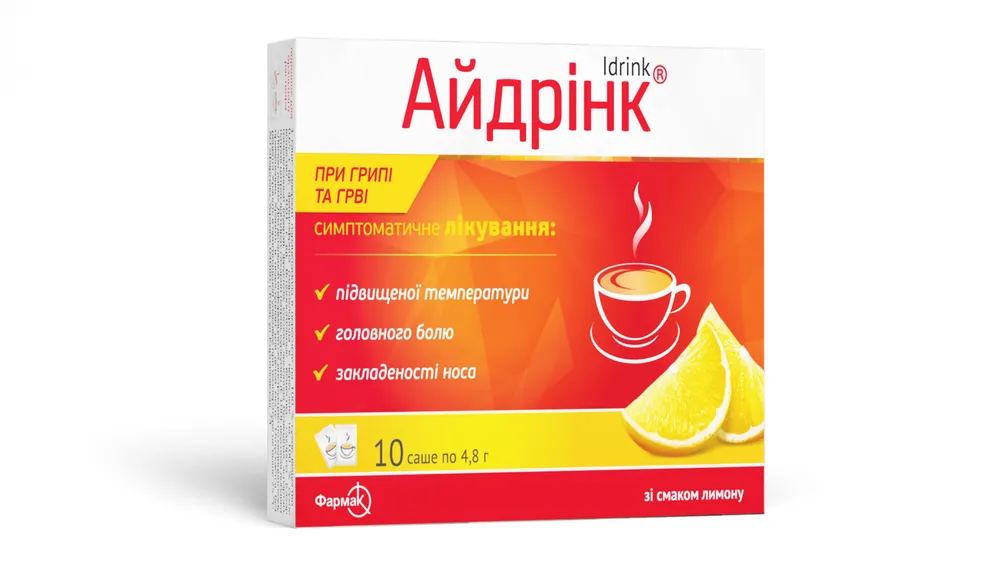
Table of Contents
INSTRUCTIONS FOR MEDICAL USE OF THE MEDICINAL PRODUCT AYDRINK® (IDRINK)
Composition:
Active substances: paracetamol, phenylephrine hydrochloride;
One sachet contains paracetamol equivalent to 100% dry substance 650 mg (0.650 g), phenylephrine hydrochloride equivalent to 100% dry substance 10 mg (0.010 g);
Excipients:
Lemon-flavored powder – sucrose (powdered sugar (sugar powder)), fructose, citric acid anhydrous, aspartame, sodium citrate dihydrate, sodium saccharin, curcumin (E 100), flavoring agent "Lemon-Lime";
Blackcurrant-flavored powder – sucrose (powdered sugar (sugar powder)), fructose, citric acid anhydrous, aspartame, sodium citrate dihydrate, sodium saccharin, flavoring "Blackcurrant", anthocyanin (E 163).
Pharmaceutical form. Oral soluble powder.
Main physicochemical properties: Lemon-flavored powder – a light yellow, powder-like substance, free from foreign mechanical inclusions; Blackcurrant-flavored powder – a light grey-violet, powder-like substance with dark specks, free from foreign mechanical inclusions.
Pharmacotherapeutic group. Analgesics and antipyretics. Paracetamol combinations without psycholeptics. ATC code N02BE51.
Pharmacological Properties.
Pharmacodynamics.
The mechanism of action of paracetamol is explained by inhibition of prostaglandin synthesis in the central nervous system; paracetamol also acts on the thermoregulatory center in the hypothalamus. Phenylephrine is a sympathomimetic agent. Its action is primarily associated with direct stimulation of adrenergic receptors and, to some extent, with an indirect effect mediated by the release of norepinephrine. Phenylephrine reduces swelling of the nasal mucosa and facilitates breathing. It causes vasoconstriction of arterioles, increases total peripheral vascular resistance, and elevates arterial blood pressure.
Pharmacokinetics.
After oral administration, paracetamol is rapidly absorbed from the gastrointestinal tract. Maximum plasma concentration is reached within 30–60 minutes. When administered in therapeutic doses, the elimination half-life is 1–4 hours. Paracetamol is metabolized in the liver, primarily via conjugation reactions. Depending on plasma concentration, it is partially deacetylated or hydroxylated. The main route of excretion is via urine (90–100 % within 24 hours): as glucuronide conjugates (60 %), sulfate conjugates (35 %), or cysteine conjugates (3 %). Phenylephrine hydrochloride is absorbed from the gastrointestinal tract at a variable rate and is metabolized by monoamine oxidase in the intestine and liver. After oral administration, peak plasma concentration occurs within 1–2 hours. The average elimination half-life is 2–3 hours. It is excreted in urine as sulfate conjugate.
Clinical characteristics.
Indications.
Symptomatic treatment of acute respiratory infections and influenza accompanied by headache, muscle and joint pain, sore throat, fever, and nasal congestion.
Contraindications.
- Hypersensitivity to any of the components of the drug.
- Severe ischemic heart disease and cardiovascular disorders.
- Hypertension.
- Hyperthyroidism.
- Contraindicated in patients currently receiving or who have discontinued therapy with monoamine oxidase inhibitors (MAOIs) within the past two weeks.
- Concurrent use of other sympathomimetic decongestants.
- Should be avoided in patients with prostatic hypertrophy.
Interaction with other medicinal products and other types of interactions.
Paracetamol
The absorption rate of paracetamol may be increased by metoclopramide or domperidone and decreased by cholestyramine.
Prolonged regular daily use of paracetamol together with warfarin or other coumarins may enhance the anticoagulant effect of the latter, leading to an increased risk of bleeding; occasional doses do not have a significant effect.
Caution is advised when paracetamol is used concomitantly with flucloxacillin, as co-administration has been associated with metabolic acidosis with a high anion gap due to pyroglutamic acidosis, particularly in patients with risk factors (see section "Special precautions").
Phenylephrine hydrochloride
Interaction of phenylephrine with MAO inhibitors (including moclobemide) may cause a hypertensive effect (see section "Contraindications").
Concurrent use of phenylephrine with other sympathomimetics increases the risk of cardiovascular adverse reactions.
Phenylephrine may reduce the effectiveness of beta-blockers and other antihypertensive agents (including debrisoquine, guanethidine, reserpine, methyldopa), increasing the risk of hypertension and other cardiovascular adverse reactions (see section "Contraindications").
Concurrent use of phenylephrine with tricyclic antidepressants (e.g., amitriptyline) increases the risk of cardiovascular adverse effects (see section "Contraindications").
Concurrent use of phenylephrine with digoxin and cardiac glycosides may increase the risk of arrhythmia or myocardial infarction.
Special precautions for use.
Use with caution in patients with Raynaud's disease or diabetes mellitus.
Use with caution in patients with severe renal or hepatic impairment. In patients with non-cirrhotic alcoholic liver disease, the risk of drug overdose is increased.
Avoid concomitant use with other medications containing paracetamol.
In case of overdose, seek immediate medical attention even if the patient feels well, as there may be a risk of delayed serious liver injury (see section "Overdose").
Cases of high anion gap metabolic acidosis (HAGMA) due to pyroglutamic acidosis have been reported in patients with severe conditions such as severe renal failure and sepsis, or in patients with malnutrition or other sources of glutathione deficiency (e.g. chronic alcoholism), who were treated with paracetamol at therapeutic doses for prolonged periods or in combination with flucloxacillin. If HAGMA due to pyroglutamic acidosis is suspected, immediate discontinuation of paracetamol is recommended, along with careful monitoring. Measurement of urinary 5-oxoproline levels may be useful in identifying pyroglutamic acidosis as the underlying cause of HAGMA in patients with multiple risk factors.
Phenylephrine should be used with caution in patients with closed-angle glaucoma.
This medicinal product contains aspartame, a phenylalanine source, which may be dangerous for patients with phenylketonuria.
This medicinal product contains 1 g of sucrose per dose and 1.723 g of fructose per dose. If a patient has been diagnosed with intolerance to certain sugars, consult a physician before taking this medicinal product. Use of this product may be harmful to teeth.
This medicinal product contains 5.26 mmol (or 121.11 mg) of sodium per 1 sachet, equivalent to 6.05% of the WHO recommended maximum daily intake of 2 g sodium for an adult. Caution is advised when administering to patients on a sodium-restricted diet.
Use during pregnancy or breastfeeding.
Pregnancy
This medicinal product should not be used during pregnancy except when prescribed by a physician. If used, it should be administered at the lowest effective dose, for the shortest duration, and with the lowest possible frequency.
The safety of this medicinal product during pregnancy or breastfeeding has not been established. Due to the potential association between fetal developmental disorders and phenylephrine exposure in the first trimester, use of this product during pregnancy should be avoided. Additionally, since phenylephrine may reduce placental perfusion, the product should not be used in patients with a history of pre-eclampsia.
Epidemiological studies in human pregnancy have not shown adverse effects associated with paracetamol use at recommended doses.
Extensive data from pregnant women do not indicate any malformative or fetotoxic/neonatal toxic effects. Epidemiological studies on neurodevelopmental outcomes in children exposed to paracetamol in utero have not provided conclusive results.
Breastfeeding
This medicinal product should not be used during breastfeeding except when prescribed by a physician. Data on the use of phenylephrine during this period are limited.
Paracetamol passes into breast milk, but not in clinically significant amounts. Available published data do not indicate the need to interrupt breastfeeding.
Fertility
There are no data available on the effects of the active substances on fertility.
Effects on ability to drive and use machines.
Aidrink® has no or negligible effect on the ability to drive or operate machinery.
Method of administration and dosage.
Empty the contents of 1 sachet into a cup and add hot water. Stir until completely dissolved; may be sweetened if desired. Take warm.
Adults and children aged 16 years and older: 1 sachet. If necessary, the dose may be repeated every 4–6 hours. Do not exceed 4 sachets per day.
The treatment course should not last more than 3–5 days.
Children.
The drug is contraindicated in children under 16 years of age.
Overdose.
Paracetamol
Hepatic injury may occur in adults who have ingested 10 g or more of paracetamol. Ingestion of 5 g or more of paracetamol may lead to liver damage in patients with risk factors such as:
- chronic treatment with carbamazepine, phenobarbital, phenytoin, primidone, rifampicin, St. John's wort preparations, or other drugs that induce liver enzymes;
- regular consumption of ethanol in doses exceeding the recommended levels;
- glutathione deficiency (e.g. due to malnutrition, cystic fibrosis, HIV infection, fasting, cachexia).
Symptoms
Within the first 24 hours after paracetamol overdose, pallor, nausea, vomiting, anorexia, and abdominal pain may appear. Liver damage may become evident 12–48 hours after ingestion. Glucose metabolism disturbances and metabolic acidosis may occur. In severe poisoning, hepatic failure may progress to encephalopathy, hemorrhage, hypoglycemia, cerebral edema, and death. Acute renal failure with acute tubular necrosis, manifested by flank pain, hematuria, and proteinuria, may develop even in the absence of severe liver injury. Cardiac arrhythmias and pancreatitis have also been reported.
Treatment
Immediate treatment is essential in paracetamol overdose. Despite the absence of significant early symptoms, patients should be urgently hospitalized to receive immediate medical care. Symptoms may be limited to nausea or vomiting and may not reflect the severity of overdose or organ damage. Treatment should follow established guidelines. Activated charcoal should be considered if the overdose was ingested within 1 hour. Plasma paracetamol concentration should be measured at least 4 hours after ingestion (earlier concentrations are unreliable). Treatment with N-acetylcysteine may be administered within 24 hours of paracetamol ingestion; however, maximum protective effect is achieved within the first 8 hours after ingestion. The efficacy of the antidote decreases sharply thereafter. If necessary, intravenous N-acetylcysteine should be administered according to the established dosing regimen. If vomiting is not a concern, oral methionine may be an acceptable alternative in remote settings outside hospital care. Management of patients with severe liver dysfunction more than 24 hours after ingestion should be discussed with a toxicology or liver disease unit.
Phenylephrine hydrochloride
Manifestations of severe phenylephrine overdose include hemodynamic disturbances and cardiovascular collapse with respiratory depression, seizures, and arrhythmias. However, in combined paracetamol and phenylephrine hydrochloride preparations, lower overdose amounts may cause paracetamol-related hepatotoxicity rather than severe phenylephrine-related toxicity. Treatment includes symptomatic and supportive measures. Hypertensive effects may be treated with intravenous alpha-receptor blockers.
Phenylephrine overdose may cause: nervousness, headache, dizziness, insomnia, elevated blood pressure, nausea, vomiting, reflex bradycardia, mydriasis, acute angle-closure glaucoma (most likely to occur in individuals with pre-existing angle-closure glaucoma), tachycardia, palpitations, allergic reactions (e.g. rash, urticaria, allergic dermatitis), dysuria, urinary retention (most likely in individuals with bladder obstruction, e.g. due to benign prostatic hyperplasia).
Additional symptoms may include hypertension and, possibly, reflex bradycardia. In severe cases, confusion, seizures, and arrhythmias may occur.
Treatment should be clinically appropriate. Management of severe hypertension may require alpha-blockers such as phentolamine.
Adverse reactions.
The adverse reactions associated with paracetamol and phenylephrine hydrochloride are listed below in the table by system organ class and frequency. Frequency is defined as: very common (≥ 1/10); common (≥ 1/100 and < 1/10); uncommon (≥ 1/1000 and < 1/100); rare (≥ 1/10000 and < 1/1000); very rare (< 1/10000); frequency not known (cannot be estimated from available data). Within each frequency group, adverse reactions are listed in order of decreasing severity.
| System organ class |
Frequency |
Adverse reactions |
| Blood and lymphatic system disorders |
Unknown |
Thrombocytopenia, leukopenia, neutropenia, pancytopenia, agranulocytosis1 |
| Immune system disorders |
Unknown |
Hypersensitivity |
| Gastrointestinal disorders |
Unknown |
Abdominal discomfort, nausea, vomiting |
| Skin and subcutaneous tissue disorders |
Very rare |
Serious skin reactions have been reported |
| Unknown |
Rash |
|
| Renal and urinary disorders |
Unknown |
Urinary retention2 |
| Metabolism and nutrition disorders |
Unknown |
Metabolic acidosis with high anion gap |
1Blood dyscrasias have been reported, including thrombocytopenia, leukopenia, pancytopenia, neutropenia, and agranulocytosis, but they were not necessarily causally related to paracetamol.
2Particularly in men.
Description of individual adverse reactions
Metabolic acidosis with a high anion gap.
Cases of metabolic acidosis with a high anion gap as a result of pyroglutamic acidemia have been observed in patients with risk factors who were taking paracetamol (see section "Special precautions"). Pyroglutamic acidemia may occur as a result of low glutathione levels in these patients.
Shelf life. 2 years.
Do not use the medicinal product after the expiry date stated on the packaging.
Storage conditions. Store in the original packaging at a temperature not exceeding 25°C.
Keep out of reach and sight of children.
Packaging.
Lemon-flavoured powder: 4.8 g per sachet; 10 sachets per pack.
Blackcurrant-flavoured powder: 5.2 g per sachet; 10 sachets per pack.
Authorization category. Over-the-counter.
Manufacturer. JSC "Farmak".
Manufacturer's name and address of the place of business.
74, Kyrylivska Street, Kyiv, 04080, Ukraine.