Atenolol-astrapharm
Ukraine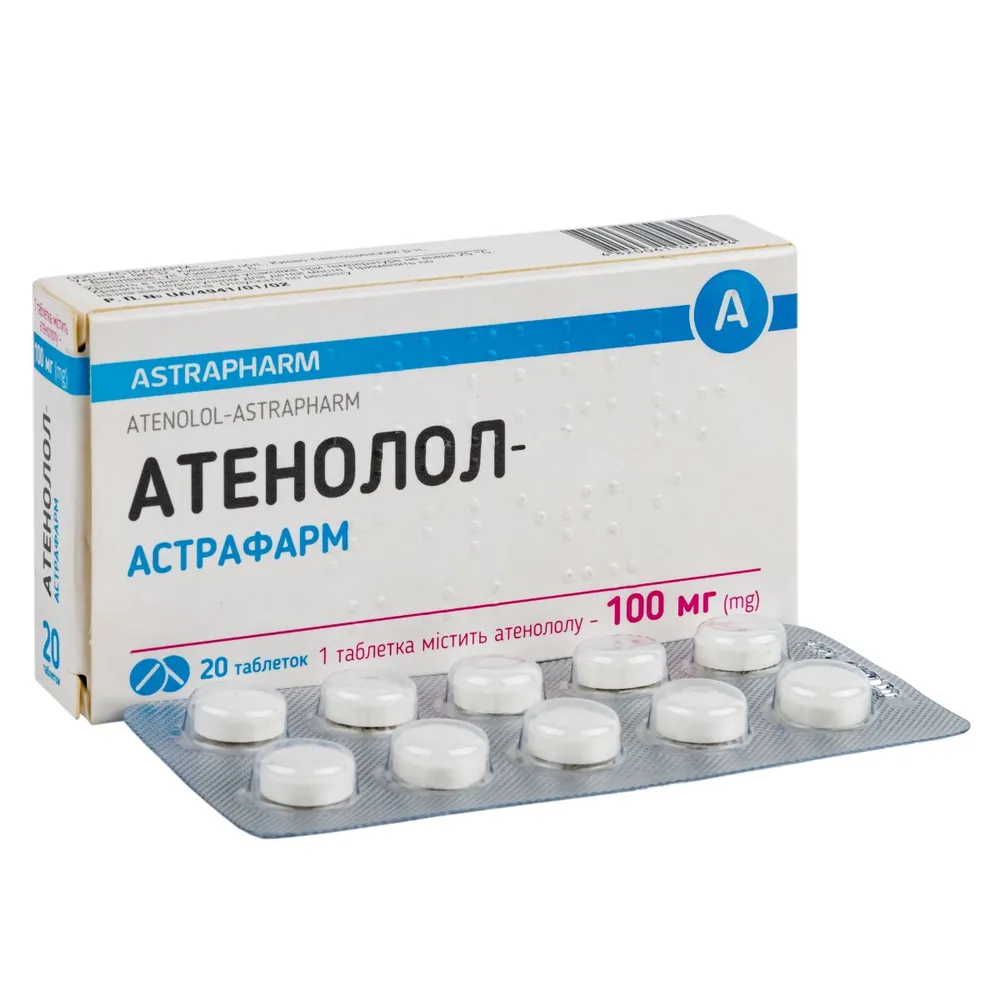
Table of Contents
INSTRUCTIONS FOR MEDICAL USE OF THE MEDICINAL PRODUCT Atenolol-Astrapharm (ATENOLOL-ASTRAPHARM)
Composition:
Active substance: atenolol;
1 tablet contains 50 mg or 100 mg of atenolol;
Excipients:
for 50 mg tablets: lactose monohydrate; magnesium stearate; maize starch;
for 100 mg tablets: lactose monohydrate; magnesium stearate; potato starch.
Pharmaceutical form. Tablets.
Main physicochemical characteristics: white or almost white tablets, round in shape, with a biconvex surface and a score line on one side.
Pharmacotherapeutic group.
Selective β-adrenoreceptor blockers. ATC code C07AB03.
Pharmacological properties.
Pharmacodynamics.
Cardioselective β-adrenoceptor blocker. Exhibits antianginal, antihypertensive, and antiarrhythmic effects. Has no intrinsic sympathomimetic or membrane-stabilizing activity. Reduces sinus node automaticity, slows atrioventricular conduction, and decreases myocardial contractility and its oxygen demand. Exerts negative chronotropic, dromotropic, bathmotropic, and inotropic effects.
Pharmacokinetics.
After oral administration, 50–60% of atenolol is absorbed in the gastrointestinal tract. Maximum plasma concentration (2 μg/mL) is reached within 2–4 hours. The elimination half-life is 6–7 hours. Less than 5% of atenolol binds to plasma proteins. Atenolol is a hydrophilic agent that poorly penetrates the blood-brain and placental barriers, but passes into breast milk. Atenolol is minimally metabolized in the liver (less than 10%). The majority of atenolol (85%) is excreted unchanged in urine.
The elimination half-life may be prolonged in patients with renal insufficiency. Atenolol is removed by hemodialysis.
Clinical characteristics.
Indications.
- Treatment of arterial hypertension.
- Treatment and prevention of angina attacks (chronic stable and unstable angina, especially in cases associated with tachycardia and arterial hypertension).
- Cardiac rhythm disorders (arrhythmia, sinus tachycardia, prevention of supraventricular tachycardia, paroxysmal supraventricular tachycardia, atrial fibrillation and flutter; ventricular arrhythmias, including those caused by increased physical exertion or intake of sympathomimetic agents; prevention of ventricular tachycardia and ventricular fibrillation).
- Myocardial infarction (treatment and prevention to reduce mortality and decrease the risk of recurrent infarction).
Contraindications.
- Hypersensitivity to atenolol or to other β-adrenoreceptor blockers, or to any component of the drug;
- acute heart failure;
- cardiogenic shock;
- second- and third-degree atrioventricular block;
- sick sinus syndrome;
- sinoatrial block;
- sinus bradycardia (heart rate less than 45 beats per minute);
- arterial hypotension (systolic blood pressure less than 90 mm Hg);
- bronchial asthma;
- metabolic acidosis;
- advanced stages of peripheral circulatory disorders;
- concomitant use of monoamine oxidase inhibitors (MAOIs), except MAO-B inhibitors;
- untreated pheochromocytoma;
- renal insufficiency;
- childhood age.
Interaction with other medicinal products and other forms of interaction.
When atenolol is used concomitantly with:
- oral antidiabetic agents, such as insulin, the effect of these agents may be enhanced or prolonged. In such cases, symptoms of hypoglycemia (especially tachycardia and tremor) may be masked or absent. Therefore, regular blood glucose monitoring is necessary;
- tricyclic antidepressants, barbiturates, phenothiazines, nitroglycerin, diuretics, vasodilators, and other antihypertensive agents (e.g., prazosin), the hypotensive effect may be enhanced;
- calcium channel blockers (e.g., nifedipine), in addition to enhanced hypotensive effect, heart failure may develop;
- calcium channel blockers with negative inotropic effect (e.g., verapamil, diltiazem), their effects may be potentiated, especially in patients with impaired ventricular function and/or atrioventricular conduction, increasing the risk of arterial hypotension and bradycardia. If intravenous verapamil is required, it should be administered no sooner than 48 hours after discontinuation of atenolol;
- cardiac glycosides, reserpine, α-methyldopa, guanfacine, and clonidine, a significant reduction in heart rate may occur;
- indomethacin, the antihypertensive effect of atenolol may be reduced;
- anesthetic agents and antiseptics, the antihypertensive effect is enhanced. An additive negative inotropic effect of both agents may occur;
- peripheral muscle relaxants (e.g., succinylcholine, tubocurarine), neuromuscular blockade may be enhanced; therefore, the anesthesiologist should be informed prior to surgery that the patient is taking Atenolol-AstraPharm;
- euphyllinum (aminophylline) and theophylline, the therapeutic effects may be suppressed;
- lidocaine, reduced elimination and increased risk of lidocaine toxicity may occur;
- sympathomimetic agents, e.g., adrenaline (epinephrine), may reduce the effectiveness of β-blockers.
In patients receiving both Atenolol-AstraPharm and clonidine, clonidine should be discontinued several days after stopping atenolol treatment.
Special precautions for use.
Atenolol should not be used concomitantly with intravenous calcium channel blockers such as verapamil and diltiazem, or other antiarrhythmic agents (e.g., disopyramide).
The exception is patients treated in intensive care units.
In all these cases, the physician must carefully weigh the benefit/risk ratio before prescribing Atenolol-Astrafarm.
If thrombocytopenic or non-thrombocytopenic purpura has occurred during treatment with other β-blockers, the possibility of this adverse effect should be considered also during atenolol therapy.
It should be remembered that, very rarely during atenolol treatment, latent diabetes mellitus may manifest or the condition of diabetic patients may worsen. Lipid metabolism disturbances may sometimes occur: while total cholesterol levels remain within normal limits, high-density lipoprotein levels may decrease and plasma triglyceride levels may increase.
Dosage adjustments or discontinuation of atenolol therapy must not be made without consulting a physician. Sudden withdrawal of the drug may lead to withdrawal syndrome. Therefore, discontinuation of the drug and dose reduction should be carried out gradually and slowly.
Atenolol-Astrafarm should be prescribed with special caution and only under strict medical supervision:
- in first-degree atrioventricular block;
- in diabetes mellitus with fluctuating blood glucose levels (due to the risk of developing severe hypoglycemia);
- during prolonged fasting and intense physical exertion (risk of severe hypoglycemic states);
- in pheochromocytoma (without α1-adrenoreceptor blockade);
- in hepatic and/or renal dysfunction (when prescribing atenolol to these patients, continuous monitoring of liver and/or kidney function is required);
- in patients with psoriasis or a personal or family history of psoriasis;
- in patients with peripheral circulatory disorders, including Raynaud's syndrome;
- in patients undergoing desensitization therapy or with a history of severe allergic reactions;
- in thyrotoxicosis, as atenolol may mask clinical signs of hyperthyroidism.
β-blockers are not recommended for use in vasospastic angina (Prinzmetal's angina).
Atenolol-Astrafarm should be prescribed cautiously in patients with myasthenia.
If surgical intervention is required, therapy with Atenolol-Astrafarm should be discontinued at least 24 hours before surgery, or an anesthetic agent with minimal negative inotropic effect should be selected.
In thyrotoxicosis, atenolol may mask symptoms of hypoglycemia, particularly tachycardia.
For elderly patients, treatment should be initiated with reduced doses (the dose may be increased under control of blood pressure and heart rate). If pronounced bradycardia, arterial hypotension, rhythm or conduction disturbances, or other complications occur in these patients, the dose of atenolol should be reduced or the drug discontinued.
The product contains lactose and therefore should not be administered to patients with rare hereditary forms of galactose intolerance, lactase deficiency, or glucose-galactose malabsorption syndrome.
Use during pregnancy or breastfeeding.
Atenolol crosses the placental barrier.
During pregnancy (especially in the first trimester), Atenolol-Astrafarm should be used only if the expected benefit to the mother outweighs the potential risk to the fetus, as sufficient experience with its use in pregnant women, particularly in early stages, is still lacking. If women have taken atenolol, therapy should be discontinued at least 24–48 hours before delivery due to the risk of bradycardia, hypoglycemia, and respiratory depression in the newborn. If discontinuation is not possible, the newborn must be closely monitored for 24–48 hours after delivery.
Atenolol is excreted in breast milk; therefore, breastfeeding should be discontinued during treatment with this drug.
Ability to affect reaction speed when driving or operating machinery.
At the beginning of treatment, during dose escalation, or when adverse reactions develop, reaction speed may be reduced. Therefore, patients should refrain from driving vehicles or operating precision machinery.
Method of Administration and Dosage
Tablets should be swallowed whole, without chewing, and taken with a small amount of liquid, before meals, preferably at the same time each day.
The dosage and duration of treatment are determined individually by a physician, depending on the therapeutic response.
Myocardial infarction: After intravenous administration, 50 mg of atenolol is administered orally 12 hours after the injection, followed by 100 mg another 12 hours later.
Chronic stable and unstable angina: Usually, 100 mg of atenolol once daily or 50 mg twice daily is prescribed.
Arterial hypertension: Treatment is generally initiated with 100 mg of Atenolol-Astrafarm once daily. Some patients may require only 50 mg daily. The effect becomes apparent within 2 weeks. If ineffective, atenolol may be used in combination with diuretics.
Supraventricular and ventricular arrhythmias: Atenolol-Astrafarm is prescribed once or twice daily at a dose of 50–100 mg.
Maximum daily dose – 200 mg.
In patients with significantly impaired renal function, Atenolol-Astrafarm dosage depends on creatinine clearance (CC): when CC is 10–30 mL/min, the dose should be halved (50 mg daily or every other day); when CC is less than 10 mL/min, the dose should be reduced fourfold compared to the standard dose.
Patients undergoing hemodialysis should receive 50 mg of the drug after each dialysis session.
This should be performed under hospital conditions, as a significant decrease in arterial pressure may occur.
Children.
The drug is not administered to children.
Overdose.
Symptoms: The clinical picture depends on the degree of intoxication and is primarily characterized by disturbances of the cardiovascular and central nervous systems.
Overdose may lead to arterial hypotension, bradycardia, heart failure, and cardiogenic shock. In severe cases, respiratory depression, bronchospasm, vomiting, and impaired consciousness may occur; generalized seizures are extremely rare.
Treatment: In case of overdose or when there is a risk of decreased heart rate and/or arterial pressure, atenolol therapy should be discontinued. Close monitoring of vital signs should be performed in an intensive care unit, with necessary corrective measures.
If required, the following should be administered:
- Atropine (0.5–2 mg intravenously as a bolus);
- Glucagon: initial dose 1–10 mg intravenously (as a bolus), followed by 2–2.5 mg/hour as a continuous infusion;
- Sympathomimetics, adjusted according to body weight and response (dopamine, dobutamine, isoprenaline, oxyprenaline, or adrenaline).
If bradycardia is refractory to treatment, temporary cardiac pacing may be considered.
For bronchospasm, β2-sympathomimetics should be administered as an aerosol (and intravenously if the response is inadequate) or intravenous aminophylline.
For generalized seizures, diazepam should be administered slowly by intravenous injection.
The drug can be removed by hemodialysis.
Adverse reactions.
Cardiovascular system: bradycardia, arterial hypotension, disturbances of atrioventricular conduction (up to cardiac arrest), signs of heart failure, cold sensation and paresthesia in limbs. In individual cases, exacerbation of angina attacks cannot be excluded in patients with angina pectoris.
Nervous system: dizziness, fatigue, headache, sleep disturbances, nightmares, depressive disorders, hallucinations, psychosis, insomnia or somnolence, confusion.
Gastrointestinal tract: dyspepsia, diarrhea, nausea, constipation, hepatotoxicity, dry mouth, disturbances in transaminase levels, intrahepatic cholestasis.
Endocrine system: hypoglycemic state may develop, especially in patients with diabetes mellitus undergoing hypoglycemic therapy.
Immune system: itching, skin redness, exanthema, photosensitization, hypersensitivity reactions (angioneurotic edema), skin rashes (exacerbation of psoriasis), urticarial rashes, increased levels of antinuclear antibodies.
Urinary system: in isolated cases, decreased libido and potency, gynecomastia, impotence, and difficulty in urination have been observed.
Respiratory system: in patients predisposed to bronchial obstruction, bronchospasm may occur.
Blood system: purpura, thrombocytopenia.
Other: conjunctivitis or decreased tear secretion, increased sweating, visual disturbances, muscle weakness, dry eyes, alopecia, psoriasiform skin reactions.
Shelf life. 3 years.
Storage conditions.
Store in original packaging at a temperature not exceeding 25 °C.
Keep out of reach of children.
Packaging.
10 tablets in a blister pack; 2, 6, 9, or 10 blisters per box.
Prescription status. Prescription only.
Manufacturer.
LLC "ASTRAFARM", Ukraine.
Manufacturer's address and place of business activity.
6, Kyivska St., Vyshneve, Kyiv-Sviatoshyn District, Kyiv Region, 08132, Ukraine.