Aris
Ukraine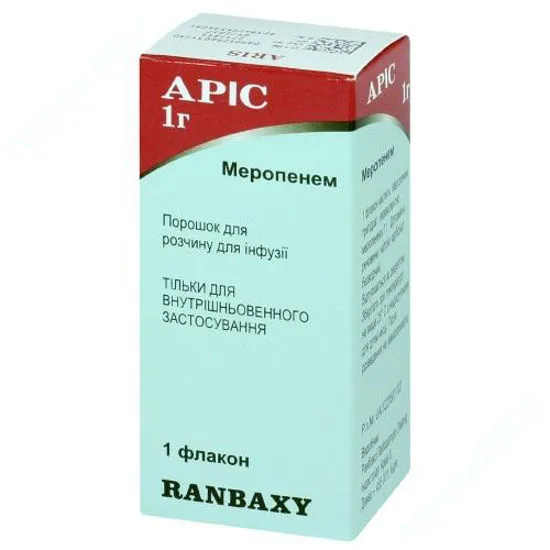
Table of Contents
INSTRUCTIONS FOR MEDICAL USE OF THE MEDICINAL PRODUCT ARIS (ARIS)
Composition:
Active substance: meropenem;
1 vial contains: meropenem trihydrate equivalent to meropenem 500 mg or 1000 mg;
Excipient: anhydrous sodium carbonate.
Pharmaceutical form. Powder for solution for infusion.
Main physicochemical properties: powder from white to light yellow color.
Pharmacotherapeutic group. Antimicrobial agents for systemic use. Carbapenems. ATC code J01D H02.
Pharmacological properties.
Pharmacodynamics.
Meropenem exerts a bactericidal effect by inhibiting the synthesis of bacterial cell walls in Gram-positive and Gram-negative bacteria through binding to penicillin-binding proteins (PBPs).
As with other beta-lactam antibacterial agents, the duration of time during which meropenem concentrations exceed the minimum inhibitory concentrations (MIC) (T>MIC) has shown a high degree of correlation with efficacy. Preclinical data indicate that meropenem demonstrated activity at plasma concentrations exceeding the MIC for the infecting microorganisms for approximately 40% of the dosing interval. This target value has not been clinically established.
Bacterial resistance to meropenem may develop due to: reduced permeability of the outer membrane of Gram-negative bacteria (due to decreased porin production), reduced affinity for target PBPs, increased expression of efflux pump components, and production of beta-lactamases capable of hydrolyzing carbapenems.
Cases of infectious diseases caused by bacteria resistant to carbapenems have been reported.
Cross-resistance between meropenem and medicinal products belonging to the classes of quinolones, aminoglycosides, macrolides, and tetracyclines is absent, considering the target microorganisms. However, bacteria may exhibit resistance to more than one class of antibacterial agents when the underlying mechanism involves cell membrane impermeability or the presence of efflux pump(s).
The MIC breakpoints established during clinical studies by the European Committee on Antimicrobial Susceptibility Testing (EUCAST) are listed below.
Table 1
| Microorganism |
Susceptible (S), (mg/l) |
Resistant (R), (mg/l) |
| Enterobacteriaceae |
≤ 2 |
> 8 |
| Pseudomonas |
≤ 2 |
> 8 |
| Acinetobacter |
≤ 2 |
> 8 |
| Streptococcus, groups A, B, C, G |
≤ 2 |
> 2 |
| Streptococcus pneumoniae1 |
≤ 2 |
> 2 |
| Other streptococci |
2 |
2 |
| Enterococcus |
|
|
| Staphylococcus2 |
note 3 |
note 3 |
| Haemophilus influenzae1 and Moraxella catarrhalis |
≤ 2 |
> 2 |
| Neisseria meningitidis2,4 |
≤ 0.25 |
> 0.25 |
| Gram-positive anaerobes |
≤ 2 |
> 8 |
| Gram-negative anaerobes |
≤ 2 |
> 8 |
| Breakpoints not associated with microorganism species5 |
≤ 2 |
> 8 |
1The susceptibility breakpoints for meropenem against Streptococcus pneumoniae and Haemophilus influenzae in meningitis are 0.25 mg/L.
2Microbial strains with MIC values exceeding the S/I breakpoint are very rare or have not been reported to date. Testing for identification and antimicrobial susceptibility for any such isolate should be repeated, and if the result is confirmed, the isolate should be referred to a reference laboratory. Until clinical response data are available for verified isolates with MICs above the current resistance breakpoints, such isolates should be reported as resistant.
3Staphylococcal susceptibility to meropenem is predicted based on methicillin susceptibility.
4Meropenem breakpoints for Neisseria meningitidis apply only to meningitis.
5Non-species-related breakpoints were primarily established based on PK/PD data and do not depend on the MIC distribution of individual species. They are intended for use with species not listed in the table and footnotes.
Susceptibility testing is not recommended, as the organism is a poor target for treatment with this medicinal product.
The prevalence of acquired resistance may vary geographically and over time for individual species; therefore, it is advisable to refer to local data on microbial resistance, especially when treating severe infections. When the local prevalence of resistance is such that the benefit of using the medicinal product, at least for certain types of infections, is questionable, expert consultation should be sought.
The following pathogenic microorganisms are listed based on clinical experience and therapeutic treatment guidelines.
Typically susceptible species
Gram-positive aerobes: Enterococcus faecalis 6; Staphylococcus aureus (methicillin-susceptible)7; Staphylococcus species (methicillin-susceptible), including Staphylococcus epidermidis, Streptococcus agalactiae (group B); Streptococcus milleri group (S. anginosus, S. constellatus, and S. intermedius), Streptococcus pneumoniae, Streptococcus pyogenes (group A).
Gram-negative aerobes: Citrobacter freundii, Citrobacter koseri, Enterobacter aerogenes, Enterobacter cloacae, Escherichia coli, Haemophilus influenzae, Klebsiella oxytoca, Klebsiella pneumoniae, Morganella morganii, Neisseria meningitidis, Proteus mirabilis, Proteus vulgaris, Serratia marcescens.
Gram-positive anaerobes: Clostridium perfringens, Peptoniphilus asaccharolyticus, Peptostreptococcus species (including P. micros, P. anaerobius, P. magnus).
Gram-negative anaerobes: Bacteroides caccae; Bacteroides fragilis group, Prevotella bivia, Prevotella disiens.
Species for which acquired resistance may be a problem
Gram-positive aerobes: Enterococcus faecium 6,8.
Gram-negative aerobes: Acinetobacter species, Burkholderia cepacia, Pseudomonas aeruginosa.
Inherently resistant microorganisms
Gram-negative aerobes: Stenotrophomonas maltophilia, Legionella species.
Other microorganisms: Chlamydophila pneumoniae, Chlamydophila psittaci, Coxiella burnetii, Mycoplasma pneumoniae.
6Species exhibiting intrinsic intermediate susceptibility.
7All methicillin-resistant staphylococci are resistant to meropenem.
8Resistance rate > 50% in one or more EU countries.
Pharmacokinetics.
In healthy volunteers, the mean plasma elimination half-life is approximately 1 hour; the mean volume of distribution is about 0.25 L/kg (11–27 L); the mean clearance is 287 mL/min following a 250 mg dose, decreasing to 205 mL/min with a 2 g dose. Following 30-minute infusions of 500, 1000, and 2000 mg, mean Cmax values are approximately 23, 49, and 115 µg/mL, respectively; corresponding AUC values are 39.3, 62.3, and 153 µg×h/mL. After 5-minute infusions, Cmax values are 52 and 112 µg/mL for 500 and 1000 mg doses, respectively. With multiple dosing every 8 hours in patients with normal renal function, accumulation of meropenem does not occur.
Data indicate that administration of meropenem 1000 mg every 8 hours to patients after surgical treatment of intra-abdominal infections results in Cmax and elimination half-life values similar to those in healthy individuals, but with a larger volume of distribution (27 L).
Distribution. The mean protein binding of meropenem to plasma proteins is approximately 2% and is independent of drug concentration. After rapid administration (5 minutes or less), the pharmacokinetics are biexponential, but this is much less pronounced after a 30-minute infusion. Meropenem penetrates well into certain body fluids and tissues, including lungs, bronchial secretions, bile, cerebrospinal fluid, female genital tissues, skin, fascia, muscle, and peritoneal exudates.
Metabolism. Meropenem is metabolized via hydrolysis of the beta-lactam ring, forming a microbiologically inactive metabolite. In vitro, meropenem demonstrates reduced susceptibility to hydrolysis by human dehydropeptidase-I (DHP-I) compared to imipenem, and thus co-administration with a DHP-I inhibitor is not required.
Excretion. Meropenem is primarily excreted unchanged by the kidneys; approximately 70% (50–75%) of the dose is excreted unchanged within 12 hours. An additional 28% is excreted as the microbiologically inactive metabolite. Fecal excretion accounts for only about 2% of the dose. Measured renal clearance and the effect of probenecid indicate that meropenem undergoes both glomerular filtration and tubular secretion.
Renal impairment. Impaired renal function leads to higher plasma AUC values and a prolonged elimination half-life for meropenem. AUC increases by a factor of 2.4 in patients with moderate renal impairment (creatinine clearance (CrCl) 33–74 mL/min), by 5 times in patients with severe renal impairment (CrCl 4–23 mL/min), and by 10 times in patients undergoing hemodialysis (CrCl <2 mL/min), compared to healthy volunteers (CrCl >80 mL/min). AUC values for the microbiologically inactive open-ring metabolite are also significantly higher in patients with renal impairment. Dose adjustment is recommended for patients with moderate to severe renal impairment.
Meropenem is removed by hemodialysis, with a clearance during dialysis approximately 4 times higher than in anuric patients.
Hepatic impairment. Data indicate no influence of liver disease on the pharmacokinetics of meropenem after repeated dosing.
Children. Pharmacokinetic data are available in children (including infants) with infection: following doses of 10, 20, and 40 mg/kg, Cmax values approach those observed in adults after 500, 1000, and 2000 mg doses, respectively. Mean meropenem clearance values are 5.8 mL/min/kg (6–12 years), 6.2 mL/min/kg (2–5 years), 5.3 mL/min/kg (6–23 months), and 4.3 mL/min/kg (2–5 months). Approximately 60% of the dose is excreted in urine as meropenem and an additional 12% as metabolite within 12 hours. Meropenem concentrations in cerebrospinal fluid in children with meningitis are approximately 20% of simultaneous plasma levels, although there is considerable inter-individual variability.
Elderly patients. Pharmacokinetic data in healthy elderly volunteers (65–80 years) indicate reduced plasma clearance, correlating with age-related decline in creatinine clearance, as well as a slight reduction in non-renal clearance. Dose adjustment is not required in elderly patients, except in cases of moderate to severe renal impairment.
Clinical characteristics.
Indications.
Indicated for the treatment of the following infections in adults and children aged 3 months and older:
- pneumonia, including community-acquired and hospital-acquired pneumonia;
- bronchopulmonary infections in cystic fibrosis;
- complicated urinary tract infections;
- complicated intra-abdominal infections;
- infections during childbirth and postpartum infections;
- complicated skin and soft tissue infections;
- acute bacterial meningitis.
May be used for the treatment of patients with neutropenia and fever suspected of bacterial infection.
Consideration should be given to obtaining official guidance on the appropriate use of antibacterial agents.
Contraindications.
Hypersensitivity to the active substance and/or to any of the excipients of the medicinal product.
Hypersensitivity to any other antibacterial agent of the carbapenem group.
Severe hypersensitivity (e.g., anaphylactic reactions, severe skin reactions) to any other type of beta-lactam antibacterial agent (e.g., penicillins or cephalosporins).
Interaction with other medicinal products and other forms of interaction.
Probenecid competes with meropenem for active tubular secretion and thus inhibits renal excretion of meropenem, leading to an increased elimination half-life and elevated plasma concentrations of meropenem. Caution should be exercised when probenecid is used concomitantly with meropenem.
The potential effect of meropenem on protein binding or metabolism of other drugs has not been studied. However, since protein binding is so minimal, interactions with other compounds based on this mechanism are not expected.
Decreased serum levels of valproic acid have been reported when co-administered with carbapenems. The reduction in valproic acid levels may reach 60–100% within approximately two days. Due to the rapid onset and extent of this interaction, concomitant use of valproic acid and carbapenems is considered non-adjustable; therefore, such combination should be avoided.
Concomitant use of antibiotics with warfarin may enhance its anticoagulant effect. Numerous reports have documented increased anticoagulant effect of orally administered anticoagulants, including warfarin, in patients receiving antibacterial agents concomitantly. The risk may vary depending on the underlying infection, age, and general condition of the patient. Thus, the contribution of antibacterial agents to increased INR (International Normalized Ratio) is difficult to assess. Frequent monitoring of INR levels is recommended during and shortly after concomitant use of antibiotics with oral anticoagulants.
Special precautions for use.
When selecting meropenem as a therapeutic agent, the appropriateness of using a carbapenem-class antibacterial agent should be considered, taking into account factors such as the severity of infection, prevalence of resistance to other relevant antibacterial agents, and the risk of selecting for carbapenem-resistant bacteria.
Serious, and sometimes fatal, hypersensitivity reactions have been reported, as with other β-lactam antibiotics.
Patients with a history of hypersensitivity to carbapenems, penicillins, or other beta-lactam antibiotics may also exhibit hypersensitivity to meropenem. A careful patient history regarding previous hypersensitivity reactions to β-lactam antibiotics should be obtained prior to initiating meropenem therapy.
If a severe allergic reaction occurs, administration of the drug should be discontinued immediately and appropriate measures should be instituted.
Cases of antibiotic-associated colitis and pseudomembranous colitis, with severity ranging from mild to life-threatening, have been reported with the use of nearly all antibacterial agents, including meropenem. Therefore, it is important to consider this diagnosis in patients who develop diarrhea during or after meropenem therapy. Consideration should be given to discontinuing meropenem and initiating specific treatment directed against Clostridium difficile. Medicinal products that inhibit intestinal peristalsis should not be administered.
Seizures have been reported rarely during treatment with carbapenems, including meropenem.
Due to the risk of hepatotoxicity (liver function abnormalities with cholestasis and cytolysis) during meropenem therapy, liver function should be closely monitored.
Use in patients with hepatic disease: liver function should be closely monitored in patients with pre-existing liver disease during meropenem therapy. Dose adjustment is not required.
Meropenem therapy may result in a positive direct or indirect Coombs test.
Concomitant administration of meropenem and valproic acid/sodium valproate is not recommended.
Meropenem contains approximately 2.0 mEq or 4.0 mEq of sodium per 500 mg or 1 g dose, respectively. This should be taken into account when prescribing the drug to patients on a sodium-restricted diet.
Use during pregnancy or breastfeeding.
Data on the use of meropenem in pregnant women are lacking or limited in number.
Animal studies have not revealed direct or indirect effects on reproductive toxicity. As a precautionary measure, it is advisable to avoid using meropenem during pregnancy.
It is unknown whether meropenem is excreted in human breast milk. Meropenem is found in very low concentrations in the milk of animals. Considering the benefit of therapy for the woman, a decision should be made whether to discontinue breastfeeding or to discontinue meropenem therapy.
Ability to affect the reaction rate when driving or operating machinery.
Studies on the influence of the drug on the ability to drive vehicles or operate machinery have not been conducted.
Dosage and administration.
The tables below provide general recommendations for dosing of the medicinal product.
The dose of meropenem and duration of treatment depend on the type of causative agent, severity of the disease, and individual patient sensitivity.
Meropenem, when administered at a dose of up to 2 g three times daily in adults and children with body weight over 50 kg, and at a dose of up to 40 mg/kg three times daily in children, may be particularly suitable for the treatment of certain types of infections, such as hospital-acquired infections caused by Pseudomonas aeruginosa or Acinetobacter spp.
Table 2
Recommended doses for adults and children with body weight over 50 kg
| Infection |
Single dose to be administered every 8 hours |
| Pneumonia, including community-acquired and hospital-acquired pneumonia |
500 mg or 1 g |
| Respiratory tract infections in cystic fibrosis |
2 g |
| Complicated urinary tract infections |
500 mg or 1 g |
| Complicated intra-abdominal infections |
500 mg or 1 g |
| Infections during childbirth and postpartum infections |
500 mg or 1 g |
| Complicated skin and soft tissue infections |
500 mg or 1 g |
| Acute bacterial meningitis |
2 g |
| Treatment of patients with febrile neutropenia |
1 g |
Meropenem should usually be administered as an intravenous infusion lasting from
15 to 30 minutes.
Additionally, doses of up to 1 g may be given as an intravenous bolus injection over approximately 5 minutes. Safety data supporting administration of a 2 g dose as an intravenous bolus injection in adults are limited.
Renal impairment
Table 3
Recommended doses of the drug for adults and children with body weight over 50 kg when patients' creatinine clearance is less than 51 ml/min
| Creatinine clearance (ml/min) |
Single dose (see Table 1) |
Frequency |
| 26–50 |
full single dose |
every 12 hours |
| 10–25 |
half the single dose |
every 12 hours |
| <10 |
half the single dose |
every 24 hours |
Data supporting the use of doses of the medicinal product as indicated in Table 2, adjusted per 2 g dose unit, are limited.
Meropenem is removed by haemodialysis and haemofiltration; therefore, the required dose of the medicinal product should be administered after completion of the haemodialysis procedure.
There are no recommendations regarding established dosage regimens for patients undergoing peritoneal dialysis.
Hepatic impairment
Dosage adjustment of the medicinal product is not required in patients with hepatic impairment.
Dosage in elderly patients
Dosage adjustment is not required in elderly patients with normal renal function or with creatinine clearance values above 50 mL/min.
Paediatric population
Table 4
Recommended doses of the medicinal product for children aged from 3 months to 11 years and with body weight up to 50 kg
| Infection |
Single dose to be administered every 8 hours |
| Pneumonia, including community-acquired and hospital-acquired |
10 or 20 mg/kg body weight |
| Respiratory tract infections in cystic fibrosis |
40 mg/kg body weight |
| Complicated urinary tract infections |
10 or 20 mg/kg body weight |
| Complicated intra-abdominal infections |
10 or 20 mg/kg body weight |
| Complicated skin and soft tissue infections |
10 or 20 mg/kg body weight |
| Acute bacterial meningitis |
40 mg/kg body weight |
| Treatment of patients with febrile neutropenia |
20 mg/kg body weight |
There is no experience with the use of the drug in children with impaired renal function.
Meropenem is usually administered as an intravenous infusion lasting from 15 to 30 minutes. Additionally, meropenem doses up to 20 mg/kg may be administered as an intravenous bolus injection over approximately 5 minutes. Safety data supporting administration of meropenem at a dose of 40 mg/kg as an intravenous bolus injection in children are limited.
Children with body weight above 50 kg
The dose should be administered as for adult patients.
Administration of intravenous bolus injection
The solution for bolus injection should be prepared by dissolving the medicinal product Aris in water for injections to obtain a concentration of 50 mg/ml.
Chemical and physical stability of the prepared bolus injection solution was maintained for 3 hours at room temperature (15–25 °C).
From a microbiological point of view, the medicinal product should be used immediately.
If the medicinal product is not used immediately, the responsibility for the storage duration and conditions after preparation lies with the physician.
Administration of intravenous infusion
The infusion solution should be prepared by dissolving the medicinal product Aris in 0.9% sodium chloride infusion solution or 5% glucose (dextrose) infusion solution to obtain a concentration of 1–20 mg/ml.
Chemical and physical stability of the prepared infusion solution using 0.9% sodium chloride solution was maintained for 6 hours at room temperature (15–25 °C) or for 24 hours at 2–8 °C. The prepared solution, if refrigerated, should be used within 2 hours after removal from the refrigerator. From a microbiological point of view, the medicinal product should be used immediately. If the medicinal product is not used immediately, the responsibility for the storage duration and conditions after preparation lies with the physician.
The infusion solution prepared with 5% glucose (dextrose) should be used immediately, i.e., within 1 hour after preparation.
Children.
The drug should be administered to children aged from 3 months.
Overdose.
Relative overdose is possible in patients with impaired renal function if the dose of the drug is not adjusted. Limited post-marketing experience indicates that if adverse reactions occur after overdose, they are consistent with the profile of the specified side effects and are generally mild in severity and resolve after discontinuation or dose reduction of the drug. Symptomatic treatment should be considered as necessary.
In individuals with normal renal function, the drug is rapidly eliminated by the kidneys.
Hemodialysis removes meropenem and its metabolites from the body.
Adverse Reactions
The most commonly reported adverse reactions associated with meropenem administration were diarrhea, rash, nausea/vomiting, and injection site inflammation. The most frequently reported laboratory abnormalities associated with meropenem were thrombocytosis and elevated liver enzymes.
The adverse reactions listed below are classified by system organ class and frequency: very common (≥ 1/10); common (≥ 1/100 to < 1/10); uncommon (≥ 1/1000 to < 1/100); rare (≥ 1/10000 to < 1/1000); very rare (< 1/10000); frequency not known (cannot be estimated based on available data). Within each frequency group, adverse reactions are listed in order of decreasing prominence.
| System organ class |
Frequency |
Adverse reaction |
| Infections and infestations |
Uncommon |
Oral and vaginal candidiasis. |
| Blood and lymphatic system disorders |
Common |
Thrombocytosis. |
| Uncommon |
Eosinophilia, thrombocytopenia, leukopenia, neutropenia. |
|
| Frequency not known |
Agranulocytosis, hemolytic anemia. |
|
| Immune system disorders |
Frequency not known |
Angioedema, anaphylactic reaction. |
| Nervous system disorders |
Common |
Headache. |
| Uncommon |
Paresthesia. |
|
| Rare |
Seizures. |
|
| Gastrointestinal disorders |
Common |
Diarrhea, vomiting, nausea, abdominal pain. |
| Frequency not known |
Antibiotic-associated colitis. |
|
| Hepatobiliary disorders |
Common |
Elevated transaminase levels, elevated alkaline phosphatase levels in blood, elevated lactate dehydrogenase levels in blood. |
| Uncommon |
Elevated bilirubin levels in blood. |
|
| Skin and subcutaneous tissue disorders |
Common |
Rash, pruritus. |
| Uncommon |
Urticaria. |
|
| Frequency not known |
Toxic epidermal necrolysis, Stevens-Johnson syndrome, erythema multiforme. |
|
| Renal and urinary disorders |
Uncommon |
Elevated creatinine levels in blood, elevated blood urea levels. |
| General disorders and administration site conditions |
Common |
Inflammation, pain. |
| Uncommon |
Thrombophlebitis. |
|
| Frequency not known |
Injection site pain. |
Shelf life. 2 years.
Storage conditions.
Store at a temperature not exceeding 25 °C, in a place inaccessible to children. Do not freeze after reconstitution.
Incompatibilities.
The powder should not be mixed or combined with other medicinal products.
The powder intended for intravenous bolus injections should be reconstituted with sterile water for injections.
The powder in vials for intravenous infusion may be directly reconstituted in
0.9% sodium chloride solution or 5% glucose solution for infusion.
Packaging.
30 ml clear glass vial closed with a grey rubber stopper and a tamper-evident cap, packed in a cardboard box.
Prescription status. Prescription only.
Manufacturer.
Sun Pharmaceutical Industries Limited.
Manufacturer's address.
Industrial Area 3, Dewas - 455001, India.