Asorbin
Ukraine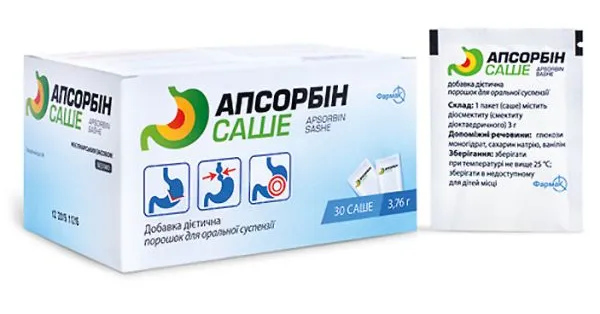
Table of Contents
INSTRUCTION FOR MEDICAL USE OF THE MEDICINAL PRODUCT APSSORBIN (APSORBIN)
Composition:
Active substance: diosmectite;
1 sachet contains diosmectite – 3 g;
Excipients: glucose monohydrate; sodium saccharin; vanillin.
Pharmaceutical form. Powder for oral suspension.
Main physicochemical properties: powder ranging from almost white to light grey or beige in colour, with a characteristic vanilla odour. Slight specks may be present.
Pharmacotherapeutic group.
Antidiarrheal agents; drugs used in the treatment of infectious and inflammatory intestinal diseases. Other enterosorbents.
ATC code A07B C05.
Pharmacological properties.
Pharmacodynamics.
During clinical pharmacology studies, diosmectite demonstrated the ability to:
- adsorb intestinal gas in adults;
- restore normal mucosal permeability (in a clinical study conducted in children with gastroenteritis).
Due to its lamellar structure and high plastic viscosity, diosmectite has a high coating capacity on the mucous membrane of the gastrointestinal tract.
Pooled results from two double-blind randomized studies evaluating the efficacy of diosmectite compared to placebo in 602 patients aged 1 to 36 months with acute diarrhea showed a significant reduction in defecation frequency during the first 72 hours in the diosmectite group receiving oral rehydration therapy.
Pharmacokinetics.
Due to its structure, diosmectite (Apsorbín) remains on the luminal side of the epithelium, is neither absorbed nor metabolized. Diosmectite is excreted in the feces through normal intestinal transit.
Clinical characteristics.
Indications.
Treatment of acute diarrhea in children from 2 years of age (in addition to oral rehydration) and in adults.
Symptomatic treatment of chronic functional diarrhea in adults.
Symptomatic treatment of pain associated with functional intestinal disorders in adults.
Contraindications.
Hypersensitivity to diosmectite or to any of the excipients listed in the section "Composition".
Interaction with other medicinal products and other forms of interaction.
Due to the adsorptive properties of this medicinal product, the extent and/or rate of absorption of other substances may be affected. Therefore, it is recommended not to administer other medicinal products simultaneously with Apzorbin (an interval of at least 2 hours should be maintained whenever possible).
Special precautions for use
Diosmectite should be used with caution in patients with a history of severe chronic constipation.
The use of the medicinal product Absorbin should be avoided in infants and children under 2 years of age. The standard treatment for acute diarrhea is an oral rehydration solution (ORS).
In children aged 2 years and older, acute diarrhea should be treated in combination with early use of an oral rehydration solution (ORS) to prevent dehydration.
Chronic use of the medicinal product Absorbin should be avoided.
For adults, treatment does not exclude rehydration when necessary.
The volume of rehydration using either oral or intravenous rehydration solutions depends on the severity of diarrhea, patient's age, and individual disease course.
Patients should be informed about the necessity of:
- rehydration using a sufficient amount of salty or sweet fluids to compensate fluid loss caused by diarrhea (the average daily fluid requirement for an adult is 2 liters);
- maintaining food intake during episodes of diarrhea:
- excluding certain foods, particularly raw vegetables and fruits, leafy greens, spicy dishes, as well as frozen foods or beverages;
- preferring baked meat and rice.
The medicinal product contains glucose. If you have been diagnosed with intolerance to certain sugars, consult your doctor before taking this medicinal product.
Use during pregnancy or breastfeeding
Pregnancy
Data on the use of the medicinal product Absorbin in pregnant women are lacking or limited.
Animal studies are insufficient to draw conclusions regarding reproductive toxicity.
The use of the medicinal product Absorbin during pregnancy is not recommended.
Breastfeeding
Data on the use of the medicinal product Absorbin during breastfeeding are limited.
The use of the medicinal product Absorbin during breastfeeding is not recommended.
Fertility
The effect of this medicinal product on human fertility has not been studied.
Ability to influence reaction rate when driving or operating machinery
Studies on the ability to drive vehicles or operate machinery under the influence of this medicinal product have not been conducted. However, its effect is expected to be negligible or absent.
Method of Administration and Dosage
Treatment of Acute Diarrhea
Children aged 2 years and older: 4 sachets per day for 3 days, followed by 2 sachets per day for 4 days.
Adults: 3 sachets per day for 7 days. If necessary, the dose may be doubled at the beginning of treatment.
Other Indications
Adults: on average, 3 sachets per day.
Method of Administration
For oral use.
The contents of the sachet should be mixed with water or liquid food to form a suspension immediately before administration.
For children, the contents of a sachet may be mixed in a bottle with 50 mL of water and administered at intervals throughout the day, or thoroughly mixed with semi-liquid food such as broth, compote, puree, infant food, etc.
For adults, the contents of a sachet may be mixed with half a glass of water.
Children
To be used for treatment of children aged 2 years and older.
Overdose
Overdose may lead to severe constipation or formation of bezoars.
Side effects
The most commonly reported adverse reaction during treatment is constipation, which occurs in approximately 7% of adults and approximately 1% of children. If constipation occurs, treatment with diosmectite should be discontinued and, if necessary, resumed at a lower dose. The table below lists adverse reactions reported during clinical trials and in the post-marketing period.
Adverse reactions are classified according to the following frequency categories: very common (≥1/10); common (≥1/100, <1/10); uncommon (≥1/1000, <1/100); rare (≥1/10,000, <1/1000); very rare (<1/10,000); frequency not known (cannot be estimated based on available data).
Adverse reactions identified during clinical trials and the post-marketing period:
Gastrointestinal disorders: common* – constipation; uncommon* – vomiting.
Skin and subcutaneous tissue disorders: uncommon* – rash; rare* – urticaria; frequency not known – angioedema, pruritus.
Immune system disorders: frequency not known – hypersensitivity.
*Frequency determined from clinical trial data.
Reporting suspected adverse reactions.
Reporting suspected adverse reactions after drug authorization is important. It allows continued monitoring of the benefit-risk balance of the medicinal product. Healthcare professionals and patients or their legal representatives are encouraged to report all suspected adverse reactions and lack of efficacy via the automated pharmacovigilance information system at: https://aisf.dec.gov.ua.
Shelf life.
3 years.
Do not use the medicinal product after the expiry date stated on the packaging.
Storage conditions.
No special storage conditions required.
Keep out of reach and sight of children.
Packaging.
3.76 g per sachet. 10 or 30 sachets per carton.
Availability.
Over-the-counter (without prescription).
Manufacturer: JSC "Farmak".
Manufacturer's address and location of operations:
74, Kyrylivska Street, Kyiv, 04080, Ukraine.