Analgin for children
Ukraine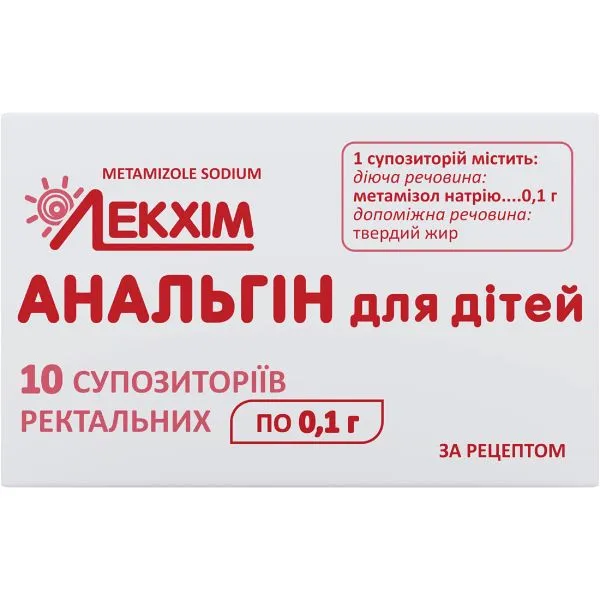
Table of Contents
INSTRUCTIONS FOR MEDICAL USE OF THE MEDICINAL PRODUCT Analgin for children (Analgin for children)
Composition:
Active substance: metamizole sodium;
1 suppository contains 100 mg (0.1 g) or 250 mg (0.25 g) of sodium metamizole;
Excipient: hard fat.
Pharmaceutical form. Rectal suppositories.
Main physicochemical properties: suppositories from white to white with yellowish or creamy tint, bullet-shaped. Presence of a white coating on the surface of the suppository is allowed.
Pharmacotherapeutic group. Analgesics and antipyretics. ATC code N02B B02.
Pharmacological properties.
Pharmacodynamics.
A non-narcotic analgesic and antipyretic. Exerts analgesic, anti-inflammatory, and antipyretic effects. The analgesic effect is due to inhibition of the biosynthesis of endogenous substances involved in the development of pain reactions (bradykinins, prostaglandins). Sodium metamizole prevents the transmission of pain impulses along nerve fibers and increases the excitation threshold at the thalamic level.
Pharmacokinetics.
Sodium metamizole is rapidly absorbed in the rectum, and peak plasma concentrations are quickly reached (within 1–2 hours). It is widely distributed throughout the body and readily penetrates the central nervous system. Sodium metamizole is excreted from the body in urine, both unchanged and as conjugates with sulfuric and glucuronic acids. The effect of the drug lasts for 5–6 hours after administration.
Clinical characteristics.
Indications.
Pain of various origins (headache, pain due to burns, neuralgia, radiculitis, myositis, postoperative pain), high body temperature.
Contraindications.
The use of analgin in suppositories is contraindicated in children under 1 year of age, in cases of hypersensitivity to the drug manifested by skin and other reactions, bronchospasm, severe impairment of liver and kidney function, leukopenia, anemia of any etiology, cytotoxic or infectious neutropenia; rhinitis, conjunctivitis, or bronchospasm following the use of nonsteroidal anti-inflammatory drugs, bronchial asthma, porphyria; suspected acute surgical pathology; hypersensitivity to pyrazolone derivatives (phenylbutazone, tribuzone, antipyrine), hereditary hemolytic anemia associated with glucose-6-phosphate dehydrogenase deficiency; history of agranulocytosis caused by metamizole, other pyrazolones or pyrazolidines; disorders of bone marrow function or diseases of the hematopoietic system.
Interaction with other medicinal products and other types of interactions.
Ethanol – the effect of ethanol is potentiated.
Chlorpromazine or other phenothiazine derivatives – simultaneous use may lead to the development of pronounced hypothermia.
X-ray contrast agents, colloidal plasma substitutes, and penicillin – should not be used during treatment with analgin.
Cyclosporine – simultaneous use reduces cyclosporine blood concentration.
Oral hypoglycemic agents, indirect anticoagulants, glucocorticosteroids, and indomethacin – sodium metamizole increases the activity of these drugs by displacing them from protein binding sites in the blood.
Phenylbutazone, barbiturates, and other hepatotoxic inducers – reduce the effectiveness of analgin when used simultaneously.
Non-narcotic analgesics, tricyclic antidepressants, hormonal contraceptives, and allopurinol – simultaneous use with analgin may increase its toxicity.
Sedatives and tranquilizers (diazepam, trioxazine, valocordin) – enhance the effect of analgin.
Caution is required when using the drug concomitantly with sulfonylurea hypoglycemic agents (hypoglycemic effect is enhanced) and diuretics (furosemide).
Thiamazole and sarcosine – increase the risk of developing leukopenia.
Codeine, H2-histamine receptor blockers, and propranolol – enhance the effect of analgin.
Other nonsteroidal anti-inflammatory drugs – their analgesic and antipyretic effects are potentiated, and the risk of additive adverse effects increases.
Mercazole, drugs that suppress bone marrow activity, including gold compounds – increase the risk of hematotoxicity, including the development of leukopenia.
Myelotoxic medicinal products – cause an increase in hematotoxicity.
Methotrexate – high doses of metamizole may lead to increased methotrexate plasma concentration and enhanced toxic effects (on the gastrointestinal tract and hematopoietic system).
Metamizole may induce metabolic enzymes, including CYP2B6 and CYP3A4.
Concomitant use of metamizole with bupropion, efavirenz, methadone, valproate, tacrolimus, or sertraline may result in decreased plasma concentrations of these drugs, with a potential reduction in clinical efficacy. Therefore, co-administration of these drugs with metamizole is recommended with caution; monitoring of clinical response and/or drug levels may be necessary.
Metamizole may reduce cyclosporine levels in blood serum; therefore, cyclosporine levels should be monitored during concomitant use with metamizole.
Special precautions for use.
| Agranulocytosis Treatment with metamizole may cause agranulocytosis, which can lead to fatal outcomes (see section "Adverse Reactions"). It may occur even after previous use of metamizole without adverse effects. Metamizole-induced agranulocytosis is an idiosyncratic adverse reaction that may occur at any time during treatment and even shortly after its discontinuation. Patients should be warned to discontinue treatment and seek immediate medical attention if any symptoms suggestive of agranulocytosis appear (e.g., fever, chills, sore throat, and painful mucosal lesions, particularly in the mouth, nose, and throat, as well as in the genital or anal areas). If metamizole is used during fever, some symptoms of developing agranulocytosis may remain unnoticed. Similarly, symptoms may be masked in patients receiving antibiotic therapy. Upon appearance of signs and symptoms suggestive of agranulocytosis, treatment should be immediately discontinued and a full blood count should be performed. If the diagnosis is confirmed, treatment must not be resumed (see section "Contraindications"). |
Do not use the drug to relieve acute abdominal pain (until the cause is determined).
Use with caution in kidney diseases (pyelonephritis, glomerulonephritis) and allergic conditions.
When using analgin, discoloration of urine to red may occur due to excretion of a metabolite.
Regular long-term use of the drug is not recommended due to the myelotoxicity of sodium metamizole.
Severe skin reactions
Severe skin reactions, including Stevens-Johnson syndrome, toxic epidermal necrolysis, and drug reaction with eosinophilia and systemic symptoms (DRESS syndrome), which may be life-threatening or fatal, have been reported during treatment with metamizole.
Patients should be informed about the signs and symptoms of skin reactions and closely monitored for them.
If symptoms indicative of these reactions occur, treatment with metamizole should be discontinued and must never be restarted (see section "Contraindications").
Drug-induced liver injury
Cases of hepatitis, mainly of hepatocellular type, have been observed in patients treated with metamizole, occurring from several days to several months after initiation of treatment. Signs and symptoms include elevated serum liver enzymes, with or without jaundice, often in the context of hypersensitivity reactions to other drugs (e.g., skin rash, blood dyscrasias, fever, and eosinophilia), or accompanied by features of autoimmune hepatitis. In most patients, condition normalized after discontinuation of metamizole therapy; however, isolated cases of progression to acute liver failure requiring liver transplantation have been reported.
The mechanism of liver injury caused by metamizole is not fully understood, although available data suggest an immune-allergic mechanism.
Patients should be informed about the need to consult a physician if symptoms suggestive of liver injury occur. In such cases, metamizole should be discontinued and liver function should be evaluated.
If symptoms such as nausea (nausea and vomiting), fever, fatigue, loss of appetite, dark-colored urine, pale-colored stools, yellowing of the skin or whites of the eyes, itching, rash, or upper abdominal pain occur, metamizole should be discontinued and medical advice must be sought immediately.
If a patient previously experienced liver problems while taking any drug containing metamizole, use of this medicinal product is not recommended.
Use during pregnancy or breastfeeding.
The drug is contraindicated during pregnancy.
Breastfeeding should be discontinued during treatment.
Ability to affect reaction speed when driving or operating machinery.
Does not affect.
Method of Administration and Dosage
Before using the suppository, it is necessary to:
- Tear off one suppository in the primary packaging along the perforation line of the blister pack;
- Then pull the edges of the film in opposite directions to open the primary packaging and remove the suppository.
The medicinal product is intended for rectal administration.
Children aged 1 to 3 years: 1 suppository of 100 mg once daily;
Aged 4 to 7 years: 1 suppository of 100 mg twice daily, no more frequently than every 4–6 hours, or 1 suppository of 250 mg once daily;
Aged 8 to 14 years: 1 suppository of 250 mg 1–2 times daily, no more frequently than every 4–6 hours.
After administration of the suppository, the child should remain lying down for 30 minutes.
The duration of treatment is determined individually and ranges from 1 to 3 days.
Children
To be used in children aged 1 year and older.
When used in children, continuous medical supervision should be maintained.
Overdose
Symptoms: hypothermia, palpitations, pronounced decrease in arterial blood pressure, tachycardia, dysphagia, dyspnea, tinnitus, nausea, vomiting, gastralgia/gastritis, weakness, drowsiness, delirium, disturbances of consciousness, convulsive syndrome; acute agranulocytosis, hemorrhagic syndrome, oliguria, anuria, acute renal or hepatic failure, and respiratory muscle paralysis may develop.
Treatment: discontinue the drug, induce vomiting, gastric lavage, administration of saline laxatives and enterosorbents, forced diuresis, and symptomatic therapy aimed at supporting vital functions. In severe cases, hemodialysis, hemoperfusion, or peritoneal dialysis may be considered.
In case of the first signs of overdose, seek immediate medical help!
Side effects
Allergic reactions: hypersensitivity reactions may occur, including skin and mucosal rashes, conjunctivitis, skin hyperemia, itching, urticaria, angioneurotic edema, bronchospastic syndrome, anaphylactic shock, Stevens-Johnson syndrome, and Lyell's syndrome.
Serious skin reactions have been reported with metamizole use, including toxic epidermal necrolysis and drug reaction with eosinophilia and systemic symptoms (DRESS) (see section "Special precautions").
Blood system: leukopenia, anemia, thrombocytopenia, granulocytopenia, agranulocytosis.
Urinary system: interstitial nephritis, oliguria, anuria.
Hepatobiliary system: drug-induced liver injury, including hepatitis, jaundice, elevated liver enzymes. Symptoms of liver injury include nausea (nausea and vomiting), fever, fatigue, loss of appetite, dark-colored urine, pale-colored stool, yellowing of the skin or sclera, itching, rash, or upper abdominal pain.
Respiratory system: in patients predisposed to bronchospasm, attacks may be triggered, dyspnea.
Other: proteinuria, decreased blood pressure.
Skin and subcutaneous tissue: drug reaction with eosinophilia and systemic symptoms (DRESS).
Reporting suspected adverse reactions.
Reporting suspected adverse reactions after drug registration is an important procedure. It enables continuous monitoring of the benefit-risk balance of the medicinal product. Healthcare and pharmacy professionals, as well as patients or their legal representatives, are required to report all suspected adverse reactions and lack of drug efficacy via the Automated Pharmacovigilance Information System at the following link: https://aisf.dec.gov.ua/.
Shelf life. 3 years.
Storage conditions. Store in the original packaging, out of reach of children, at a temperature not exceeding 25 °C.
Packaging. 5 suppositories per blister; 2 blisters per carton.
Prescription status. Prescription only.
Manufacturer. Private Joint-Stock Company "Lekhim-Kharkiv".
Manufacturer's address and location of business activity.
36 Severina Pototskoho Street, Kharkiv, Kharkiv Oblast, 61115, Ukraine.