Aminoven infant 10 %
Ukraine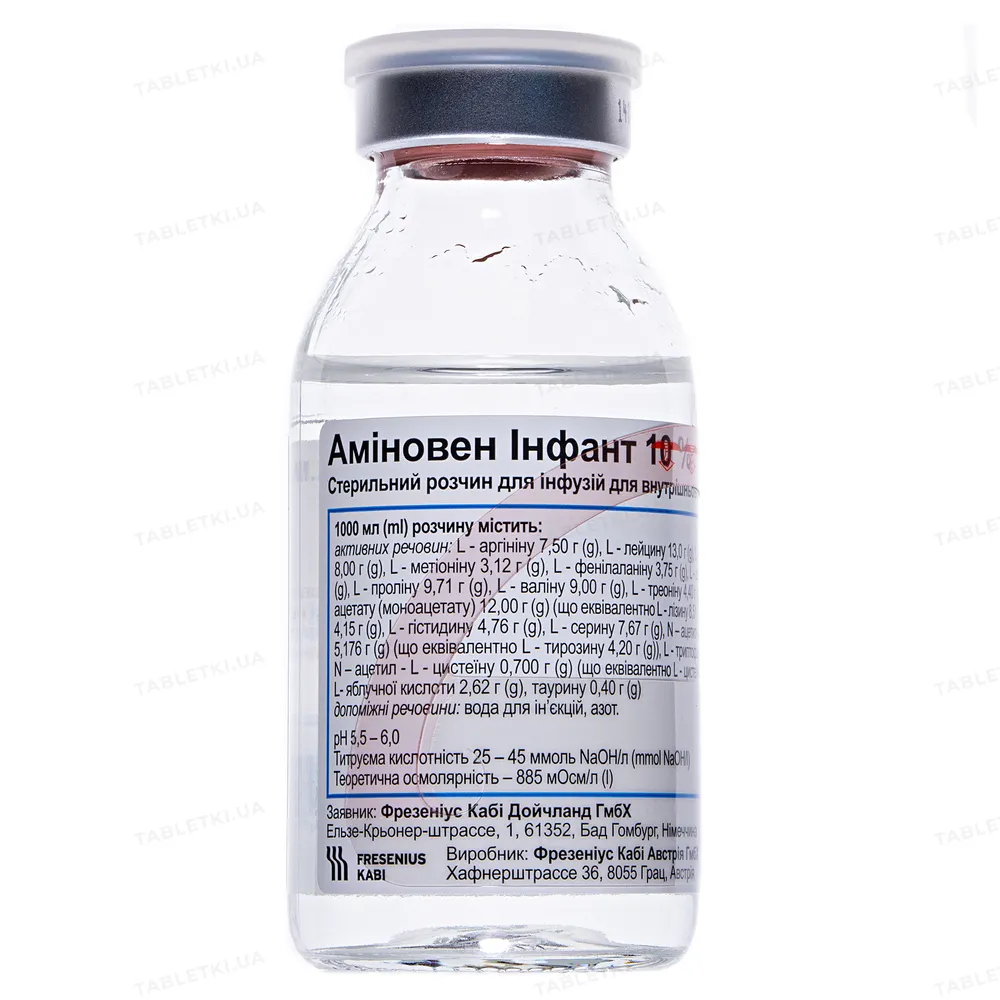
Table of Contents
INSTRUCTIONS FOR MEDICAL USE OF THE MEDICINAL PRODUCT AMINOVEN INFANT 10 % (AMINOVEN INFANT 10 %)
Composition:
Active substances: 1000 ml of solution contains
L-arginine 7.50 g
L-leucine 13.0 g
L-isoleucine 8.0 g
L-methionine 3.12 g
L-phenylalanine 3.75 g
L-alanine 9.3 g
L-proline 9.71 g
L-valine 9.00 g
L-threonine 4.40 g
L-lysine acetate (monoacetate) 12.0 g (equivalent to L-lysine 8.51 g)
glycine 4.15 g
L-histidine 4.76 g
L-serine 7.67 g
N-acetyl-L-tyrosine 5.176 g (equivalent to L-tyrosine 4.20 g)
L-tryptophan 2.01 g
N-acetyl-L-cysteine 0.700 g (equivalent to L-cysteine 0.52 g)
L-malic acid 2.62 g
taurine 0.40 g;
Excipients: water for injections, nitrogen.
Pharmaceutical form. Infusion solution.
Main physicochemical properties: clear solution, free from visible particles.
Pharmacotherapeutic group.
Plasma substitutes and perfusion solutions. Solutions for parenteral nutrition. Amino acids. ATC code B05B A01.
Pharmacological properties.
Pharmacodynamics.
The amino acids contained in the Amiven Infant 10% preparation are physiological components. After parenteral administration, they enter the body's pool of free amino acids and participate in all metabolic processes, including protein synthesis.
Pharmacokinetics.
The bioavailability of Amiven Infant 10% when administered intravenously is 100%.
Amino acids enter the general plasma pool of free amino acids in the body and are distributed into the interstitial fluid and intercellular spaces of organs and tissues. The concentration of free amino acids in blood plasma and cell cytoplasm is regulated within narrow limits depending on age, nutritional status, and the patient's general condition. When administered correctly (slowly and at a constant rate), Amiven Infant 10% does not disrupt the amino acid balance. In severe liver or kidney dysfunction, regulation of amino acid balance is impaired. In such cases, a different amino acid solution composition for parenteral nutrition should be used. Only a small portion of amino acids is eliminated by the kidneys. The half-life of amino acids in blood plasma largely depends on age.
Clinical characteristics.
Indications.
Partial parenteral nutrition in preterm infants, newborns, and young children.
In combination with carbohydrate solutions, lipid emulsions, as well as vitamin, electrolyte, and trace element preparations, provides complete parenteral nutrition.
Contraindications.
Disorders of amino acid metabolism, metabolic acidosis, hyperhydration, hypokalemia, hypersensitivity to the drug, shock, hypoxia, decompensated heart failure, renal failure in the absence of hemodialysis or hemofiltration, severe liver failure. Individual dosing is required in cases of hepatic or renal insufficiency. Use with caution in patients with hyponatremia.
Interaction with other medicinal products and other forms of interaction.
To date, interactions between Aminoven Infant 10% and other medicinal products are unknown.
Special precautions for use.
When administering parenteral nutrition to infants and young children, the following parameters should be monitored: urinary nitrogen, blood ammonia, glucose, electrolytes, triglycerides (when fat emulsions are additionally administered), liver enzymes, serum osmolality, acid-base balance, and water-electrolyte balance.
Too rapid infusion may lead to increased renal excretion of amino acids and, consequently, to amino acid imbalance.
Exposure of intravenous parenteral nutrition solutions to light, especially in the presence of trace elements and/or vitamins, may adversely affect clinical outcomes in neonates due to the formation of peroxides and other degradation products. When administering Amiven Infant 10% to neonates and children under 2 years of age, the solution must be protected from ambient light until the end of administration (see sections of the instruction "Method of administration and dosage", "Shelf life").
Use during pregnancy or breastfeeding.
To be used exclusively in pediatric practice.
Ability to affect reaction speed when driving or operating machinery.
Not studied.
2
Method of Administration and Dosage
Aminoven Infant 10% is intended for prolonged intravenous infusion into central veins.
Maximum infusion rate: up to 0.1 g of amino acids per kg of body weight per hour, equivalent to 1 ml/kg of body weight per hour.
Maximum daily dose:
- Children under 1 year of age – 1.5–2.5 g of amino acids per kg of body weight per day, or 15–25 ml of Aminoven Infant 10% infusion solution per kg of body weight per day;
- Children aged 2–5 years – 1.5 g of amino acids per kg of body weight per day, or 15 ml/kg of body weight per day;
- Children aged 6–14 years – 1.0 g of amino acids per kg of body weight per day, or 10 ml/kg of body weight per day.
Aminoven Infant 10% should be administered as long as parenteral nutrition remains necessary.
When administered to newborns and children under 2 years of age, the solution (in bottles and infusion sets) must be protected from light until the end of infusion (see sections "Special precautions", "Shelf life").
Children
Aminoven Infant 10% is indicated for parenteral nutrition in premature infants, neonates, and young children.
Overdose
In cases of overdose or excessive infusion rate of Aminoven Infant 10%, as with other amino acid solutions, symptoms such as chills, nausea, vomiting, and renal aminoacidosis may occur. In such cases, the infusion must be stopped immediately. Therapy may be continued using lower doses. In case of hyperkalemia, administer 200 to 500 ml of 5% glucose solution with the addition of 1–3 IU insulin per 3–5 g of glucose.
Side effects.
Not observed with proper use.
Possible development of allergic reactions.
When administering Amiven Infant 10% into peripheral veins, local reactions may occur: redness, phlebitis, thrombosis. Daily monitoring of the puncture site is recommended.
Shelf life.
2 years.
When used in newborns and children under 2 years of age, the solution (in bottles and administration sets) should be protected from light exposure until the end of infusion (see sections of the instructions "Dosage and administration", "Special precautions").
Storage conditions.
Store in a place protected from light at a temperature not exceeding 25 °C. Do not freeze. Keep the medication out of reach of children.
Incompatibility.
Amino acid solutions should not be mixed with other medicinal products due to increased risk of microbial contamination.
Adding other medicinal agents to Amiven Infant 10% should be avoided, as this may cause toxic reactions. In any case, compatibility of the drugs, maintenance of sterility, and thorough mixing must be ensured. Solutions with added medications must not be stored.
3
Packaging.
Glass bottles of 100 ml and 250 ml, stoppered with rubber stoppers and sealed with aluminum-plastic caps.
Prescription status. By prescription only.
Manufacturer.
Fresenius Kabi Austria GmbH.
Manufacturer's name and address of place of business.
Hafnerstrasse 36, 8055 Graz, Austria.
Marketing Authorization Holder.
Fresenius Kabi Deutschland GmbH.
Address of Marketing Authorization Holder and/or its representative.
Else-Kröner-Strasse 1, 61352 Bad Homburg, Germany.
4