Aminoplasmal® hepa - 10 %
Ukraine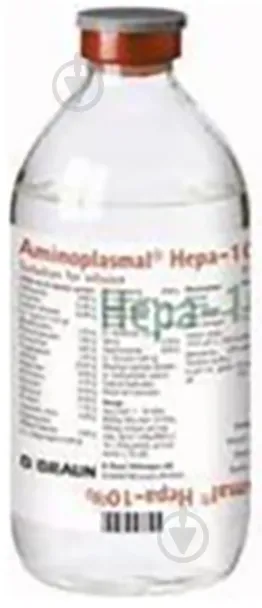
Table of Contents
INSTRUCTIONS for medical use of the medicinal product AMINOPLASMAL® HEPA - 10 % (AMINOPLASMAL® HEPA - 10 %)
Composition:
Active substances:
1000 ml of solution contain isoleucine 8.8 g; leucine 13.6 g; lysine acetate 10.6 g (equivalent to lysine 7.51 g); methionine 1.2 g; phenylalanine 1.6 g; threonine 4.6 g; tryptophan 1.5 g; valine 10.6 g; arginine 8.8 g; histidine 4.7 g; glycine 6.3 g; alanine 8.3 g; proline 7.1 g; aspartic acid 2.5 g; asparagine monohydrate 0.55 g (equivalent to asparagine 0.48 g); acetylcysteine 0.8 g (equivalent to cysteine 0.59 g); glutamic acid 5.7 g; ornithine hydrochloride 1.66 g (equivalent to ornithine 1.3 g); serine 3.7 g; acetyltyrosine 0.86 g (equivalent to tyrosine 0.7 g);
amino acid content – 100 g/L; total nitrogen content – 15.3 g/L;
electrolyte concentration: sodium – 0.3 mmol/L; acetates – 51 mmol/L;
chlorides – 10 mmol/L;
Excipients: disodium edetate; sodium hydroxide or hydrochloric acid (for pH adjustment); water for injections.
Pharmaceutical form. Infusion solution.
Main physicochemical properties: clear, aqueous solution, colorless to light yellow; energy value: 1675 kJ/L = 400 kcal/L; theoretical osmolarity: 875 mOsm/L; pH: 5.5 – 6.5.
Pharmacotherapeutic group. Solutions for parenteral nutrition. Amino acids. ATC code B05B A01.
Pharmacological properties.
Pharmacodynamics.
When using the medicinal product Aminoplasmal® Hepa - 10%, whose composition is specifically adapted to pathological metabolic changes in patients with liver cirrhosis, normalization of amino acid imbalance can be achieved. Thus, the main therapeutic effect of the drug consists in providing the body with substrates for protein synthesis during parenteral nutrition in patients with hepatic insufficiency.
The amino acid concentrations are selected so that the increase in concentration of each amino acid in plasma remains within normal limits, thereby maintaining amino acid homeostasis in plasma.
Pharmacokinetics.
Since Aminoplasmal® Hepa - 10% is administered intravenously, its bioavailability is 100%.
The amino acid composition of Aminoplasmal® Hepa - 10% is based on pharmacokinetic studies of amino acids in patients with liver cirrhosis. In such patients, a typical amino acid imbalance is present, characterized by low concentrations of branched-chain amino acids and elevated concentrations of aromatic amino acids and methionine. This imbalance is considered one of the causes of reduced protein tolerance and development of hepatic encephalopathy in patients with liver cirrhosis.
The composition of this medicinal product is characterized by a relatively high ratio of branched-chain amino acids and is adapted to specific features of amino acid and protein metabolism in patients with liver cirrhosis.
Clinical characteristics.
Indications.
Provision of amino acids to patients with severe liver insufficiency during parenteral nutrition; prevention and treatment of hepatic encephalopathy.
Contraindications.
Hypersensitivity to the active substances or to any of the excipients of the medicinal product.
Disorders of amino acid metabolism of non-hepatic origin.
Severe, life-threatening circulatory impairment (shock).
Hypoxia.
Metabolic acidosis.
Severe renal insufficiency in the absence of treatment with hemofiltration or hemodialysis.
Decompensated cardiac insufficiency.
Acute pulmonary edema.
Hyperhydration.
Due to the specific composition of Aminoplasmal® Hepa - 10%, it may cause significant metabolic disturbances when used for indications other than those recommended. Therefore, use not according to the recommended indications should be avoided.
Interaction with other medicinal products and other forms of interactions.
If simultaneous administration of Aminoplasmal® Hepa - 10% with other medicinal products is necessary, their compatibility should be checked.
Special precautions for use
Aminoplasmal® Hepa - 10% should not be administered to patients with hypotonic dehydration, hypokalemia, or hyponatremia without prior correction of these conditions.
Due to its specific composition, Aminoplasmal® Hepa - 10% may be administered to patients with concomitant renal insufficiency only after an individual assessment of benefit-risk ratio. The dose should be adjusted based on serum concentrations of urea and creatinine.
Caution should be exercised in patients with increased serum osmolarity.
Do not administer through a peripheral venous catheter.
Amino acid therapy does not replace standard therapeutic measures in the treatment of hepatic encephalopathy, such as the use of laxatives, lactulose, and/or intestinal sterilization with antibiotics.
Infusion of Aminoplasmal® Hepa - 10% must be accompanied by adequate carbohydrate administration.
Electrolytes should be added according to individual patient requirements.
During parenteral therapy, fluid and electrolyte balance, serum osmolarity, acid-base balance, blood glucose concentration, and liver function parameters should be monitored. The type and frequency of monitoring depend on the patient's underlying condition and clinical status.
In particular, patients with disorders of amino acid metabolism require regular and more frequent clinical and laboratory tests.
Infusion of the contents of one vial should not exceed 24 hours.
For complete parenteral nutrition, administration of carbohydrates, essential fatty acids, vitamins, and trace elements is necessary.
The infusion site should be inspected daily for signs of inflammation or infection.
The preparation is supplied in 500 mL vials.
After opening, the solution should be administered immediately. Any unused contents of the vial should be discarded and must not be stored for later use.
Do not administer the solution if it is cloudy or if there are visible signs of vial or cap damage.
A sterile administration system must be used.
Use during pregnancy or breastfeeding
There are insufficient data on the use of Aminoplasmal® Hepa - 10% in these patient groups.
Effect on the ability to drive or operate machinery
There is insufficient experience regarding the effect of treatment on the ability to drive or operate machinery.
Administration and Dosage.
Administered by intravenous infusion into a central vein.
Dosage is adjusted according to individual patient needs:
| Usual dose: |
7 – 10 ml/kg body weight/day, corresponding to |
| 0.7 – 1 g amino acids/kg body weight/day. |
|
| Maximum dose: |
15 ml/kg body weight/day, corresponding to |
| 1.5 g amino acids/kg body weight/day. |
For children aged 2 years and older, dosage should be adjusted according to body weight, nutritional status, and underlying disease.
Infusion rate
Treatment of hepatic coma
In hepatic encephalopathy, it is recommended to start administration of the medicinal product Aminoplasmal® Hepa - 10% at a higher rate until effect is achieved. For example, for a patient with a body weight of 70 kg:
| 1st – 2nd hour: |
150 ml/hour (2 ml/kg body weight/hour), corresponding to approximately 50 drops/minute. |
| 3rd – 4th hour: |
75 ml/hour (1 ml/kg body weight/hour), corresponding to approximately 25 drops/minute. |
| from the 5th hour onwards: |
45 ml/hour (0.6 ml/kg body weight/hour), corresponding to approximately 15 drops/minute. |
Supportive therapy/parenteral nutrition
45 – 75 mL/hour, corresponding to 15 – 25 drops/minute or 0.6 – 1 mL/kg body weight/hour.
Duration of use:
Aminoplasmal® Hepa - 10% may be administered for as long as there is a risk of developing hepatic encephalopathy.
Children.
The drug is indicated for use in children aged 2 years and older.
There are no available data on the use of Aminoplasmal® Hepa - 10% in children under 2 years of age; therefore, administration of the solution to these patients is not recommended.
Overdose.
Symptoms. Symptoms of overdose or excessively rapid infusion rate may manifest as nausea, chills, vomiting, and loss of amino acids in urine.
Treatment. In such cases, the infusion should be discontinued and resumed later at a slower rate.
Adverse reactions.
Undesirable effects not specifically related to this medicinal product may occur during parenteral nutrition in general, particularly at the beginning of therapy.
Uncommon (≥ 1/1,000 to < 1/100):
Gastrointestinal disorders: nausea, vomiting.
General disorders: headache, chills, fever, anaphylactic reactions including rash.
Shelf life.
3 years.
After opening, the contents of the vial should be used immediately.
Storage conditions.
Store at a temperature not exceeding 25 °C in a light-protected place.
Keep out of reach of children.
Packaging.
500 ml of solution in a vial; 10 vials in a cardboard box.
Incompatibilities.
Amino acid solutions must not be mixed with other medicinal products due to the risk of microbial contamination and physicochemical incompatibility.
Prescription status.
Prescription only.
Manufacturer: B. Braun Melsungen AG.
Manufacturer's address and place of business:
Carl-Braun-Strasse 1, 34212 Melsungen, Germany.