Aminol®
Ukraine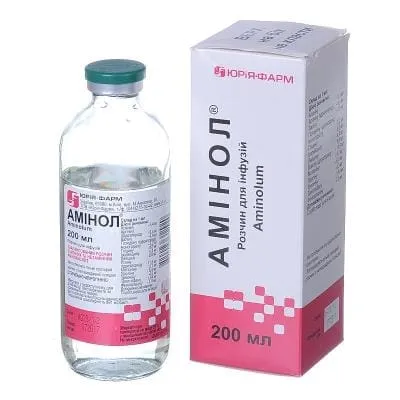
Table of Contents
INSTRUCTIONS for medical use of the medicinal product AMINOL® (AMINOLUM)
Composition:
Active substances: 1 ml of solution contains: alanine – 6.4 mg; arginine hydrochloride – 6.4 mg; valine – 4.9 mg; histidine hydrochloride monohydrate – 3.2 mg; glycine – 8.0 mg; isoleucine – 4.4 mg; leucine – 9.8 mg; lysine hydrochloride – 11.5 mg; methionine – 5.7 mg; proline – 6.4 mg; threonine – 4.3 mg; tryptophan – 1.44 mg; phenylalanine – 7.0 mg;
Excipients: sorbitol, water for injections.
Pharmaceutical form. Infusion solution.
Main physicochemical properties: clear, colorless or slightly yellow liquid. Theoretical osmolarity 891 mOsm/L.
Pharmacotherapeutic group. Amino acids. ATC code B05BA01.
Pharmacological properties.
Pharmacodynamics. Aminol® is a balanced mixture of 13 amino acids, 8 of which are essential. When administered slowly, it is readily assimilated by the body. Provided that energy requirements are met, amino acids are incorporated into protein biosynthesis, promote a positive nitrogen balance, and correct protein deficiency.
Pharmacokinetics. Not studied.
Clinical characteristics.
Indications.
Parenteral protein nutrition in hypoproteinemias of various origins due to significant protein loss and inability or severe restriction of natural food intake:
- before and after major surgery;
- gastrointestinal tract surgeries;
- maxillofacial surgeries;
- stenosis of various gastrointestinal segments;
- esophageal or intestinal injury caused by toxic substances;
- head injuries;
- prolonged and deep unconscious states;
- burn disease;
- diffuse peritonitis;
- septic conditions, severe purulent processes;
- osteomyelitis;
- hypoparathyroidism;
- cachexia in oncological diseases;
- prolonged febrile states;
- severe infectious diseases (meningitis, encephalitis, typhoid fever, cholera);
- prolonged diarrhea, intractable vomiting;
- anorexia.
Contraindications.
Disorders of amino acid metabolism, hyperhydration, acute renal failure with elevated residual nitrogen levels, severe liver function impairment, metabolic acidosis, severe circulatory disturbances, hypoxia, decompensated heart failure, phenylketonuria, hypersensitivity to the components of the drug.
Interaction with other medicinal products and other types of interactions.
Mixing with other medicinal products is not recommended.
Special precautions.
Use only a clear solution from an intact vial.
Exceeding the recommended infusion rate leads to incomplete absorption of amino acids and loss of the drug through urine. To ensure more complete amino acid utilization, administration of the drug should be combined with simultaneous infusion of carbohydrate solutions (glucose), and vitamins B1, B6, and C.
If administration of Aminol® is necessary in patients with decompensated cardiac function, renal or hepatic insufficiency, the drug should be administered cautiously in reduced doses under monitoring of diuresis and biochemical blood parameters. In cases of cerebral hemorrhage, administration should follow recommendations ensuring that the total volume of infused fluid does not exceed 2 liters per day.
During prolonged administration of Aminol®, daily monitoring of plasma osmolarity, urinary nitrogen content, electrolyte levels, urea concentration, and blood acid-base balance is required.
Any infusion into a peripheral vein may cause irritation of the vessel wall and thrombophlebitis. Therefore, the catheter insertion site should be examined daily. If a fat emulsion is also prescribed for the patient, it should be administered, whenever possible, simultaneously with Aminol® to reduce the risk of phlebitis. Strict adherence to aseptic techniques is essential, especially when inserting a catheter into a central vein.
The following rules must be observed when using the drug:
- Use the drug immediately after opening the vial;
- The drug is intended for single use only;
- Do not use the drug after its expiration date;
- Any unused solution remaining in the vial and any mixture left after infusion must be discarded.
Use during pregnancy or breastfeeding.
Use with caution in women during pregnancy or breastfeeding—only when clearly indicated and after careful assessment of the potential risk versus expected benefit of the drug.
Ability to affect reaction speed when driving or operating machinery.
The drug should be administered only under hospital conditions.
Method of Administration and Dosage
To perform a biological test for tolerance to the drug, use the following regimen:
- for patients weighing up to 40 kg, administer 2 ml of the drug intravenously;
- for patients weighing from 40 kg to 60 kg, administer 3 ml of the drug intravenously by slow bolus injection;
- for patients weighing over 60 kg, administer 5 ml of the drug intravenously by slow bolus injection.
Evaluate the patient's reaction to drug tolerance. In the absence of a negative reaction 3 minutes after the test, proceed with administration of the drug according to the Instructions for Medical Use.
Administer intravenously by drip infusion to adults at a rate of 15–25 drops per minute (45–75 ml per hour). At least 1 hour is required for administration of each 100 ml of solution. Before administration, warm the solution to 35–37 °C.
For partial parenteral nutrition, the daily dose is 400–800 ml over 5 days; for complete parenteral nutrition, 400–1200 ml daily until enteral feeding is restored.
Children
Experience with use in children is lacking.
Overdose
Progressive renal insufficiency and hypersensitivity reactions may occur. If such symptoms occur, infusion must be discontinued. For management of hypersensitivity reactions, carry out desensitizing therapy. After resolution of hypersensitivity reactions, resumption of infusion at a reduced rate may be considered if necessary. In cases of drug overdose, increased excretion of amino acids through the urinary tract may occasionally occur, which resolves upon discontinuation of the drug.
Side effects.
When administered rapidly, facial hyperemia, increased body temperature, dizziness, nausea, headache, and vomiting are possible. Administration of the drug into a peripheral vein may cause irritation of the venous wall and thrombophlebitis.
Shelf life. 2 years.
Storage conditions. Store in a place inaccessible to children. Store protected from light at a temperature not exceeding 25 °C. Do not freeze.
Packaging. 100 ml, 200 ml, 400 ml in a bottle No. 1 in a carton. 3 ml in a vial No. 1 in a carton. 3 ml in a vial No. 5 in a carton. 5 ml in a vial No. 1 in a carton. 5 ml in a vial No. 5 in a carton.
Prescription status. Prescription only.
Manufacturer. Yuria-Pharm LLC.
Manufacturer's address and location of business activity.
108, Kobzarska St., Cherkasy, Cherkasy region, 18030, Ukraine. Tel.: (044) 281-01-01.