Jodi gel 10%
Poland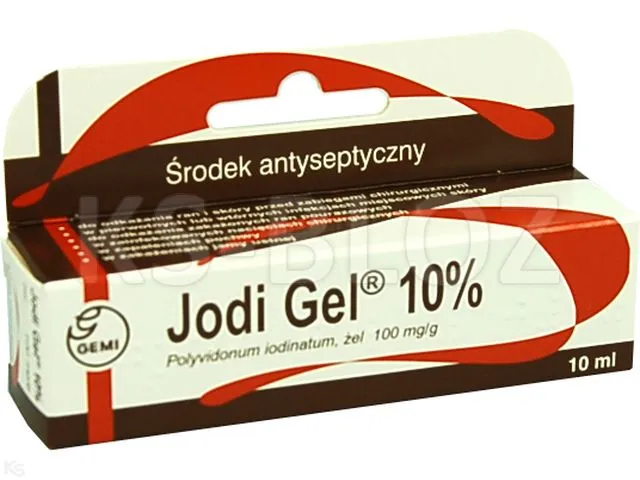
Table of Contents
Package leaflet: Information for the user
JODI GEL 10%, 100 mg/g, gel
Povidonum iodinatum
Please read all of this leaflet carefully before using this medicine because it contains important information for you.
Always use this medicine exactly as described in this patient leaflet or as directed by your doctor or pharmacist.
- Keep this leaflet. You may need to read it again.
- If you need advice or additional information, please consult your pharmacist.
- If you experience any side effects, including any not listed in this leaflet, tell your doctor or pharmacist. See section 4.
- If there is no improvement after a few days, or if you feel worse, contact your doctor.
Contents of the leaflet:
- What Jodi Gel 10% is and what it is used for
- What you need to know before you use Jodi Gel 10%
- How to use Jodi Gel 10%
- Possible side effects
- How to store Jodi Gel 10%
- Contents of the pack and other information
1. What Jodi Gel 10% is and what it is used for
Jodi Gel 10% contains as the active substance povidone-iodine, which is a complex
combination of iodine and povidone. When in contact with skin or mucous membranes, the medicine slowly
decomposes, releasing free iodine. Exhibiting a broad spectrum of antiseptic activity, it combats and prevents infections of wounds, skin, and body cavities, including cuts and lacerations. The gel effectively prevents inflammatory conditions of the vagina and infections of the oral cavity. It acts against bacteria (particularly streptococci and Staphylococcus aureus) and fungi, without inducing resistance. The gel formulation ensures prolonged action compared to liquid forms and prevents the medicine from running off the application site.
Indications:
Jodi Gel 10% is intended for use as an antiseptic agent:
- for disinfection of wounds and skin before surgical procedures;
- for disinfection of infected traumatic wounds;
- in primary or secondary local skin infections;
- in infected surgical incisions;
- in vaginal inflammations;
- in oral cavity infections.
Povidone-iodine may also be used for skin disinfection prior to insertion of needles and catheters. The medicine can be used in both hospital, outpatient, and home settings.
2. Important information before using the medicine 10%
When not to use the medicine 10%
- if the patient is allergic (hypersensitive) to the active substance or to any of the other ingredients of the medicine (listed in section 6);
- if the patient has thyroid disorders;
- if the patient has Cushing's disease;
- on deep wounds or severe burns without consulting a doctor.
Warnings and precautions
Before starting to use this gel, discuss it with your doctor or pharmacist. Increased iodine concentration in the blood may cause disturbances in thyroid function and other adverse effects (see section 4).
Children and adolescents
Use in children under 11 years of age only on the advice of a doctor.
10% and other medicines
Tell your doctor or pharmacist about all medicines the patient is currently taking or has recently taken, as well as any medicines the patient plans to use.
Absorption of iodine from the medicine may adversely affect thyroid function tests: thyroid scintigraphy, diagnosis using radioactive iodine isotopes, PBI (protein-bound iodine) assessment.
Medicines containing mercury, silver, or hydrogen peroxide should not be used together with povidone-iodine.
Povidone-iodine may interfere with certain tests for detecting blood and glucose in stool or urine, giving falsely positive results.
Pregnancy and breastfeeding
Before using any medicine, consult a doctor or pharmacist.
Do not use during pregnancy and breastfeeding.
Driving and operating machinery
The medicine does not affect the ability to drive or operate machinery.
3. How to use 10%
This medicine should always be used exactly as described in the patient information leaflet or as directed by a doctor or pharmacist. If in doubt, consult a doctor or pharmacist.
Gel for application on skin and mucous membranes. Use of this medicine should be limited to small wound surfaces. For external use only. Apply to affected areas, minor abrasions or small wound surfaces.
Children and adolescents
Use in children under 11 years of age only on medical advice.
Use of a higher than recommended dose of 10%
Cases of overdose have not been reported.
If more medicine is used than recommended, remove the excess gel.
Missed dose of 0.1%
Apply the next dose as scheduled. Do not use a double dose to make up for a missed dose.
Stopping treatment with 10%
If you have any further doubts regarding the use of this medicine, consult your doctor or pharmacist.
4. Possible adverse reactions
Like all medicines, this medicine can cause adverse reactions, although not everybody will experience them.
Allergic reactions may occur. Increased transdermal absorption of iodine following prolonged use of the medicine on large areas of skin may lead to goitre with symptoms of hyperthyroidism or hypothyroidism, as well as systemic symptoms such as: metallic taste in the mouth, salivation, burning or irritation in the mouth, lung irritation or oedema, diarrhoea, metabolic acidosis, hypernatraemia (increased sodium concentration in blood serum), renal function disorders, skin oedema, acne-like skin eruptions.
In newborns and infants, due to iodine absorption through the skin, metabolic acidosis, neutropenia, and hypothyroidism may occur.
Reporting of adverse reactions
If any adverse reactions occur, including any not listed in this leaflet, inform your doctor, pharmacist, or nurse. Adverse reactions can be reported directly to the Department of Monitoring Adverse Drug Reactions of the Office for Registration of Medicinal Products, Medical Devices and Biocidal Products
Al. Jerozolimskie 181C, 02-222 Warsaw
Tel.: + 48 22 49 21 301
Fax: + 48 22 49 21 309
Website: https://smz.ezdrowie.gov.pl
By reporting adverse reactions, additional information regarding the safety of the medicine can be collected.
5. How to store 10%
Keep the medicine out of sight and reach of children.
Store below 25°C.
Do not use the medicine after the expiry date stated on the packaging. The expiry date refers to the last day of the stated month.
The medicine has thermoreversible properties. It is in gel form at temperatures between 20–45°C; below 20°C and above 45°C it becomes liquid.
Shelf life after first opening the container: 1 year.
Medicines must not be disposed of via wastewater or household waste. Ask your pharmacist how to dispose of medicines no longer required. This helps protect the environment.
6. Contents of the pack and other information
What Jodi Gel 10% contains
- The active substance is povidone-iodine. 100 g of gel contains 10 g of povidone-iodine.
- The other ingredients are: poloxamer 407, sodium chloride, purified water.
What Jodi Gel 10% looks like and contents of the pack
Jodi Gel 10% is a dark brown gel with a characteristic odour.
1 aluminium tube containing 10 ml of gel in a cardboard box;
1 glass bottle with dispenser containing 1000 ml of gel.
Marketing Authorisation Holder and Manufacturer
GEMIPHARMA sp. z o.o.
ul. Mickiewicza 36
05-480 Karczew
tel. +48 22 780 83 05 ext. 70
e-mail: [email protected]