Willfact 1000 j.m.
PolandTable of Contents
PACKAGE LEAFLET: INFORMATION FOR THE USER
Willfact 500 IU
powder and solvent for solution for injection
Willfact 1000 IU
powder and solvent for solution for injection
Willfact 2000 IU
powder and solvent for solution for injection
human von Willebrand factor
Please read carefully the entire leaflet before using the medicine, because it contains
important information for the patient.
- Keep this leaflet, as you may need to read it again.
- If you have any further questions, please consult your doctor, pharmacist, or nurse.
- This medicine has been prescribed for a specific individual. Do not pass it on to others. It may harm them even if their symptoms are the same.
- If the patient experiences any adverse reactions, including any not listed in this leaflet, inform the doctor, pharmacist, or nurse. See section 4.
Leaflet Contents
- What Willfact is and what it is used for
- Important information before using Willfact
- How to use Willfact
- Possible side effects
- How to store Willfact
- Contents of the pack and other information
1. What Willfact is and what it is used for
Willfact is manufactured from human plasma (the liquid part of blood) and contains the active substance called human von Willebrand factor (vWF).
vWF factor plays a role in blood clotting. A deficiency of this factor, as occurs for example in von Willebrand disease, causes blood not to clot as quickly as it should, resulting in an increased tendency to bleed. Replacement of vWF with Willfact temporarily restores normal blood clotting mechanisms.
Willfact is indicated for the prevention and treatment of bleeding episodes, including those associated with surgical procedures, in patients diagnosed with von Willebrand disease, when treatment with desmopressin (DDAVP) alone is ineffective or contraindicated.
Willfact may be used in all age groups.
Willfact must not be used in the treatment of haemophilia A.
2. Important information before using Willfact
When not to use Willfact
- If the patient is allergic to human von Willebrand factor or to any of the other ingredients of this medicine (listed in section 6).
- If the patient has been diagnosed with haemophilia A.
Warnings and precautions
Treatment with Willfact must always be supervised by a physician experienced in the treatment of bleeding disorders.
If the patient experiences severe bleeding and blood tests confirm reduced levels of factor VIII, the patient will receive a factor VIII concentrate and additionally a vWF preparation within the first 12 hours.
Allergic reactions
Hypersensitivity reactions, including allergic reactions, may occur, as with other intravenous protein medicines derived from human blood or plasma.
The patient will be monitored during infusion for early signs of hypersensitivity. These may include rash (urticaria or generalized urticaria), feeling of tightness in the chest, wheezing, decreased blood pressure (hypotension), and severe allergic reactions (anaphylaxis).
The physician will inform the patient about warning signs indicating an allergic reaction.
If symptoms of hypersensitivity occur, treatment must be discontinued immediately and medical help must be sought without delay.
Viral safety
When manufacturing medicines derived from human blood or plasma, certain measures are taken to prevent transmission of infections to patients. These include:
- careful selection of blood and plasma donors to exclude individuals at risk of infections,
- testing each donated blood batch and plasma pool for the presence of viruses/infections,
- incorporating steps in the manufacturing process that inactivate or remove viruses.
Despite these measures, it cannot be completely excluded that administration of medicines derived from human blood or plasma may lead to transmission of infections, including unknown or newly emerging viruses or other types of infections.
These measures are considered effective against enveloped viruses such as human immunodeficiency virus (HIV, causing AIDS), hepatitis B virus, and hepatitis C virus.
These measures have limited effectiveness against non-enveloped viruses such as hepatitis A virus and parvovirus B19. Infection with parvovirus B19 may be serious in pregnant women (due to the risk of infection to the unborn child) and in patients with weakened immune systems or certain types of anemia (e.g. sickle cell anemia or hemolytic anemia).
Vaccinations
The physician may recommend vaccination against hepatitis A and hepatitis B if the patient regularly/repeatedly receives human plasma-derived von Willebrand factor.
Recording batch numbers
It is strongly recommended that, each time a dose of Willfact is administered, the patient's name and the batch number of the medicine are recorded, to document which batches of the medicine have been administered.
Thrombosis risk
Blood clots (thrombosis) may block blood vessels. The risk is particularly high if certain risk factors have been identified in the patient's medical history or laboratory tests. In such cases, the patient's condition should be closely monitored for early signs of thrombosis. Medications preventing (prophylaxis) blockage of blood vessels by blood clots should also be administered.
The physician administering a factor VIII preparation containing von Willebrand factor should remember that continued treatment may lead to excessive increase in factor VIII activity. If the patient receives a vWF preparation containing factor VIII, the physician should regularly monitor factor VIII activity in plasma. This will protect the patient from excessively high factor VIII activity in plasma, which may increase the risk of thrombotic events.
Reduced effectiveness
In patients with von Willebrand disease (especially type 3), proteins that neutralize the action of von Willebrand factor may develop. These proteins are called neutralizing antibodies or inhibitors. The physician will check whether inhibitors to vWF have developed in the patient's body if laboratory test results show lack of proper restoration of vWF levels or if bleeding does not subside despite administration of an appropriate dose of Willfact. If high levels of inhibitors are present, treatment with vWF may not be effective. In such cases, alternative treatment methods should be considered. A new therapy will be initiated by a physician experienced in treating bleeding disorders.
Willfact and other medicines
The patient should inform the physician or pharmacist about all medicines currently or recently used, as well as any medicines planned for future use.
Pregnancy and breastfeeding
Willfact may be used in pregnant or breastfeeding women only if clearly indicated.
Controlled clinical studies evaluating the safety of Willfact in pregnant and breastfeeding women have not been conducted, and animal studies are insufficient to confirm safety regarding fertility, pregnancy, and child development during pregnancy and after birth.
If the patient is pregnant or breastfeeding, suspects she may be pregnant, or plans to have a child, she should consult her physician or pharmacist before using this medicine.
Driving and operating machinery
No effects on the ability to drive or operate machinery have been observed.
Willfact contains sodium
One vial of 5 ml (500 IU) of Willfact contains 0.15 mmol (3.4 mg) of sodium.
This corresponds to 0.17% of the recommended maximum daily intake of sodium for an adult.
One vial of 10 ml (1000 IU) of Willfact contains 0.3 mmol (6.9 mg) of sodium.
This corresponds to 0.35% of the recommended maximum daily intake of sodium for an adult.
One vial of 20 ml (2000 IU) of Willfact contains 0.6 mmol (13.8 mg) of sodium.
This corresponds to 0.69% of the recommended maximum daily intake of sodium for an adult.
3. How to use Willfact
Treatment should be initiated and monitored by a physician experienced in the management of bleeding disorders.
If the physician determines that the patient may self-administer the medication at home, appropriate instruction will be provided to the patient.
Dosage
This medicine should always be used exactly as prescribed by the physician. In case of doubt, consult the physician.
Ideally, Willfact should be administered by a physician or nurse. However, if the patient has been given Willfact for home use, the physician will ensure that the patient is informed about how to perform the injection and the correct dosage. Follow the physician's instructions and seek help if experiencing difficulties with using the syringe. The syringe must only be used by a trained person.
The physician will calculate the appropriate dose of Willfact (expressed in international units — IU).
The dose depends on:
- body weight,
- site of bleeding,
- severity of bleeding,
- patient's clinical condition,
- need for surgical procedure,
- von Willebrand factor (vWF) activity in blood after the procedure,
- severity of the disease.
The dose ranges from 40–80 IU/kg body weight.
The physician will recommend performing blood tests during treatment to monitor:
- factor VIII (FVIII:C) levels,
- von Willebrand factor activity (vWF:RCo),
- presence of inhibitors,
- early signs of thrombosis — in patients at risk of such complications.
Based on the results of these tests, the physician may adjust the frequency of injections and the dose administered.
In certain cases, it may be necessary to additionally use a factor VIII preparation (another protein with coagulation activity) together with Willfact to enable faster treatment or prevention of bleeding (in emergency situations or in cases of acute bleeding).
Willfact may also be used for long-term prophylaxis, in which case the dose is individually determined. Administration of Willfact at a dose of 40–60 IU/kg body weight two to three times per week reduces the number of bleeding episodes.
If the patient feels that Willfact is too strong or not strong enough, consult the physician.
Use in children and adolescents
Dosing in children and adolescents is based on body weight. In some cases, particularly in younger patients (under 6 years of age), higher doses (up to a maximum of 100 IU/kg body weight) may be required.
Method of administration
Detailed instructions for reconstitution and administration of the medicinal product are provided at the end of this leaflet.
Use of a higher than recommended dose of Willfact
Symptoms of overdose with Willfact have not been reported; however, administration of a large amount cannot exclude the risk of thrombosis.
Missed dose of Willfact
If a dose of Willfact is missed, consult the physician.
Do not use a double dose to make up for the missed dose.
If you have any further questions about the use of this medicine, consult your physician, pharmacist, or nurse.
4. Possible adverse reactions
Like all medicines, this medicine can cause adverse reactions, although not everybody will experience them.
You should contact your doctor immediately in the following cases:
- Occurrence of symptoms of hypersensitivity or allergic reactions (observed not very commonly, may affect up to 1 in 100 patients). In some cases, such reactions may develop into a severe allergic reaction (anaphylaxis), including anaphylactic shock (frequency not known).
Warning signs indicating an allergic reaction include:
- difficulty breathing or swallowing,
- wheezing,
- chest tightness,
- rapid heartbeat,
- drop in blood pressure,
- fainting,
- extreme fatigue,
- restlessness, nervousness,
- headache,
- chills, feeling cold,
- hot flushes,
- swelling of various body parts,
- skin rash, generalized urticaria,
- burning or stinging sensation at the site of infusion,
- tingling,
- vomiting,
- nausea.
If any of these symptoms occur, infusion must be stopped immediately and the doctor informed
so that appropriate treatment can be initiated, depending on the type and severity of the reaction.
- Loss of expected therapeutic effect (lack of bleeding control). This may result from inhibition of von Willebrand factor (vWF) (frequency not known).
In patients with von Willebrand disease, especially type 3, development of proteins neutralizing the action of vWF may occur. These proteins are called neutralizing antibodies or inhibitors. Patients treated with vWF should be closely monitored by a physician for the development of inhibitors through appropriate clinical observation and laboratory testing. The presence of inhibitors may manifest as inadequate clinical response. It may also coexist with severe allergic reactions.
- Signs of circulatory disturbances in the limbs (e.g. cold, pale extremities) or vital organs (e.g. severe chest pain). This may result from formation of blood clots in blood vessels (frequency not known).
There is a risk of blood clot formation (thrombosis), especially in patients at risk. After correction of von Willebrand factor deficiency, patients should be monitored for early signs of thrombosis or disseminated intravascular coagulation, and prophylactic antithrombotic treatment should be considered in situations where the risk is increased (after procedures, in bedridden patients, in case of deficiency of coagulation inhibitors or fibrinolytic enzymes).
If the patient is receiving vWF preparations containing FVIII, the risk of thrombosis may be higher due to persistently elevated FVIII plasma levels.
The following adverse reactions have been observed frequently (may affect up to 1 in 10 patients):
- reactions at the site of infusion.
The following adverse reactions have been observed not very commonly (may affect up to 1 in 100 patients):
- dizziness,
- paresthesia, hypoesthesia,
- hot flushes,
- itching,
- feeling of chest tightness,
- chills, feeling cold.
The following adverse reactions have been observed with unknown frequency:
- fever.
Reporting of adverse reactions
If any adverse reactions occur, including any not listed in this leaflet, tell your doctor, pharmacist, or nurse. Adverse reactions can be reported directly to the Department of Monitoring of Adverse Drug Reactions of the Office for Registration of Medicinal Products, Medical Devices and Biocidal Products:
Al. Jerozolimskie 181C
02-222 Warsaw
Tel.: + 48 22 49 21 301
Fax: + 48 22 49 21 309
Website: https://smz.ezdrowie.gov.pl
Adverse reactions can also be reported to the marketing authorization holder.
Reporting adverse reactions helps to provide more information on the safety of the medicine.
5. How to store Willfact 1000 j.m.
Keep this medicine out of sight and reach of children.
Do not use this medicine after the expiry date stated on the vial and carton.
Do not store above 25°C. Store in the original packaging to protect from light.
Do not freeze.
To maintain sterility, the product should be used immediately after reconstitution. However, chemical and physical in-use stability has been demonstrated for up to 24 hours at 25°C.
Do not use this medicine if cloudiness or particulate matter is observed in the solution.
Medicines must not be disposed of via wastewater or household waste. Ask your pharmacist how to dispose of medicines no longer required. Such measures help protect the environment.
6. Contents of the package and other information
What Willfact contains
The active substance is human von Willebrand factor (500 IU, 1000 IU, 2000 IU), expressed in
international units of ristocetin cofactor activity (vWF:RCo).
After reconstitution with 5 ml (500 IU), 10 ml (1000 IU), or 20 ml (2000 IU) of water for injections, one
vial contains approximately 100 IU/ml of human von Willebrand factor.
Prior to the addition of albumin, the specific activity of the solution is at least 60 IU vWF:RCo per 1 mg of total protein.
Other components:
Powder: human albumin, arginine hydrochloride, glycine, sodium citrate, and calcium chloride dihydrate.
Solvent: water for injections.
What Willfact looks like and contents of the pack
Willfact is supplied as a white or pale yellow powder or fragile solid, and a clear, colourless solvent for preparation of a solution for injection after reconstitution using a transfer system.
Available pack sizes of Willfact are 500 IU/5 ml, 1000 IU/10 ml, 2000 IU/20 ml.
The solution after reconstitution should be clear or slightly opalescent, colourless to slightly yellowish.
Marketing Authorisation Holder and Manufacturer
LFB-BIOMEDICAMENTS
3, avenue des Tropiques,
ZA de Courtaboeuf,
91940 LES ULIS,
FRANCE
[email protected]
Manufacturers
LFB-BIOMEDICAMENTS
3, avenue des Tropiques,
ZA de Courtaboeuf,
91940 LES ULIS,
FRANCE
LFB-BIOMEDICAMENTS
59 Rue de Trévise
59000 LILLE
FRANCE
This medicinal product is authorised in the European Economic Area countries and in the United Kingdom (Northern Ireland) under the following names:
Austria Willfact
Czech Republic WILLFACT
Denmark Willfact
Spain Willfact
Germany WILLFACT
Norway Willfact
Poland Willfact
Slovakia Willfact
Sweden Willfact
Hungary Willfact
United Kingdom (Northern Ireland) Willfact
01.2024
________________________________________________________________________________________
USER INSTRUCTION:
Dosage
In general, administration of 1 IU/kg body weight of von Willebrand factor results in an increase of circulating vWF:RCo activity by approximately 0.02 IU/ml (2%).
Target levels should be vWF:RCo >0.6 IU/ml (60%) and FVIII:C >0.4 IU/ml (40%).
Achievement of haemostasis is uncertain until factor VIII coagulant activity (FVIII:C) reaches 0.4 IU/ml (40%). Injection of von Willebrand factor alone does not lead to maximal increase in FVIII:C activity within the first 6–12 hours and is insufficient for immediate normalization of FVIII:C activity. Therefore, if the patient's baseline FVIII:C activity is below the critical level and rapid correction of haemostasis is required—as in treatment of bleeding, severe trauma, or during emergency surgery—factor VIII should be administered together with the first dose of von Willebrand factor to achieve plasma FVIII:C activity sufficient for haemostasis.
However, if immediate increase in FVIII:C activity is not necessary—e.g. in the case of elective surgery—or if the patient's baseline FVIII:C activity allows for maintenance of haemostasis, the physician may decide to omit factor VIII administration with the first injection of von Willebrand factor.
- Initial treatment: The initial dose of Willfact is 40–80 IU/kg body weight in the treatment of bleeding or trauma. It should be administered in combination with the required amount of factor VIII-containing product, calculated based on the patient's baseline plasma FVIII:C activity, to achieve appropriate plasma FVIII:C activity, immediately before surgery or as soon as possible after onset of a bleeding episode or severe trauma. For surgical procedures, the first injection should be given one hour before surgery. An initial dose of 80 IU/kg body weight of Willfact may be necessary, especially in patients with von Willebrand disease type 3, in whom maintaining adequate activity may require higher doses than in other types of vWD.
In the case of elective surgery, the first injection of Willfact should be administered 12–24 hours before surgery, and the second injection immediately before surgery. In such cases, concomitant administration of factor VIII product is not necessary, as endogenous FVIII:C concentration usually reaches the critical level of 0.4 IU/ml (40%) before surgery. However, this should be confirmed for each individual patient.
- Subsequent injections: If needed, treatment with Willfact should be continued as monotherapy at a dose of 40–80 IU/kg body weight per day, administered in one or two injections daily for one to several days. The dose and frequency of injections should always be adjusted according to the type of procedure, the patient's clinical and biological status (vWF:RCo and FVIII:C), and the type and severity of the bleeding episode.
- Long-term prophylaxis: Willfact may be administered for long-term prophylaxis at a dose individually adjusted for each patient. Willfact at a dose of 40–60 IU/kg body weight administered 2–3 times weekly reduces the number of bleeding episodes.
- Home treatment: With physician's approval, especially in cases of minor or moderate bleeding or long-term prophylaxis, home treatment may be initiated.
Children and adolescents
The dose for each indication is based on body weight. The dose and duration of treatment should be adjusted according to the patient's clinical status and plasma levels of vWF:RCo and FVIII:C.
- Initial treatment
- In children under 6 years of age, the initial dose may be determined based on the patient's incremental recovery (IR). If IR data are not available, an initial dose of 60 to 100 IU/kg body weight may be required to increase the patient's vWF:RCo concentration to 100 IU/dl.
- In children over 6 years of age and adolescents, dosing is the same as in adult patients.
- Subsequent injections: In children and adolescents, subsequent doses should be individually determined based on clinical status and vWF:RCo levels and adjusted according to clinical response.
Elective surgery
- In children under 6 years of age, after the first dose administered 12 to 24 hours before surgery, a repeat dose may be given 30 minutes before surgery.
- In children over 6 years of age and adolescents, dosing is the same as in adult patients.
- Prophylaxis: In children and adolescents, the dose and frequency of administration should be individually determined based on incremental recovery and vWF:RCo levels and adjusted according to clinical response.
Method and route of administration
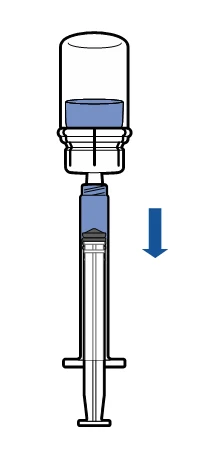
Intravenous administration
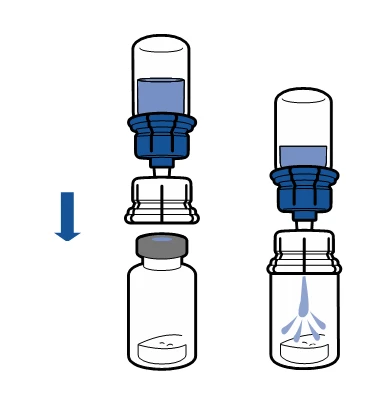
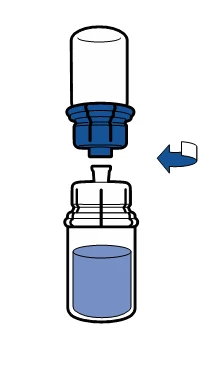
Reconstitution
Current guidelines for aseptic technique must be followed. The transfer system is intended solely for reconstitution of the medicine, as described below. The system is not intended for administration of the medicine to the patient.
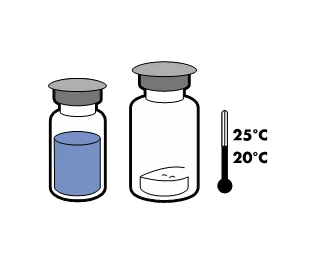 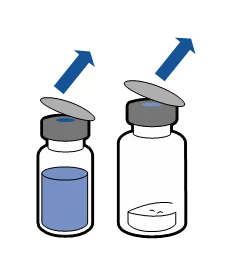 |
|
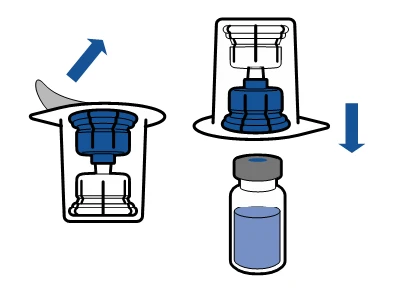 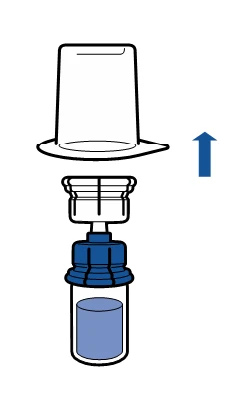   |
|
The powder should dissolve within 5 minutes, usually dissolving immediately.
The resulting solution should be clear or slightly opalescent, colorless or slightly yellow. Before
administration, the reconstituted product should be inspected visually for the presence of particulate matter
and discoloration.
Do not use solutions that are cloudy or contain a precipitate.
Do not mix with other medicinal products.
Do not dilute the product after reconstitution.
Administration
 |
|
Storage after reconstitution
To maintain sterility, the product should be used immediately after reconstitution. However, chemical and physical stability of the product has been demonstrated for 24 hours when stored at 25°C.
Any unused residues or waste material should be disposed of in accordance with local regulations.