Verdye
Poland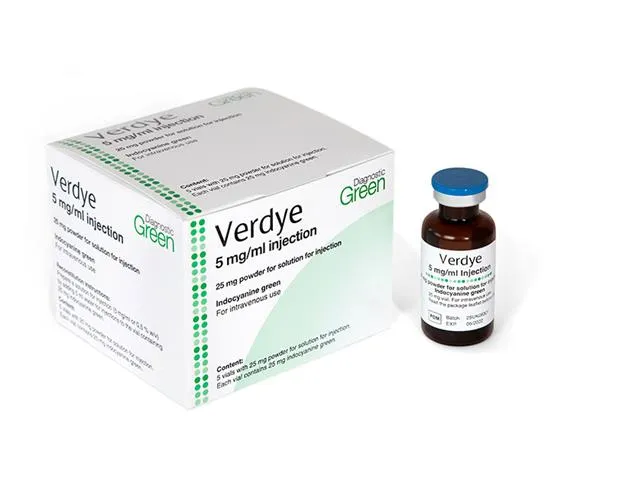
Table of Contents
- Package leaflet: Information for the user
- 1. What VERDYE is and what it is used for
- 2. Important information before using VERDYE
- 3. How to use VERDYE
- 4. Possible adverse reactions
- 5. How to store the medicinal product VERDYE
- 6. Contents of the package and other information
- Information intended exclusively for medical professionals:
Package leaflet: Information for the user
VERDYE, 5 mg/ml, powder for solution for injection
Indocyanine green
Please read all of this leaflet carefully before using this medicine, because it contains
important information for you.
Keep this leaflet, as you may need to read it again.
If you have any further questions, please ask your doctor, pharmacist, or nurse.
This medicine has been prescribed for a specific individual. Do not pass it on to others. The medicine may harm
another person, even if their symptoms are the same as yours.
If you experience any adverse reactions, including any not listed in this leaflet, tell your doctor, pharmacist, or nurse. See
section 4.
Leaflet contents
- What VERDYE is and what it is used for
- Important information before using VERDYE
- How to use VERDYE
- Possible side effects
- How to store VERDYE
- Contents of the pack and other information
1. What VERDYE is and what it is used for
What VERDYE is
VERDYE is a dark green powder which is mixed with water for injection. The active substance in the solution is called indocyanine green and is a coloured dye. This solution is then injected into one of the patient's veins, where it mixes with the blood. The doctor will then be able to see:
- how far the dye travels from the injection site;
- how much of it is present in different parts of the patient's body.
What VERDYE is used for
It is used exclusively for diagnostic purposes to determine what health problems a patient may have, for example:
a) how well blood flows through a particular part of the patient's body, such as:
- the heart,
- the brain,
- the liver,
- the inner layer of the eye called the choroid.
b) how much blood is present in specific parts of the patient's body.
c) how well the patient's liver is functioning.
2. Important information before using VERDYE
When not to use VERDYE
if the patient is allergic to indocyanine green, sodium iodide or iodine.
if the patient has hyperthyroidism or benign thyroid tumours.
if the patient has ever experienced adverse reactions after receiving this injection.
Special patient groups
Premature infants and newborns
Premature infants and newborns should not receive VERDYE if they suffer from hyperbilirubinemia (a condition in which there is an exceptionally high level of bilirubin in the blood).
Warnings and precautions
Before using VERDYE, discuss with your doctor or pharmacist:
if the patient has kidney failure. Contact a doctor to determine whether this medicine is suitable for the patient.
if the patient needs to undergo a test called "radioactive iodine uptake", which assesses how well the patient's thyroid gland is functioning. This test should be postponed for at least one week after administration of VERDYE, as the injection may affect the results of the thyroid test.
VERDYE and other medicines
Tell your doctor or pharmacist about all medicines the patient is currently taking or has recently taken, as well as any medicines the patient plans to take. This particularly applies to the following situations:
if the patient is taking any medicines that affect liver function, because the elimination process of indocyanine green from the body after injection may be impaired.
if the patient is taking, using, or suspects they may be taking or using any of the following medicines, because some of these medicines may alter the way indocyanine green—the active substance in VERDYE—is absorbed by the body, which could lead to inaccurate diagnostic results:
- anticonvulsant medicines (morphine (a strong painkiller) and antiepileptic medicines)
- cyclopropane (an anaesthetic) – nitrofurantoin (an antibiotic)
- sulfite compounds (a preservative) – opium alkaloids (antidiarrheal medicines)
- haloperidol (an antipsychotic medicine) – phenobarbital (an antiepileptic and anaesthetic medicine)
- diamorphine (an opioid medicine) – phenylbutazone (a painkiller)
- pethidine (a strong painkiller) – probenecid (a medicine used in the treatment of gout)
- metamizole (a painkiller) – rifamycin (an antibiotic)
- methadone (a medicine used in opioid substitution therapy) – any injections containing sodium sulfite (a preservative)
Pregnancy, breastfeeding and fertility
If the patient is pregnant or breastfeeding, suspects she may be pregnant, or is planning to have a child, she should consult her doctor before using this medicine. The doctor will decide whether the patient should be given this medicine.
Driving and operating machinery
No studies have been conducted on the effects on the ability to drive and operate machinery.
Before driving or operating machinery immediately after injection of this medicine, consult your doctor.
3. How to use VERDYE
The injection is performed exclusively under the supervision of a physician.
To dissolve the green powder – indocyanine green – only water for injection should be used.
The solution for injection must be inspected before administration to the patient. If it is cloudy, it will not be used.
The physician or nurse will administer the medicine directly into a vein using a needle, catheter, or vascular (cardiac) catheter.
The vein selected for injection will depend on the type of procedure being performed.
If this medicine is injected into a vein in the arm, the physician or nurse may first apply a temporary tourniquet. This is intended to facilitate insertion of the needle into the vein.
The dose the patient will receive depends on both the type of procedure being performed and the patient's body weight.
The physician may need to add a substance called heparin to blood samples taken from the patient. This is to prevent the samples from clotting.
Recommended dosage (mg/kg = milligrams of medicine per kilogram of patient body weight)
Single doses
Adults (aged 18–64 years), elderly patients (aged 65 years or older), adolescents and children (aged 11–18 years):
For assessment of blood flow through the heart, brain, general circulation, and microcirculation (e.g., blood flow through certain parts of the eye, choroid), the recommended dose is 0.1–0.3 mg/kg body weight.
For liver function assessment, the recommended dose is 0.25–0.5 mg/kg body weight.
Maximum daily dose
Adults and elderly patients:
The total daily dose should be less than 5 mg/kg body weight.
Adolescents and children:
- ( aged 11–18 years ): total daily dose should be less than 5 mg/kg body weight
- ( aged 2–11 years ): total daily dose should be less than 2.5 mg/kg body weight
- ( aged 0 months–2 years ): total daily dose should be less than 1.25 mg/kg body weight
Use in children and adolescents
Single doses used in children and adolescents are the same as in adults, but the total daily dose should be maintained below 2.5 mg/kg body weight in children aged 2 to 11 years and below 1.25 mg/kg body weight in children aged 0 to 2 years.
Use in patients with renal or hepatic impairment
VERDYE should be administered cautiously in patients with severe renal or hepatic impairment.
After injection, the physician may measure the amount of dye relative to the amount of blood. Measurements are usually taken from an artery, finger, or earlobe. The patient may ask the physician for an explanation of the techniques related to the procedure.
Administration of a higher than recommended dose of VERDYE
The patient should inform the physician if they believe an excessive dose of the medicine has been administered.
If there are any further doubts regarding the use of this medicine, consult the physician or pharmacist.
4. Possible adverse reactions
Like all medicines, VERDYE can cause adverse reactions, although not everyone will experience them.
Severe allergic reaction: very rare (may occur in no more than 1 in 10,000 people):
Symptoms include:
- tightness in the throat,
- skin itching,
- skin rash,
- urticaria (hives),
- coronary artery spasm,
- facial swelling (facial edema),
- breathing difficulties,
- chest tightness and/or chest pain,
- rapid heartbeat,
- drop in blood pressure and shortness of breath,
- heart failure (cardiac arrest),
- motor restlessness,
- nausea,
- sensation of warmth,
- hot flushes.
With the occurrence of symptoms of an allergic reaction, an increase in the number of specific white
blood cells associated with allergic reactions (hypereosinophilia) may occur.
The likelihood of an allergic reaction is higher in patients with severely impaired kidney function.
If a severe allergic reaction occurs, emergency treatment may be necessary, such as:
- injection of adrenaline (epinephrine), hydrocortisone, or antihistamines,
- artificial blood or electrolyte solutions (by infusion),
- oxygen to assist the patient in breathing.
Reporting of adverse reactions
If any adverse reactions occur, including any adverse reactions not listed in this leaflet, inform a doctor, pharmacist, or nurse. Adverse reactions can be reported directly to the national reporting system: Department for Monitoring Adverse Drug Reactions, Office for Registration of Medicinal Products, Medical Devices and Biocidal Products, Al. Jerozolimskie 181C, PL-02 222 Warsaw, Tel.: +48 22 49 21 301, Fax: +48 22 49 21 309, Website: https://smz.ezdrowie.gov.pl.
Reporting adverse reactions allows further information on the safety of the medicine to be collected.
Adverse reactions can also be reported to the marketing authorization holder.
5. How to store the medicinal product VERDYE
Keep the medicinal product out of sight and reach of children.
Do not store above 30°C.
Keep the glass vials in the outer packaging to protect from light.
After reconstitution, protect the injection solution from light and use immediately.
Only clear solutions without visible particles should be used.
Do not use this medicinal product after the expiry date stated on the carton and vial label. The expiry date refers to the last day of the stated month.
Medicinal products must not be disposed of via the sewage system or household waste. Ask your pharmacist how to dispose of medicines no longer required. Such measures will help protect the environment.
6. Contents of the package and other information
What VERDYE contains
The active substance is indocyanine green.
Each vial contains: 25 mg of indocyanine green as a powder (for reconstitution in 5 ml of water for injection).
What VERDYE looks like and contents of the pack
VERDYE is a dark green powder for solution for injection in a type I amber glass vial, closed with a grey bromobutyl rubber stopper and sealed with an aluminium cap and a blue polypropylene flip-off cap.
Pack sizes:
- 5 vials, each containing 25 mg of indocyanine green.
Marketing Authorisation Holder
Diagnostic Green Limited
Athlone Business and Technology Park
Garrycastle
Athlone
Co. Westmeath
N37 F786
Ireland
Email: [email protected]
Tel.: +353 90 646 5499
Manufacturer
Renew Pharmaceuticals Ltd.
Athlone Business and Technology Park
Garrycastle, Athlone, Co. Westmeath
N37 F786
Ireland
This medicinal product is authorised in the Member States of the European Economic Area under the following names:
Austria, Belgium, Croatia, Greece, Netherlands, Poland, Czech Republic, Italy: VERDYE
Denmark, Finland, Ireland, Portugal, Romania, Slovenia, Sweden, Hungary: Verdye
Information intended exclusively for medical professionals:
Instructions for use
The medicinal product must be reconstituted immediately before use.
Reconstitute this medicinal product by adding 5 ml of water for injections to the vial containing 25 mg of active substance, or 10 ml of water for injections to the vial containing 50 mg of active substance, resulting in both cases in a dark green injection solution with a concentration of 5 mg/ml (0.5% w/v).
Inspect the reconstituted solution. If any abnormality is observed, such as cloudiness, the reconstituted solution must be discarded.
Use only clear solutions free from visible particles.
This medicinal product is intended for single use only.